

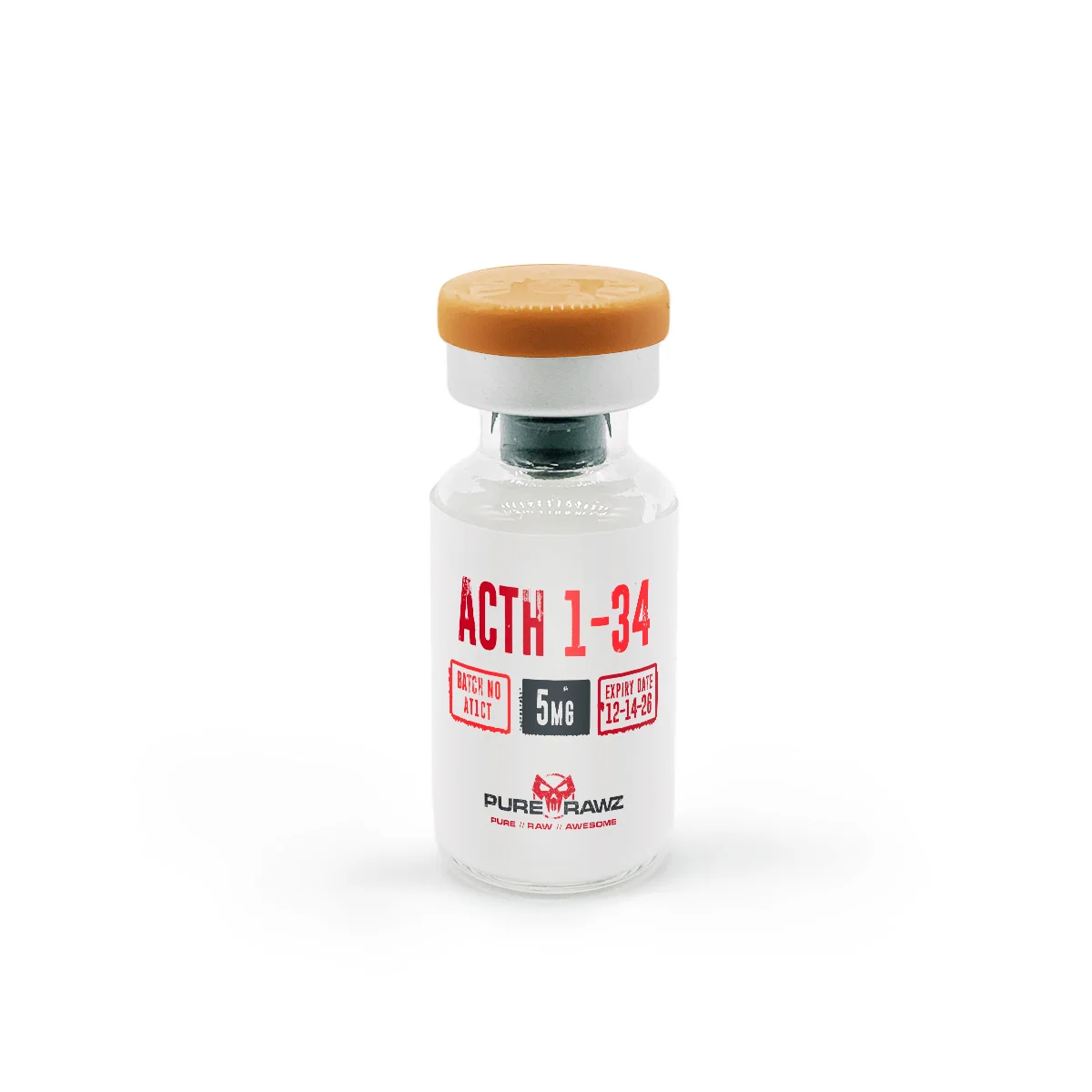
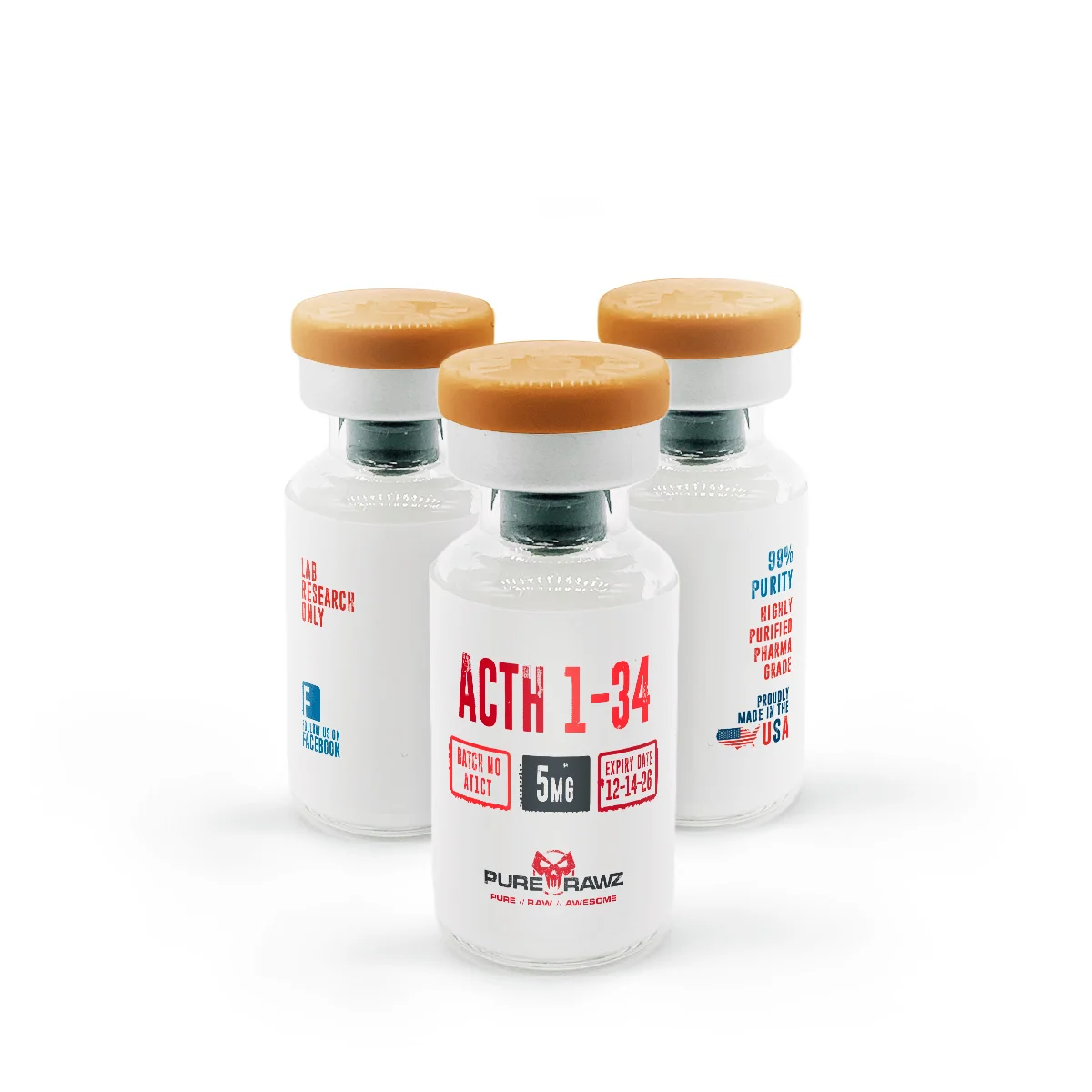

ACTH 1-34
$660.80
Earn 661 points upon purchasing this product.
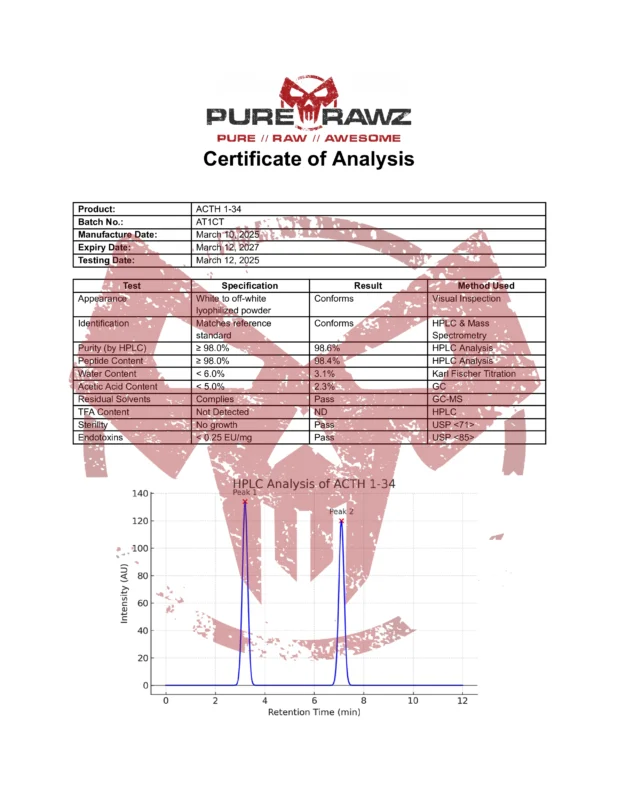
✅ 99% Purity – Third-Party Tested
🚚 Free U.S. Shipping on Orders $100+
 Proudly Made in the USA
⚡ Fast & Reliable Shipping
🔒 Secure Checkout Guaranteed
All products are strictly intended for laboratory and research purposes only and are not approved for veterinary or human use.
Description
Overview of ACTH 1–34
ACTH 1‑34 is a peptide fragment of the full adrenocorticotropic hormone (ACTH). It binds selectively to melanocortin receptors on adrenal cortical cells, triggering intracellular signaling pathways. This fragment is used exclusively as a research tool to study receptor-ligand interactions and molecular signaling within adrenal-like systems.
Chemical and Molecular Properties
| ACTH 1-34 | |
|---|---|
| PubChem CID | No universal CID for 1‑34 fragment; full ACTH (1–39) entries exist in PubChem |
| Molecular Formula | Approx. C180H276N52O50S (estimated for 34 residues) |
| Molecular Weight | 4115 Da (calculated for 34 residues) |
| Source | Recombinant production or synthetic peptide based on natural human ACTH fragment |
| Major Constituents | Single peptide chain of 34 amino acids corresponding to ACTH residues 1‑34 |
| CAS | No universal CAS for 1–34; full ACTH: 12279–41–3 |
| Labeling | Research Use Only (RUO) |
| Purity | ≥98% |
| Classification | Research Use Only (RUO) |
| Storage Temperature | –20 °C (frozen) |
| Solubility | Water/aqueous buffer |
| Safety | Research reagent; not for human or animal use |
ACTH 1-34 Mechanism
ACTH 1–34 binds selectively to melanocortin 2 receptors (MC2R) on adrenal-like cells. Binding induces a conformational change in the receptor, activating the associated Gs protein and stimulating adenylate cyclase. This increases intracellular cyclic AMP (cAMP), which activates protein kinase A (PKA). PKA phosphorylates target proteins, including transcription factors, to regulate genes involved in steroidogenic enzyme production.
Key Molecular Insights:
- Signal transduction: Converts extracellular receptor binding into intracellular biochemical signals.
- Enzyme regulation: PKA-mediated phosphorylation controls steroidogenic enzyme activity.
- Receptor specificity: Demonstrates selective engagement of MC2R compared to other melanocortin receptors.
Research Application on ACTH 1-34
ACTH 1‑34 is used as a research tool in cellular and molecular studies to probe:
- Receptor-ligand binding dynamics at melanocortin receptors.
- Intracellular signaling pathways mediated by cAMP and PKA.
- Transcriptional regulation of steroidogenic enzymes.
- Structure-function relationships of peptide hormones.
Why Choose PureRawz ACT-134?
Buy ACT-134 for laboratory research use from our online shop. At Purerawz, we provide high-quality reference materials. Each research compound comes with a Certificate of Analysis for verification of purity and concentration.
Note:
ACT-134 is an investigational compound currently undergoing clinical evaluation and has not been established as safe or effective for any therapeutic use.
Disclaimer
This information is for educational purposes only and not medical advice. Products are for research use only. Research must follow IRB or IACUC guidelines. Verify information independently before purchasing. By ordering, you agree to our Terms and Conditions. If you are not 100% satisfied with the product you received, please contact us at support@purerawz.co
ATTENTION: All our products are for LABORATORY AND RESEARCH PURPOSES ONLY, not for veterinary or human use.
Reference Links
Stewart, P. M., Gibson, S., Crosby, S. R., Penn, R., Holder, R., Ferry, D., Thatcher, N., Phillips, P., London, D. R., & White, A. (1994). ACTH precursors characterize the ectopic ACTH syndrome. Clinical Endocrinology, 40(2), 199–204. https://doi.org/10.1111/j.1365-2265.1994.tb02468.x
Kovalitskaya, Y. A., Zolotarev, Y. A., Kolobov, A. A., Sadovnikov, V. B., Yurovsky, V. V., & Navolotskaya, E. V. (2007). Interaction of ACTH synthetic fragments with rat adrenal cortex membranes. Journal of Peptide Science, 13(8), 513–518. https://doi.org/10.1002/psc.873
PubChem. (n.d.). ACTH 1–34. National Center for Biotechnology Information. https://pubchem.ncbi.nlm.nih.gov/compound/ACTH-1-34

About Team PureRawz
Team PureRawz is dedicated to providing accurate, science-based information on research chemicals, including Peptides, Nootropics, and SARMs. Our team of expert writers, researchers, and editors is committed to delivering reliable, up-to-date content you can trust.
Our mission is to build an educated and informed community spanning researchers, laboratories, and general readers empowering them to make confident, well-informed decisions when selecting the right research chemical.
Related products
-

Thymalin
Price range: $76.92 through $321.92 Select options This product has multiple variants. The options may be chosen on the product page -

BPC-157 ARG
Price range: $85.34 through $462.55 Select options This product has multiple variants. The options may be chosen on the product page -

Spartan 1 (Mod GRF 1-29/CJC-1295 No Dac + Hexarelin)
$103.28 Select options This product has multiple variants. The options may be chosen on the product page -

Adipotide
Price range: $50.62 through $119.07 Select options This product has multiple variants. The options may be chosen on the product page