

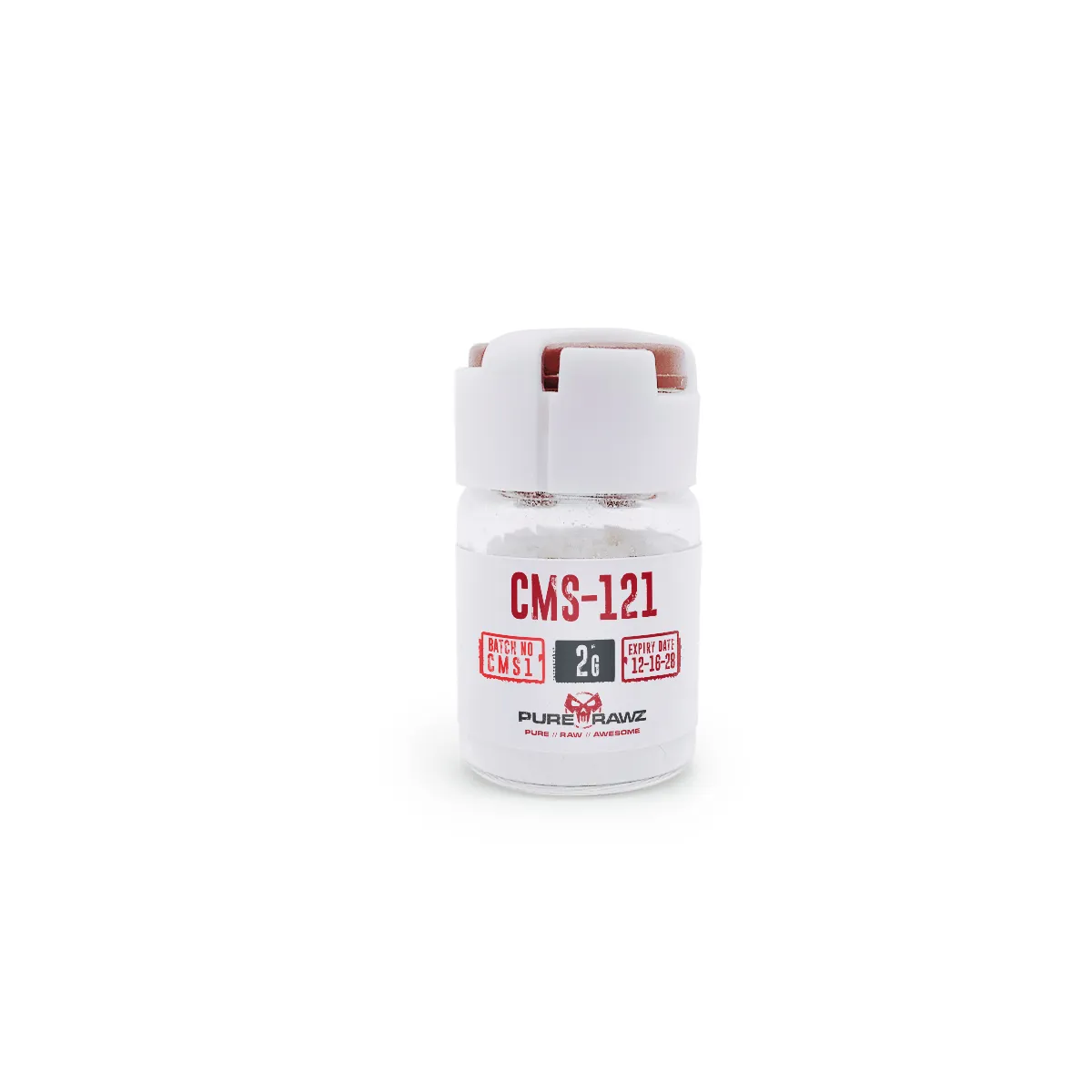


CMS-121 Powder
$48.99
Earn 49 points upon purchasing this product.
✅ 99% Purity – Third-Party Tested
🚚 Free U.S. Shipping on Orders $100+
 Proudly Made in the USA
⚡ Fast & Reliable Shipping
🔒 Secure Checkout Guaranteed
All products are strictly intended for laboratory and research purposes only and are not approved for veterinary or human use.
Description
Overview of CMS-121 Powder
CMS-121 is a synthetic quinoline derivative developed through chemical modification of fisetin, a naturally occurring flavonoid with known multitarget neuroprotective activity.
Researchers investigate CMS-121 powder for its potential role in cellular stressors, including ischemia, inflammation, and endogenous oxidative stress in research models.
CMS-121 is intended strictly for laboratory research purposes and is not approved for human or animal consumption.
Proposed Mechanism of Action of CMS-121 Powder
CMS-121 is a synthetic fisetin derivative that is being investigated for its effects on cellular metabolism and mitochondrial function in research models.
Current research indicates that it primarily modulates fatty acid synthase (FASN), an enzyme involved in lipid biosynthesis, which may help reduce lipid peroxidation and oxidative stress.
Studies also suggest that CMS-121 supports mitochondrial bioenergetics by preserving mitochondrial integrity and maintaining cellular redox balance.
Rather than acting through a single molecular target, CMS-121 appears to regulate multiple pathways associated with lipid metabolism, oxidative stress, and mitochondrial homeostasis, making it an active area of research in cellular and molecular biology.
Chemical & Molecular Properties
| Property | Description |
| Common Name | CMS-121 (CMS121) |
| Chemical Classification | Substituted quinoline; fisetin derivative |
| Molecular Formula | C₂₀H₁₉NO₃ |
| Molecular Weight | 321.37 g/mol |
| CAS Number | 1353224-53-9 |
| InChIKey | OMHNVUCFPJJLKD-UHFFFAOYSA-N |
| SMILES | Oc1ccc(-c2cc(OC3CCCC3)c3ccccc3n2)cc1O |
| Molecular Target | Acetyl-CoA carboxylase 1 (ACC1); fatty acid synthase (FASN) |
| Storage Condition | -20°C |
| Purity (Reference Grade) | ≥98% |
| Analytical Characterization | HPLC, NMR spectroscopy |
Potential Research Applications of CMS-121 Powder
Researchers investigate CMS-121 powder under controlled laboratory conditions for the following research applications. Though more extensive study is required.
-
Lipid Peroxidation and Ferroptosis/Oxytosis Research
Used to study FASN-mediated lipid metabolism and its relationship to oxidative cell death pathways.
-
Acetyl-CoA and Mitochondrial Metabolism Research
Investigated for effects on ACC1 phosphorylation and acetyl-CoA regulation in research models.
-
Neuroinflammation Research
Used to examine microglial activation suppression in LPS-stimulated N9 cell models.
Why Choose Purerawz to Buy CMC-121 Powder?
Each batch of CMS-121 supplied by Purerawz undergoes first- and third-party testing, with a Certificate of Analysis (CoA) available for identity and purity verification. Purerawz maintains a 99%+ purity standard confirmed through independent batch testing.
Frequently Asked Questions
Why does CMS-121 have two different EC50 values?
Because iodoacetic acid and glutamate induce cell death through different upstream mechanisms (ischemia-mimicking metabolic stress vs. oxytosis via glutathione depletion), the differing potency suggests CMS-121 may intervene more efficiently at one stage of the stress-response cascade than another.
How can a single compound show both FASN-related and ACC1-related mechanistic data?
ACC1 and FASN operate sequentially in the same fatty acid synthesis pathway, so findings on ACC1 phosphorylation and FASN inhibition are describing two points along one connected metabolic pathway, not two unrelated mechanisms.
What does an 82% reduction in LPS-induced microglial activation actually tell researchers, mechanistically?
It indicates a substantial but incomplete suppression of the inflammatory response, which is useful for researchers benchmarking CMS-121's anti-inflammatory potency against complete inhibitors..
Disclaimer:
The products sold by Purerawz are intended solely for laboratory and research purposes. They are not FDA-approved for human or animal consumption, and Purerawz does not sell these compounds for use in humans or animals. All compounds are strictly for use by qualified researchers in controlled, non-clinical laboratory environments in compliance with applicable regulations.
Reference Links
Chiruta, C., Schubert, D., Dargusch, R., & Maher, P. (2012). Chemical modification of the multitarget neuroprotective compound fisetin. Journal of Medicinal Chemistry, 55(1), 378–389. https://doi.org/10.1021/jm2012563
Prior, M., Dargusch, R., Ehren, J. L., Chiruta, C., & Schubert, D. (2014). Back to the future with phenotypic screening. ACS Chemical Neuroscience, 5(7), 503–513. https://doi.org/10.1021/cn500051h
Currais, A., Huang, L., Goldberg, J., Petrascheck, M., Ates, G., Pinto-Duarte, A., Shokhirev, M. N., Schubert, D., & Maher, P. (2019). Elevating acetyl-CoA levels reduces aspects of brain aging. eLife, 8, e47866. https://doi.org/10.7554/eLife.47866
Ates, G., Goldberg, J., Currais, A., & Maher, P. (2020). CMS121, a fatty acid synthase inhibitor, protects against excess lipid peroxidation and inflammation and alleviates cognitive loss in a transgenic mouse model of Alzheimer's disease. Redox Biology, 36, Article 101648. https://doi.org/10.1016/j.redox.2020.101648
Goldberg, J., Currais, A., Ates, G., Huang, L., Shokhirev, M., Maher, P., & Schubert, D. (2020). The mitochondrial ATP synthase is a shared drug target for aging and dementia. Aging Cell, 17(2), e12715. https://doi.org/10.1111/acel.12715

About Team PureRawz
Team PureRawz is dedicated to providing accurate, science-based information on research chemicals, including Peptides, Nootropics, and SARMs. Our team of expert writers, researchers, and editors is committed to delivering reliable, up-to-date content you can trust.
Our mission is to build an educated and informed community spanning researchers, laboratories, and general readers empowering them to make confident, well-informed decisions when selecting the right research chemical.
Related products
- Sale!

7,8 Dihydroxyflavone
Original price was: $27.31.$22.69Current price is: $22.69. Select options This product has multiple variants. The options may be chosen on the product page -

Emoxypine Succinate
$22.93 Select options This product has multiple variants. The options may be chosen on the product page -

Fonturacetam Phenylpiracetam Hydrazide 98%
Price range: $25.68 through $71.05 Select options This product has multiple variants. The options may be chosen on the product page -

Galantamine Hydrobromide
$57.37 Select options This product has multiple variants. The options may be chosen on the product page