

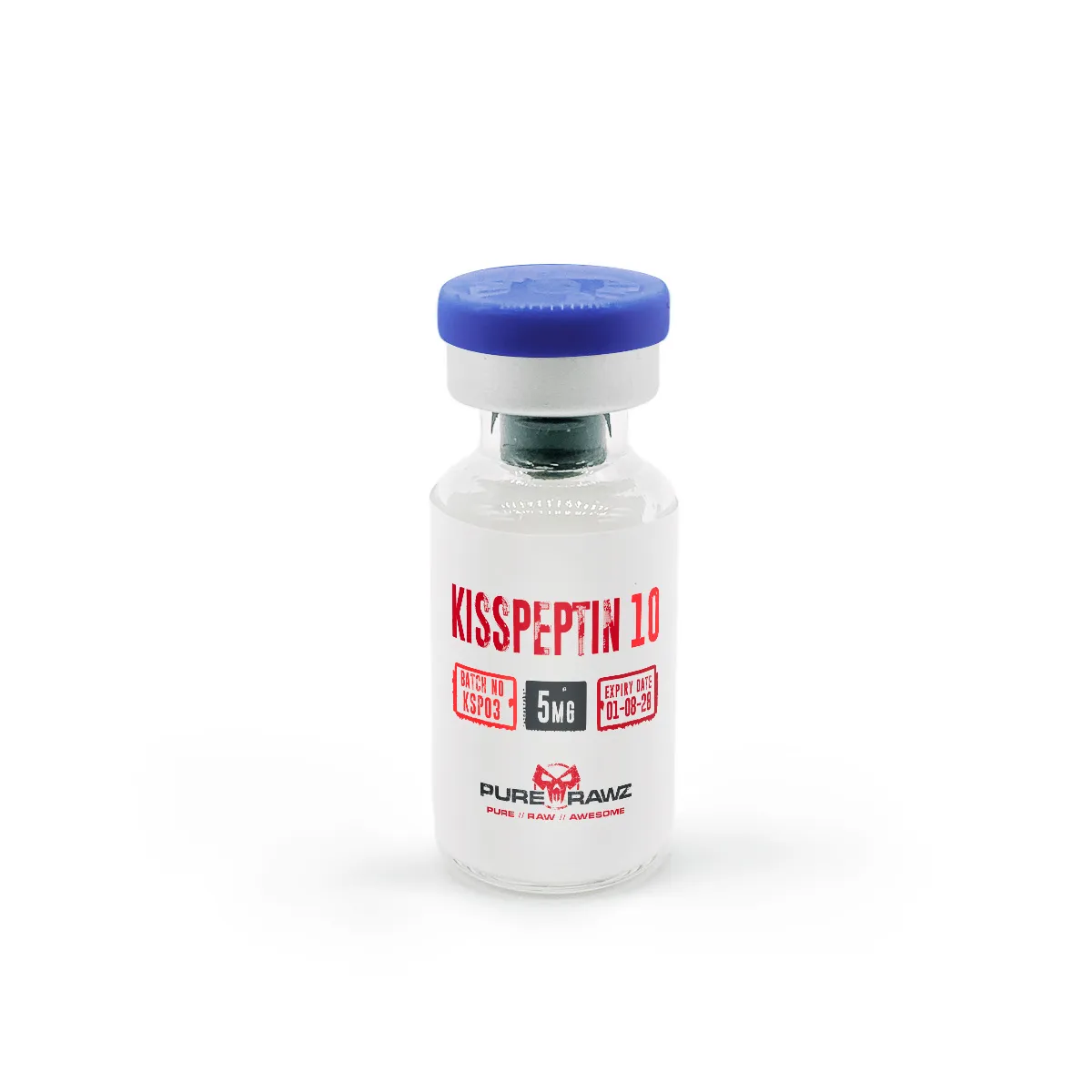


Kisspeptin-10
Price range: $74.00 through $135.15
Earn 74 - 135 points upon purchasing this product.
✅ 99% Purity – Third-Party Tested
🚚 Free U.S. Shipping on Orders $100+
 Proudly Made in the USA
⚡ Fast & Reliable Shipping
🔒 Secure Checkout Guaranteed
All products are strictly intended for laboratory and research purposes only and are not approved for veterinary or human use.
Description
Kisspeptin-10 (KP-10) is a synthetic decapeptide with the amino acid sequence Tyr-Asn-Trp-Asn-Ser-Phe-Gly-Leu-Arg-Phe-NH₂.
KP-10 is the shortest biologically active fragment of kisspeptin-54, a neuropeptide encoded by the KISS1 gene. The peptide belongs to the RFamide peptide family.
Its C-terminal amidation may contribute to receptor affinity and stability, but KP-10 is primarily defined by its 10-amino-acid sequence derived from kisspeptin.
Kisspeptin peptides derived from the KISS1 gene are endogenous ligands of KISS1R; KP-10 is a commonly studied active fragment.
What does KP-10 typically look like?
KP-10 is generally supplied as a white to off-white lyophilized (freeze-dried) powder for laboratory research. Slight variations in appearance may occur depending on manufacturing and storage conditions. Researchers should review the accompanying analytical documentation to verify product specifications.
Proposed Mechanism of Action of KP-10
Preclinical research indicates KP-10 acts as a full agonist at the KISS1R (GPR54) receptor. KISS1R is a Gq/11-coupled receptor expressed on gonadotropin-releasing hormone (GnRH) neurons. Kisspeptin-producing neurons are primarily located in the arcuate nucleus (ARC) and anteroventral periventricular nucleus (AVPV) of the hypothalamus.
Upon binding to KISS1R, research models show activation of phospholipase C (PLC), generating inositol trisphosphate (IP₃) and diacylglycerol (DAG).
This results in intracellular Ca²⁺ mobilization and protein kinase C (PKC) activation. Downstream, the MAPK/ERK1/2 and p38 MAPK cascades have been identified as additional downstream signaling events in multiple assay systems.
In preclinical HPG axis research, KP-10 interaction with KISS1R on GnRH neurons is associated with downstream signaling involved in gonadotropin-releasing hormone (GnRH) secretion.
Chemical Properties of KP-10
| Sequence | Tyr-Asn-Trp-Asn-Ser-Phe-Gly-Leu-Arg-Phe-NH₂ (Verified) |
| Length | 10 aa (Verified) |
| Chemical Class | RFamide peptide (Verified) |
| Average Molecular Mass | ~1302 Da (Estimated; verify with supplier COA) |
Possible Research Applications of KP-10
KP-10 has been investigated in several preclinical research applications, though further study is required
-
Receptor Binding Research
KP-10 is used in KISS1R (GPR54) receptor-binding studies to investigate ligand-receptor affinity, binding kinetics, and receptor activation dynamics under controlled experimental conditions. These studies help characterize peptide–receptor affinity and downstream GPCR signaling.
-
Signal Transduction Pathway Research
Experimental studies have examined KP-10-mediated signaling pathways associated with intracellular second messenger systems and downstream kinase activation. Research includes analysis of pathway components involved in signal propagation, phosphorylation events, and regulatory signaling networks.
Risk and Handling of KP-10 in Lab Settings
This compound is for research use only. It should be handled by qualified researchers in a controlled laboratory environment.
- Store according to manufacturer specifications, commonly at −20°C or below for lyophilized peptide.
- Once reconstituted in an appropriate aqueous vehicle, store at 4°C and use within the timeframe recommended in product documentation.
- Avoid repeated freeze-thaw cycles to preserve peptide structural integrity.
- Use appropriate PPE including gloves, eye protection, and a lab coat when handling powder or reconstituted solutions.
- Work in a designated peptide-handling area or biological safety cabinet as appropriate.
Researchers are advised to consult the Safety Data Sheet (SDS) before handling.
Why Choose Purerawz?
Product documentation may include batch-specific testing results such as Certificates of Analysis (CoAs), along with analytical data generated through methods such as HPLC or mass spectrometry. Availability of supporting documentation may vary by product and batch.
The information presented on this site is intended to assist researchers in reviewing compound characteristics, specifications, and handling considerations. All materials referenced are for research purposes only and are not intended for human or veterinary use unless explicitly stated otherwise.
(FAQs)
How does KP-10 differ from other kisspeptin fragments?
KP-10 is the shortest known biologically active fragment derived from longer kisspeptin peptides such as kisspeptin-54, kisspeptin-14, and kisspeptin-13. While these peptides share the same conserved C-terminal sequence required for receptor interaction, differences in peptide length may influence stability, degradation rate, and pharmacokinetic behavior in experimental systems.
Why is KP-10 classified as an RFamide peptide?
KP-10 belongs to the RFamide peptide family because it contains the conserved Arg–Phe–NH₂ (RFamide) motif at its C-terminus. This motif is characteristic of a broader group of neuropeptides involved in receptor-mediated signaling and is often important for receptor recognition.
What analytical methods are used to characterize KP-10?
KP-10 characterization commonly involves multiple analytical techniques, including mass spectrometry (MS) for molecular mass confirmation, HPLC for purity analysis, and peptide sequencing methods for identity verification. Additional tests may assess peptide degradation and batch consistency.
What factors can affect KP-10 stability during experiments?
Peptide stability can be influenced by temperature, pH, solvent composition, oxidation, and repeated freeze–thaw cycles. Exposure to proteolytic enzymes or prolonged storage in solution may also accelerate degradation and reduce experimental consistency.
Why is peptide aggregation important when working with KP-10?
Under certain buffer conditions or concentrations, peptides may self-associate or aggregate. Aggregation can affect solubility, reduce effective concentration, and alter assay reproducibility. Proper solvent selection and controlled storage conditions help minimize this issue.
What makes KP-10 useful in receptor signaling studies?
KP-10 is frequently used in receptor signaling research because of its relatively short sequence, defined structure, and strong affinity for KISS1R. Its size can make synthesis, purification, and mechanistic studies more straightforward compared with longer peptide analogs.
How is KP-10 synthesized?
KP-10 is typically produced using solid-phase peptide synthesis (SPPS), a widely used method for manufacturing research peptides. Following synthesis, the peptide is purified and analytically characterized using techniques such as RP-HPLC and mass spectrometry to verify identity and quality before laboratory use.
Disclaimer
The products sold by Purerawz are intended solely for laboratory and research purposes. They are not FDA-approved for human or animal consumption, and Purerawz does not sell these compounds for use in humans or animals. All compounds are strictly for use by qualified researchers in controlled, non-clinical laboratory environments in compliance with applicable regulations.
References
- Dhillo WS, et al. Central and peripheral administration of kisspeptin-10 stimulates the hypothalamic-pituitary-gonadal axis. PubMed PMID: 15500545. https://pubmed.ncbi.nlm.nih.gov/15500545/
- Son HE, et al. Kisspeptin-10 (KP-10) stimulates osteoblast differentiation through GPR54-mediated regulation of BMP2 expression. Sci Rep. 2018;8(1):2134. https://www.nature.com/articles/s41598-018-20571-2
- Bhattacharya M, et al. GPR54 (KISS1R) Transactivates EGFR to Promote Breast Cancer Cell Invasiveness. PMC3125256. https://www.ncbi.nlm.nih.gov/pmc/articles/PMC3125256/
- Kotani M, et al. Kisspeptins: a multifunctional peptide system with a role in reproduction, cancer and the cardiovascular system. PMC2189831. https://pmc.ncbi.nlm.nih.gov/articles/PMC2189831/
- Kisspeptin-10 Prevents the Development of Cerebral Aneurysms by Reducing the Expression of Egr-1. PMC12086517. https://www.ncbi.nlm.nih.gov/pmc/articles/PMC12086517/
- Ohtaki T, Shintani Y, Honda S, et al. Metastasis suppressor gene KiSS-1 encodes peptide ligand of a G-protein-coupled receptor. Nature. 2001;411(6837):613–617. https://doi.org/10.1038/35079135

About Team PureRawz
Team PureRawz is dedicated to providing accurate, science-based information on research chemicals, including Peptides, Nootropics, and SARMs. Our team of expert writers, researchers, and editors is committed to delivering reliable, up-to-date content you can trust.
Our mission is to build an educated and informed community spanning researchers, laboratories, and general readers empowering them to make confident, well-informed decisions when selecting the right research chemical.
Related products
-

Thymosin Alpha 1
Price range: $79.45 through $424.10 Select options This product has multiple variants. The options may be chosen on the product page -

KP-102
Price range: $35.50 through $127.32 Select options This product has multiple variants. The options may be chosen on the product page -

Thymalin
Price range: $76.92 through $321.92 Select options This product has multiple variants. The options may be chosen on the product page -

LL-37 (CAP-18)
$104.37 Select options This product has multiple variants. The options may be chosen on the product page