

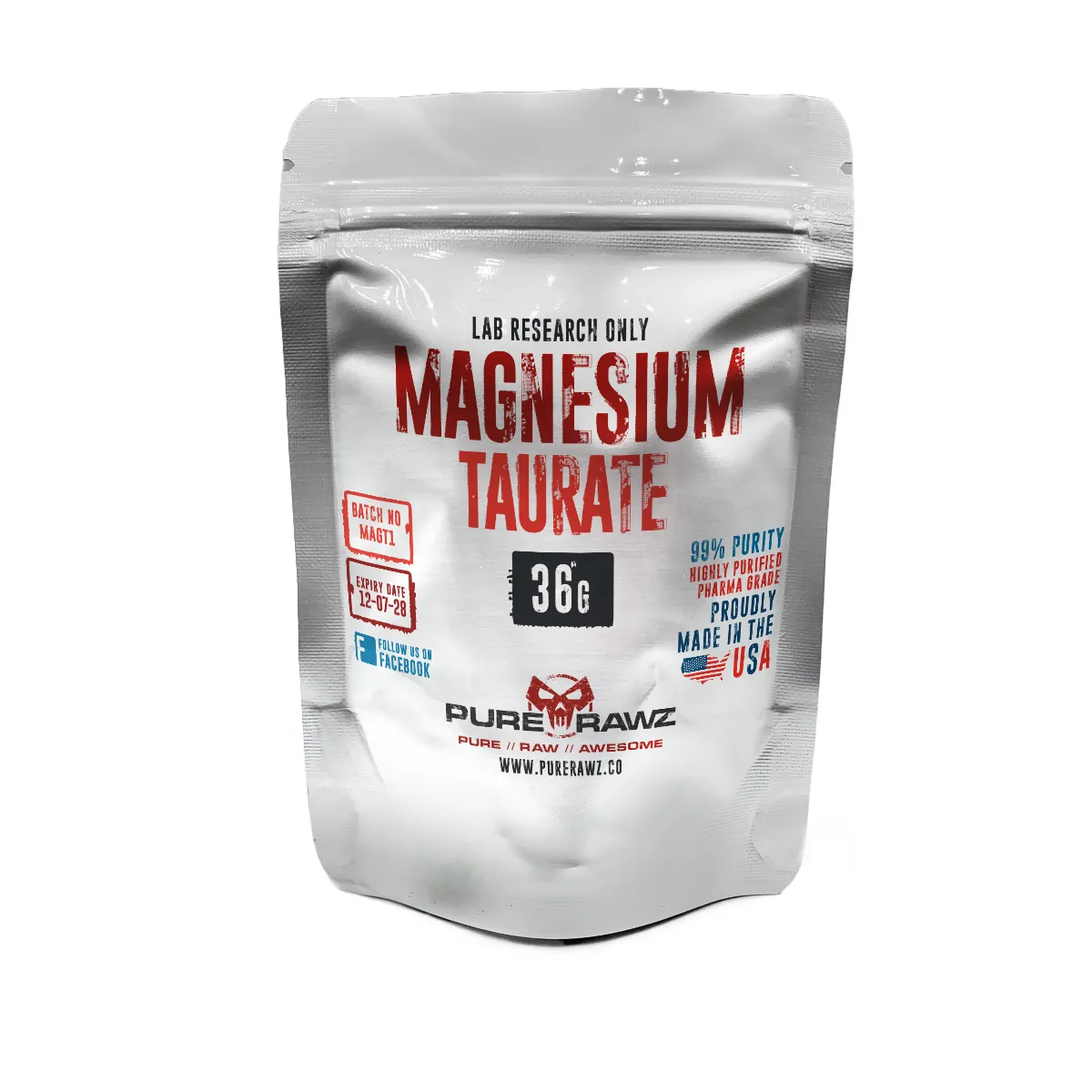

Magnesium Taurate
$17.85
Earn 18 points upon purchasing this product.
✅ 99% Purity – Third-Party Tested
🚚 Free U.S. Shipping on Orders $100+
 Proudly Made in the USA
⚡ Fast & Reliable Shipping
🔒 Secure Checkout Guaranteed
All products are strictly intended for laboratory and research purposes only and are not approved for veterinary or human use.
Description
Overview of Magnesium Taurate
Magnesium taurate is a mineral-amino acid salt formed by combining elemental magnesium with taurine (2-aminoethanesulfonic acid) at a 1:2 magnesium-to-taurine ratio.
Structurally, magnesium taurate is understood in the research literature to dissociate into its constituent magnesium and taurine ions prior to absorption.
Researchers study magnesium taurate primarily because it sits at the intersection of two well-characterized areas of neuroscience research: magnesium's role in ion channel regulation and taurine's role as a neuromodulatory amino acid.
Researchers believe that magnesium taurate might be a useful compound to study glutamatergic signaling, calcium influx regulation, and GABAergic/glycinergic neurotransmission in experimental models.
Magnesium taurate is intended strictly for laboratory research purposes and is not approved for human or animal consumption.
Proposed Mechanism of Action of Magnesium Taurate
Research models investigating taurine, the organic component of magnesium taurate, have identified multiple proposed mechanisms relevant to neuromodulatory and neuroprotective research.
Investigations on receptor-binding studies have shown that taurine may interacts directly with the NMDA (N-methyl-D-aspartate) glutamate receptor subtype through multiple binding mechanisms.
Separate research studies have shown that taurine dampens glutamate-induced calcium influx through L-, P/Q-, and N-type voltage-gated calcium channels, as well as through the NMDA receptor calcium channel.
Notably, this calcium-dampening effect was not observed in NMDA receptor calcium channels when cultured neurons were studied in magnesium-free medium.
Potential Research Applications of Magnesium Taurate
Researchers investigate Magnesium Taurate under controlled laboratory conditions for the following research applications. Though more extensive study is required.
-
NMDA Receptor and Glutamatergic Signaling Research
Used to study taurine's direct and indirect modulation of NMDA receptor activity in preclinical research models.
-
Calcium Signaling and Excitotoxicity Research
Investigated for effects on glutamate-induced calcium influx through voltage-gated and NMDA receptor-associated calcium channels.
-
GABAergic and Glycinergic Neurotransmission Research
Studied for taurine's activity at GABA_A and glycine receptor-associated chloride channels in rodent brain models.
-
Mineral-Amino Acid Complex Bioavailability Research
Used as a reference compound in comparative studies examining magnesium salt dissociation and absorption kinetics.
-
Comparative Electrolyte and Ion Channel Research
Studied alongside other magnesium salts to characterize magnesium's role in ion channel gating and membrane excitability.
Chemical & Molecular Properties
| Property | Description |
| Common Name | Magnesium Taurate |
| Synonyms | Magnesium Ditaurate; Magnesium Taurinate; Ethanesulfonic acid, 2-amino-, magnesium salt (2:1) |
| Chemical Classification | Mineral-amino acid salt (magnesium salt of taurine) |
| Molecular Formula | C₄H₁₂MgN₂O₆S₂ |
| Molecular Weight | 272.57–272.6 g/mol |
| PubChem CID | 13343447 |
| UNII | RCM1N3D968 |
| InChIKey | YZURQOBSFRVSEB-UHFFFAOYSA-L |
| Elemental Magnesium Content | ~8.9% by mass |
| Appearance | White to off-white crystalline powder |
| Solubility | Water-soluble |
| Storage Stability | Store sealed in a cool, dry environment |
| Analytical Characterization | HPLC, elemental analysis |
Why Researchers Source Magnesium Taurate from Purerawz?
Purerawz supplies Magnesium Taurate exclusively for laboratory research and analytical applications. Available product documentation may include batch-specific information, certificates of analysis (CoAs), and analytical characterization data to assist researchers in evaluating material identity and quality for experimental use.
As with all research materials, investigators should independently review the available specifications and supporting documentation to determine whether the material is appropriate for their intended laboratory protocols and research objectives.
Frequently Asked Questions
How does magnesium taurate differ from other forms of magnesium?
Magnesium taurate differs from forms such as magnesium citrate, glycinate, oxide, or malate because it is bound to taurine instead of another compound. The attached molecule influences the chemical properties of the supplement and may affect its intended use.
What is taurine?
Taurine is a sulfur-containing amino acid derivative that occurs naturally in many tissues and participates in a variety of physiological processes, including cellular function, electrolyte balance, and nervous system activity.
How is magnesium taurate produced?
Magnesium taurate is manufactured by combining a magnesium source with taurine under controlled processing conditions. The finished material is purified and tested to verify its identity, composition, and quality.
Is magnesium taurate water soluble?
Magnesium taurate has limited water solubility compared with some other magnesium salts. Solubility can vary depending on manufacturing methods and formulation.
Reference Links
Chan, C. Y., Sun, H. S., Shah, S. M., Agovic, M. S., Ho, I., Friedman, E., & Banerjee, S. P. (2013). Direct interaction of taurine with the NMDA glutamate receptor subtype via multiple mechanisms. Advances in Experimental Medicine and Biology, 775, 45–52. https://doi.org/10.1007/978-1-4614-6130-2_4
Sun, M., Zhao, Y., Gu, Y., & Xu, C. (2014). Modes of direct modulation by taurine of the glutamate NMDA receptor in rat cortex. European Journal of Pharmacology, 728, 45–52. https://doi.org/10.1016/j.ejphar.2014.01.037
Wu, H., Jin, Y., Wei, J., Jin, H., Sha, D., & Wu, J. Y. (2005). Mode of action of taurine as a neuroprotector. Brain Research, 1038(2), 123–131. https://doi.org/10.1016/j.brainres.2005.01.058
Song, Y., Xu, C., Wu, H., et al. (2005). Taurine acts on a subclass of GABA_A receptors in mammalian brain in vitro. European Journal of Pharmacology, 512(2–3), 125–133. https://doi.org/10.1016/j.ejphar.2005.02.028
Ricciardi, C. J., & El Idrissi, A. (2022). Taurine supplementation as a neuroprotective strategy upon brain dysfunction in metabolic syndrome and diabetes. Nutrients, 14(6), Article 1292. https://doi.org/10.3390/nu14061292
Disclaimer:
The products sold by Purerawz are intended solely for laboratory and research purposes. They are not FDA-approved for human or animal consumption, and Purerawz does not sell these compounds for use in humans or animals. All compounds are strictly for use by qualified researchers in controlled, non-clinical laboratory environments in compliance with applicable regulations.

About Team PureRawz
Team PureRawz is dedicated to providing accurate, science-based information on research chemicals, including Peptides, Nootropics, and SARMs. Our team of expert writers, researchers, and editors is committed to delivering reliable, up-to-date content you can trust.
Our mission is to build an educated and informed community spanning researchers, laboratories, and general readers empowering them to make confident, well-informed decisions when selecting the right research chemical.
Related products
-

Agrocybe 30% Bisporiust
Price range: $26.77 through $56.28 Select options This product has multiple variants. The options may be chosen on the product page -

Emoxypine Succinate
$22.93 Select options This product has multiple variants. The options may be chosen on the product page - Sale!

7,8 Dihydroxyflavone
Original price was: $27.31.$22.69Current price is: $22.69. Select options This product has multiple variants. The options may be chosen on the product page -

CDP Choline (Citicoline)
$28.41 Select options This product has multiple variants. The options may be chosen on the product page