

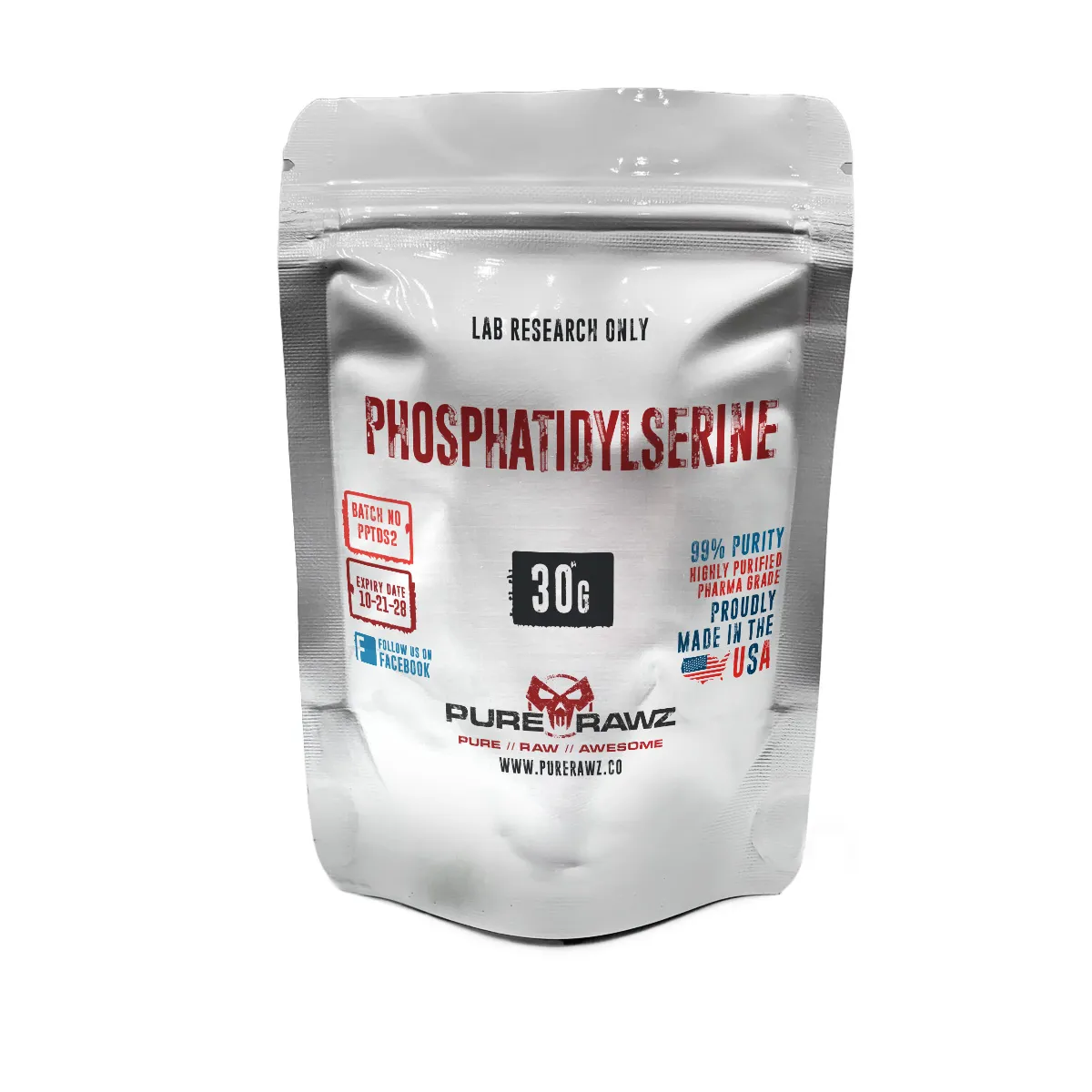

Phosphatidylserine
$39.85
Earn 40 points upon purchasing this product.
✅ 99% Purity – Third-Party Tested
🚚 Free U.S. Shipping on Orders $100+
 Proudly Made in the USA
⚡ Fast & Reliable Shipping
🔒 Secure Checkout Guaranteed
All products are strictly intended for laboratory and research purposes only and are not approved for veterinary or human use.
Description
Overview of Phosphatidylserine
Phosphatidylserine (PS) is a glycerophospholipid class characterized by a serine head group esterified to a phosphatidic acid backbone.
As a class of compounds, phosphatidylserine species vary depending on fatty acid composition and biological source (soy, sunflower, or bovine-derived).
Phosphatidylserine is a native component of the inner leaflet of eukaryotic plasma membranes, where it is maintained by flippase enzymes under normal cellular conditions.
It has been investigated in preclinical and biochemical literature for its role in relation to apoptotic pathway studies, where surface exposure of phosphatidylserine serves as a recognized biochemical marker.
Phosphatidylserine is intended strictly for laboratory research purposes and is not approved for human or animal consumption.
Proposed Mechanism of Action of Phosphatidylserine
Preclinical and biochemical research indicates that phosphatidylserine's primary research relevance centers on its membrane-localization dynamics.
In research models, phosphatidylserine is retained on the cytosolic (inner) leaflet of the plasma membrane.
Research studies demonstrate that during apoptotic signaling, phosphatidylserine is redistributed from the inner to the outer leaflet, where its surface exposure functions as a recognition signal in cell-clearance and immune-signaling research pathways.
Biosynthesis pathway research indicates that phosphatidylserine is generated through base-exchange reactions involving phosphatidylcholine and phosphatidylethanolamine in research models.
This happens through condensation of serine with CDP-activated phosphatidic acid in bacterial research systems.
Additional research has examined phosphatidylserine's proposed role in membrane fluidity, protein-binding domain interactions (e.g., Gla-domain-containing proteins), and cell-signaling cascades relevant to neuronal membrane research models.
Chemical and Molecular Properties
| Property | Description |
| Common Name | Phosphatidylserine (PS) |
| Chemical Classification | Glycerophospholipid (phospholipid class) |
| Molecular Formula | C₄₂H₈₂NO₁₀P (representative soy-derived / distearoyl form; varies by fatty acid composition) |
| Molecular Weight | ~792.06–792.07 g/mol (representative value; varies by acyl chain composition and source) |
| CAS Number | 51446-62-9 |
| Chemical Nature | Glycerol-based phospholipid with a serine head group esterified via a phosphodiester bond to phosphatidic acid |
| Backbone Structure | Glycerol backbone; two fatty acid acyl chains at sn-1 and sn-2 positions; phosphoserine head group at sn-3 position |
| Source Variability | Derived from soy lecithin, sunflower lecithin, or bovine brain tissue; fatty acid composition and exact molecular weight vary by source |
| Appearance | Light yellow to tan powder |
| Solubility | Fat-soluble (lipophilic); insoluble in water |
| Storage Stability | Store dry, dark, and refrigerated (0–4°C) for short-term use; -20°C for long-term storage |
| Physical State | Solid (powder form) |
| Analytical Characterization | HPLC, LC-MS/MS, thin-layer chromatography (TLC), NMR spe |
Note on variability: Phosphatidylserine is not a single fixed-structure molecule but a phospholipid class. The molecular formula and molecular weight listed above correspond to a representative reference form (e.g., distearoyl phosphatidylserine, CAS 51446-62-9). Actual molecular weight and formula will vary depending on the specific fatty acid chains present in a given batch or biological source, and should be confirmed against the batch-specific Certificate of Analysis (CoA).
Potential Research Applications of Phosphatidylserine
Researchers investigate Phosphatidylserine under controlled laboratory conditions for the following research applications. Though more extensive study is required.
-
Apoptosis and Cell-Signaling Research
Preclinical findings suggest phosphatidylserine externalization serves as a research marker for apoptotic pathway activation in cell-based models.
-
Lipid Dynamics Studies
It is used to investigate flippase-mediated lipid asymmetry and membrane composition in cellular research models.
-
Neuroscience and Membrane Signaling Research
Preclinical data have examined phosphatidylserine's role in neuronal membrane composition and cell-signaling research contexts.
-
Protein-Lipid Interaction Studies
Investigated as a binding substrate for Gla-domain-containing proteins in coagulation and cell-targeting research models.
-
Analytical Lipidomics Research
Used as a reference standard for lipid class identification and quantification via chromatographic and mass spectrometry methods.
Why Researchers Trust Purerawz for Phosphatidylserine?
Purerawz provides phosphatidylserine exclusively for laboratory research and analytical applications. Available product documentation may include batch-specific information, certificates of analysis (CoAs), and analytical characterization data to support the evaluation of material identity, purity, and consistency for experimental use.
FAQs
Why is phosphatidylserine used as a marker in apoptosis assays?
Researchers believe that, during early apoptosis, phosphatidylserine translocates from the inner to the outer leaflet of the plasma membrane. This makes it a key biomarker for detecting apoptotic cells using Annexin V-based assays.
Which laboratory techniques are commonly used to detect phosphatidylserine exposure?
Phosphatidylserine exposure is most commonly detected using Annexin V staining coupled with flow cytometry, fluorescence microscopy, or confocal microscopy.
What factors can affect phosphatidylserine externalization in cell culture experiments?
Factors such as oxidative stress, chemical treatments, UV irradiation, hypoxia, calcium imbalance, and apoptosis-inducing agents can influence phosphatidylserine externalization.
How should phosphatidylserine-containing samples be stored for research applications?
Phosphatidylserine standards and reagents should typically be stored at the temperature recommended by the manufacturer (often −20°C or below), protected from light and oxidation to maintain stability.
What are the common research applications of phosphatidylserine?
Phosphatidylserine is used in apoptosis research, membrane biology studies, lipidomics, cell signaling investigations, immunology, and the validation of Annexin V-based detection assays.
Disclaimer
The products sold by Purerawz are intended solely for laboratory and research purposes. They are not FDA-approved for human or animal consumption, and Purerawz does not sell these compounds for use in humans or animals. All compounds are strictly for use by qualified researchers in controlled, non-clinical laboratory environments in compliance with applicable regulations.
Reference Links
Vance, J. E., & Tasseva, G. (2013). Formation and function of phosphatidylserine and phosphatidylethanolamine in mammalian cells. Biochimica et Biophysica Acta (BBA) - Molecular and Cell Biology of Lipids, 1831(3), 543–554. https://doi.org/10.1016/j.bbalip.2012.08.016
Leventis, P. A., & Grinstein, S. (2010). The distribution and function of phosphatidylserine in cellular membranes. Annual Review of Biophysics, 39, 407–427. https://doi.org/10.1146/annurev.biophys.093008.131234
Fadeel, B., & Xue, D. (2009). The ins and outs of phospholipid asymmetry in the plasma membrane: Roles in health and disease. Critical Reviews in Biochemistry and Molecular Biology, 44(5), 264–277. https://doi.org/10.1080/10409230903193307
Kim, H.-Y., Huang, B. X., & Spector, A. A. (2014). Phosphatidylserine in the brain: Metabolism and function. Progress in Lipid Research, 56, 1–18. https://doi.org/10.1016/j.plipres.2014.06.002
Glade, M. J., & Smith, K. (2015). Phosphatidylserine and the human brain. Nutrition, 31(6), 781–786. https://doi.org/10.1016/j.nut.2014.10.014

About Team PureRawz
Team PureRawz is dedicated to providing accurate, science-based information on research chemicals, including Peptides, Nootropics, and SARMs. Our team of expert writers, researchers, and editors is committed to delivering reliable, up-to-date content you can trust.
Our mission is to build an educated and informed community spanning researchers, laboratories, and general readers empowering them to make confident, well-informed decisions when selecting the right research chemical.
Related products
-

Oxiracetam
$22.94 Select options This product has multiple variants. The options may be chosen on the product page -

Galantamine Hydrobromide
$57.37 Select options This product has multiple variants. The options may be chosen on the product page -

HBT1
$92.36 Select options This product has multiple variants. The options may be chosen on the product page -

CDP Choline (Citicoline)
$28.41 Select options This product has multiple variants. The options may be chosen on the product page