

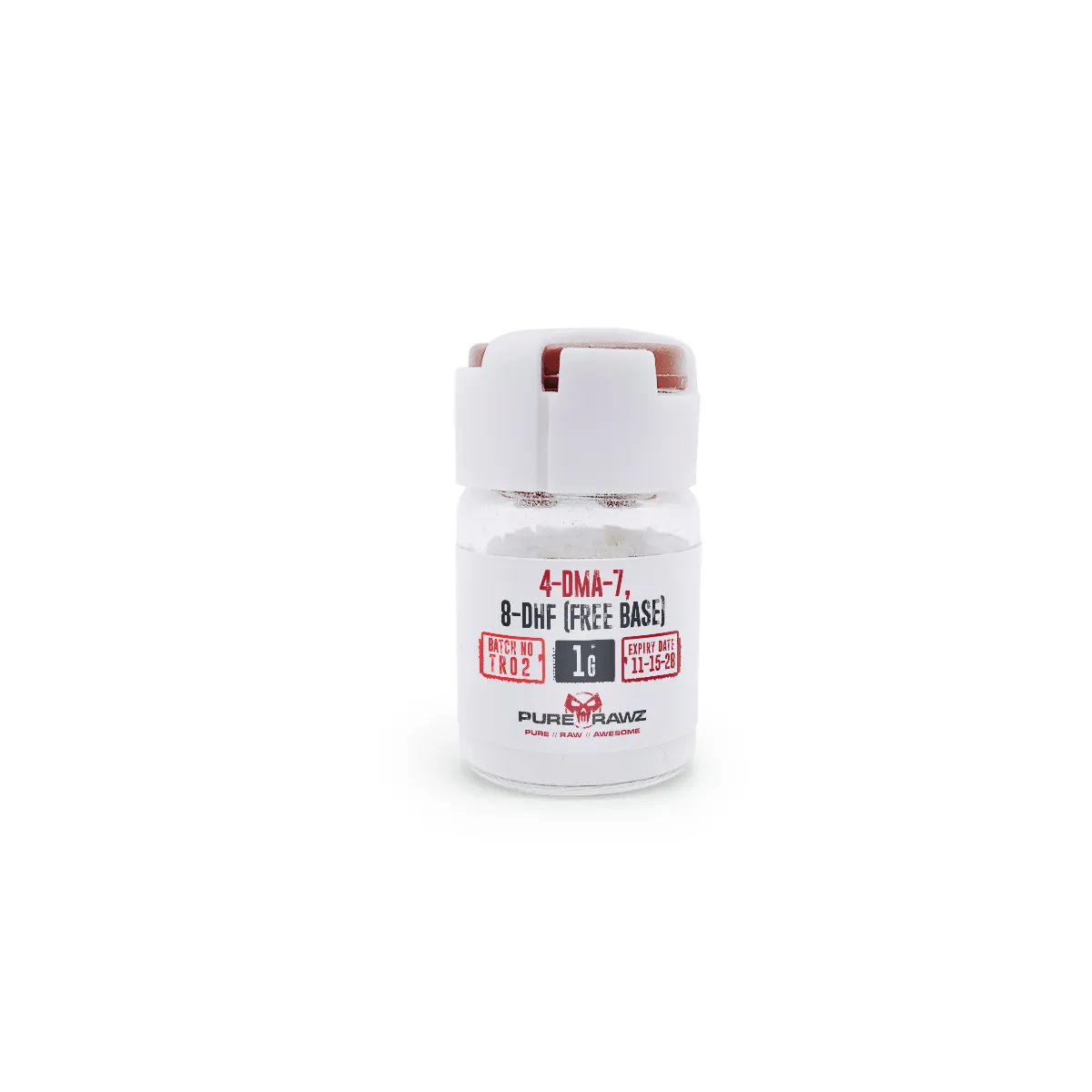


4-DMA-7,8-DHF (Free Base)
$32.99
Earn 33 points upon purchasing this product.
✅ 99% Purity – Third-Party Tested
🚚 Free U.S. Shipping on Orders $100+
 Proudly Made in the USA
⚡ Fast & Reliable Shipping
🔒 Secure Checkout Guaranteed
All products are strictly intended for laboratory and research purposes only and are not approved for veterinary or human use.
Description
Overview of 4-DMA-7,8-DHF (Free Base)
4-DMA-7,8-DHF (4'-dimethylamino-7,8-dihydroxyflavone), free base, is a synthetic flavone derivative belonging to the 7,8-dihydroxyflavone (7,8-DHF) structural class.
It is distinguished by a dimethylamino substitution at the 4' position of the flavone backbone. This compound emerged from structure-activity relationship (SAR) work built on 7,8-DHF.
In medicinal chemistry screening, 4'-DMA-7,8-DHF was identified among a series of 7,8-DHF derivatives as demonstrating higher antiapoptotic activity and TrkB phosphorylation than 7,8-DHF in in vitro research models.
4-DMA-7,8-DHF is intended strictly for laboratory research purposes and is not approved for human or animal consumption.
Proposed Mechanism of Action of 4-DMA-7,8-DHF (Free Base)
Preclinical research models indicate that 4-DMA-7,8-DHF interacts with the extracellular domain of the TrkB receptor (tropomyosin receptor kinase B).
Studies on various preclinical research models found that 4'-DMA-7,8-DHF triggered TrkB activation at concentrations as low as 10 nM, compared to a minimal effective concentration of 100 nM observed for the parent compound 7,8-DHF.
Researchers have characterized 4-DMA-7,8-DHF as possessing an approximately 10-fold higher TrkB agonistic effect relative to 7,8-DHF. Studies also indicate that 4-DMA-7,8-DHF more sustained receptor activation profile in preclinical models.
These proposed mechanisms remain under continued investigation and should not be interpreted as established pharmacological fact outside the research setting in which they were generated.
4-DMA-7,8-DHF (Free Base) — Chemical & Molecular Properties
| Property | Description |
| Common Name | 4-DMA-7,8-DHF (Free Base); also referred to as Eutropoflavin |
| Chemical Name | 4'-Dimethylamino-7,8-Dihydroxyflavone |
| IUPAC Name | 2-[4-(Dimethylamino)phenyl]-7,8-dihydroxy-4H-chromen-4-one |
| Chemical Classification | Synthetic flavone derivative; TrkB receptor agonist (7,8-DHF analog) |
| Molecular Formula | C₁₇H₁₅NO₄ |
| Molecular Weight | ~297.31 g/mol |
| CAS Number | 1205548-04-4 (free base form) |
| Appearance | Yellow powder |
| Topological Polar Surface Area | ~73.91 Ų |
| Hydrogen Bond Acceptors | 4 |
| Hydrogen Bond Donors | 2 |
| Rotatable Bonds | 2 |
| cLogP | ~2.28 |
| Molar Refractivity | ~86.17 |
| Chemical Nature | Synthetic dimethylamino-substituted flavonoid |
| Structural Note | Derived from 7,8-dihydroxyflavone with a dimethylamino group added at the 4' position of the flavone ring |
| Analytical Characterization | HPLC, LC-MS/MS, NMR spectroscopy |
Note on CAS discrepancy: Some suppliers list CAS 1205548-00-0 for material labeled "4-DMA-7,8-DHF Free Base," but this CAS number is officially registered to the hydrobromide (HBr) salt form (molecular formula BrHC₁₇H₁₅NO₄). The free base form is more consistently documented under CAS 1205548-04-4 across independent nootropic-research suppliers. Researchers sourcing this compound should verify the CAS number and salt form against the Certificate of Analysis (CoA) for the specific batch purchased, since vendor listings are not always consistent on this point.
Possible Research Applications 4-DMA-7,8-DHF (Free Base)
Researchers investigate 4-DMA-7,8-DHF (Free Base) under controlled laboratory conditions for the following research applications. Though more extensive study is required.
-
TrkB/BDNF Signaling Pathway Research
Preclinical findings suggest 4-DMA-7,8-DHF may function as a research tool for probing TrkB receptor agonism and downstream neurotrophin signaling, with data pointing to measurable receptor phosphorylation in vitro.
-
Neuronal Survival and Apoptosis Pathway Studies
Structure-activity data indicate this derivative exhibits antiapoptotic activity in cortical neuron research models, supporting its use in studies of cell survival signaling.
-
Comparative Flavonoid SAR Research
Researchers use 4-DMA-7,8-DHF alongside 7,8-DHF and related analogs as reference compounds for structure-activity relationship investigations examining how substituent modifications affect receptor binding kinetics and potency.
-
Pharmacokinetic and Receptor Duration-of-Action Modeling
Preclinical research models have been used to characterize the extended TrkB activation window associated with this derivative, informing research on flavonoid bioavailability and metabolic stability.
-
Analytical and Bioanalytical Method Development
The compound serves as a reference standard for HPLC, LC-MS/MS, and related analytical techniques used to validate identity, purity, and quantification methods in laboratory settings.
Why Researchers Choose Purerawz to Buy 4-DMA-7,8-DHF (Free Base)
Each batch of 4-DMA-7,8-DHF (Free Base) supplied by Purerawz undergoes first- and third-party testing, with a Certificate of Analysis (CoA) available for verification of identity and purity.
Purerawz maintains a 99%+ purity standard, confirmed through independent batch testing protocols. Researchers can access batch-specific CoA documentation, including HPLC and mass spectrometry data, to validate compound integrity prior to incorporating the material into experimental protocols.
FAQs
Why is brain-derived neurotrophic factor (BDNF) signaling frequently investigated alongside 4-DMA-7,8-DHF?
Brain-derived neurotrophic factor (BDNF) is the endogenous ligand for the tropomyosin receptor kinase B (TrkB) receptor and plays a central role in neuronal signaling. Researchers investigate 4-DMA-7,8-DHF in experimental systems to examine TrkB-mediated signaling pathways and compare small-molecule receptor activation with endogenous neurotrophin signaling.
Why is 4-DMA-7,8-DHF frequently compared with 7,8-dihydroxyflavone in experimental studies?
Researchers compare 4-DMA-7,8-DHF with its parent compound, 7,8-dihydroxyflavone, to investigate how structural modification may influence receptor interactions, physicochemical properties, pharmacological characteristics, and downstream signaling in experimental models. These comparative studies contribute to structure–activity relationship (SAR) investigations and medicinal chemistry research.
Is 4-DMA-7,8-DHF approved for human or clinical use?
No. 4-DMA-7,8-DHF is not FDA-approved and is not intended for human or animal use of any kind. It is sold exclusively for laboratory and investigational research purposes.
Disclaimer
The products sold by Purerawz are intended solely for laboratory and research purposes. They are not FDA-approved for human or animal consumption, and Purerawz does not sell these compounds for use in humans or animals. All compounds are strictly for use by qualified researchers in controlled, non-clinical laboratory environments in compliance with applicable regulations.
Reference Links
Jang, S. W., Liu, X., Yepes, M., Shepherd, K. R., Miller, G. W., Liu, Y., Wilson, W. D., Xiao, G., Blanchi, B., Sun, Y. E., & Ye, K. (2010). A selective TrkB agonist with potent neurotrophic activities by 7,8-dihydroxyflavone. Proceedings of the National Academy of Sciences, 107(6), 2687–2692. https://doi.org/10.1073/pnas.0913572107
Liu, X., Chan, C. B., Qi, Q., Xiao, G., Luo, H. R., He, X., & Ye, K. (2012). Optimization of a small tropomyosin-related kinase B (TrkB) agonist 7,8-dihydroxyflavone into a potent, selective, and efficacious TrkB agonist in vivo. Journal of Medicinal Chemistry, 55(21), 8524–8537. https://doi.org/10.1021/jm301099x
Chen, C., Wang, Z., Zhang, Z., Liu, X., Kang, S. S., Zhang, Y., & Ye, K. (2018). The prodrug of 7,8-dihydroxyflavone development and therapeutic efficacy for treating Alzheimer's disease. Proceedings of the National Academy of Sciences, 115(3), 578–583. https://doi.org/10.1073/pnas.1718683115
Zeng, Y., Liu, Y., Wu, M., Liu, J., & Hu, Q. (2013). Activation of TrkB by 7,8-dihydroxyflavone prevents fear memory defects and facilitates amygdalar synaptic plasticity in aging. Journal of Alzheimer's Disease, 30(4), 831–843. https://doi.org/10.3233/JAD-2012-111814
Longo, F. M., & Massa, S. M. (2013). Small-molecule modulation of neurotrophin receptors: A strategy for the treatment of neurological disease. Nature Reviews Drug Discovery, 12(7), 507–525. https://doi.org/10.1038/nrd4024

About Team PureRawz
Team PureRawz is dedicated to providing accurate, science-based information on research chemicals, including Peptides, Nootropics, and SARMs. Our team of expert writers, researchers, and editors is committed to delivering reliable, up-to-date content you can trust.
Our mission is to build an educated and informed community spanning researchers, laboratories, and general readers empowering them to make confident, well-informed decisions when selecting the right research chemical.
Related products
-

CDP Choline (Citicoline)
$28.41 Select options This product has multiple variants. The options may be chosen on the product page -

L-Tetrahydropalmatine (L-THP)
$25.68 Select options This product has multiple variants. The options may be chosen on the product page -

Galantamine Hydrobromide
$57.37 Select options This product has multiple variants. The options may be chosen on the product page -

Adamantyl Carbonyl Proline
$37.71 Select options This product has multiple variants. The options may be chosen on the product page