

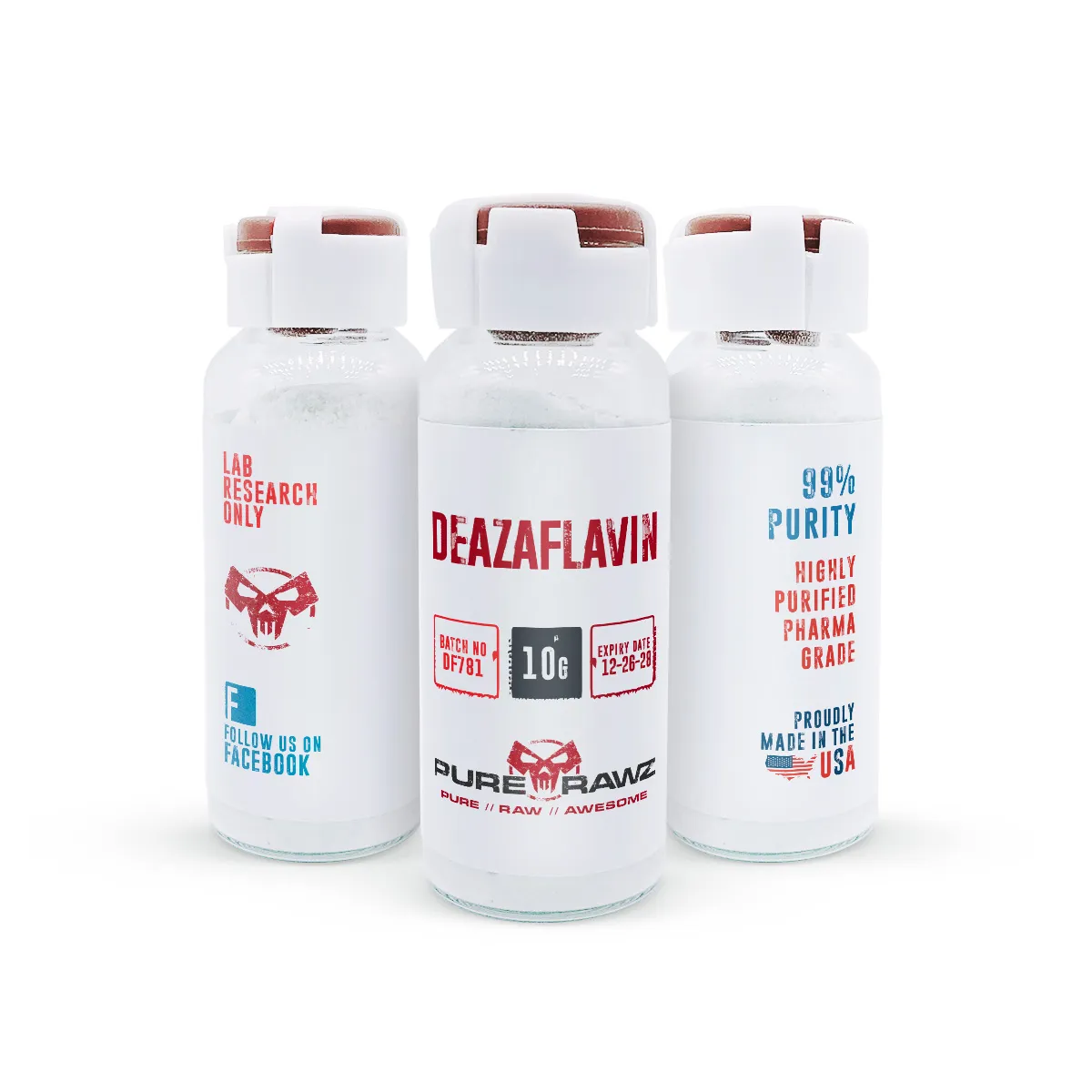


5-Deazaflavin
$119.95
Earn 120 points upon purchasing this product.
✅ 99% Purity – Third-Party Tested
🚚 Free U.S. Shipping on Orders $100+
 Proudly Made in the USA
⚡ Fast & Reliable Shipping
🔒 Secure Checkout Guaranteed
All products are strictly intended for laboratory and research purposes only and are not approved for veterinary or human use.
Description
Overview of 5-Deazaflavin
5-Deazaflavin (commonly referred to simply as Deazaflavin) is a pyridopyrimidine compound structurally derived from the flavin ring system found in riboflavin (vitamin B2). It is generated by substituting the nitrogen-containing aza group at position 5 of the flavin skeleton with a carbon-containing deaza group.
Researchers study 5-deazaflavin primarily because this structural substitution allows the deazaflavin backbone to function in a manner more comparable to the vitamin B3 (nicotinamide/NAD⁺) backbone.
Rather than riboflavin itself. Moreover, research indicates the parent flavin ring system remains chemically stable, positioning 5-deazaflavin as a redox-active scaffold with multiple sites available for chemical derivatization.
Researchers believe that 5-deazaflavin and its derivatives might be useful compounds to study redox cofactor chemistry, electron transfer processes, and flavoprotein enzymology in experimental models.
5-Deazaflavin is intended strictly for laboratory research purposes and is not approved for human or animal consumption.
Proposed Mechanism of Action of 5-Deazaflavin
Research models have characterized 5-deazaflavins as compounds that lack the single-electron reactivity with O₂ that is characteristic of riboflavin-derived coenzymes such as FMN and FAD, while generally exhibiting a more negative redox potential than NAD(P)⁺.
This distinct redox behavior has been studied in relation to naturally occurring 5-deazaflavin cofactors such as F420 and FO, which complement nicotinamide and flavin redox coenzymes in biochemical oxidoreductase systems.
Structural and biochemical research has examined 8-hydroxy-5-deazaflavin (FO) as a light-harvesting chromophore used by DNA photolyase enzymes.
Additionally, as the biosynthetic precursor to coenzyme F420, a redox cofactor studied in methanogenic archaea and select actinobacteria, including Mycobacterium species.
Research models investigating F420-dependent oxidoreductase enzymes have found that the oligoglutamate side-chain length of the cofactor modulates binding affinity to these enzymes.
Chemical & Molecular Properties
| Property | Description |
| Common Name | 5-Deazaflavin |
| Synonyms | Deazaflavin; Pyrimido[4,5-b]quinoline-2,4(1H,3H)-dione |
| Chemical Classification | Pyridopyrimidine; flavin-derived heterocyclic compound |
| ChEBI ID | CHEBI:4342 |
| UNII | K2CC2RHC84 |
| Exact/Monoisotopic Mass | 213.053826 |
| Topological Polar Surface Area | 71.1 Ų |
| Hydrogen Bond Donors | 2 |
| Hydrogen Bond Acceptors | 3 |
| Appearance | Off-white to light brownish-yellow powder |
| Purity (Reference Grade) | ≥98% (HPLC) |
| Analytical Characterization | HPLC, NMR spectroscopy |
Potential Research Applications of 5-Deazaflavin
Researchers investigate 5-deazaflavin under controlled laboratory conditions for the following research applications. Though more extensive study is required.
-
Redox Cofactor and Electron Transfer Research
Used as a reference compound to study oxidoreductase enzyme mechanisms and cofactor-dependent electron transfer processes.
-
F420 Cofactor Biosynthesis Research
Studied as a structural precursor and analog in research examining coenzyme F420 biosynthesis pathways in methanogenic archaea and actinobacteria.
-
Flavoprotein Enzymology Research
Used as a reference standard in protein mechanism studies and flavoprotein chemistry research.
-
Antitumor Structure-Activity Relationship (SAR) Research
Investigated as a synthetic scaffold for developing 5-deazaflavin derivatives studied for kinase inhibition and cytotoxicity in research investigational models.
-
Photobiology and DNA Repair Cofactor Research
Studied in connection with FO, a related 5-deazaflavin cofactor examined for its role as a light-harvesting agent in DNA photolyase research.
Why Buy 5-Deazaflavin Powder from Purerawz?
Purerawz supplies 5-deazaflavin exclusively for laboratory research and analytical applications. Available product documentation may include batch-specific information, certificates of analysis (CoAs), and analytical characterization data to assist researchers in evaluating material identity and quality for experimental use.
As with all research materials, investigators should independently review the available specifications and supporting documentation to determine whether the material is appropriate for their intended laboratory protocols and research objectives.
Frequently Asked Questions
Why does removing a single nitrogen atom from the flavin ring change 5-deazaflavin's redox behavior?
The nitrogen-to-carbon substitution at position 5 removes the site responsible for riboflavin's characteristic single-electron reactivity with oxygen, which is why 5-deazaflavins behave more like NAD(P)⁺-type two-electron carriers than like typical flavin coenzymes such as FMN or FAD.
Why is F420's oligoglutamate tail length studied separately from its redox-active headgroup?
Because research shows the headgroup handles the actual electron transfer chemistry, while the glutamate tail length independently governs how tightly the cofactor binds to its enzyme — these are two structurally and functionally distinct variables researchers can study on their own.
How does FO's role in DNA photolyases connect to its role as an F420 precursor?
FO functions as a light-harvesting chromophore in photolyase enzymes, and separately serves as the starting structure that biosynthetic enzymes convert into F420 — meaning the same molecule sits at the entry point of two very different studied pathways: light-driven DNA repair and redox cofactor biosynthesis.
Why is 5-deazaflavin called a "fake flavin"?
Although it looks structurally similar to flavins like FAD and FMN, replacing the nitrogen at the 5-position with carbon dramatically changes its chemistry. It behaves more like the nicotinamide cofactor NADH than like riboflavin.
Why can't ordinary flavoproteins simply use 5-deazaflavin instead of FAD?
The substitution changes electron transfer properties. Many flavoproteins rely on single-electron (radical) chemistry, while 5-deazaflavin strongly favors two-electron hydride transfer, making it incompatible with many flavin-dependent enzymes.
Reference Links
Graham, D. E., Xu, H., & White, R. H. (2003). Identification of coenzyme M biosynthetic phosphosulfotransferase and characterization of the F420 biosynthetic pathway in methanogenic archaea. Journal of Biological Chemistry, 278(35), 32750–32759. https://doi.org/10.1074/jbc.M304070200
Bashiri, G., Rehan, A. M., Greenwood, D. R., Dickson, J. M., & Baker, E. N. (2010). Metabolic engineering of cofactor F420 production in Mycobacterium smegmatis. PLOS ONE, 5(12), e15803. https://www.ncbi.nlm.nih.gov/pmc/articles/PMC5352752/
Ney, B., Ahmed, F. H., Carere, C. R., Biswas, A., Warden, A. C., Morales, S. E., Pandey, G., Watt, S. J., Oakeshott, J. G., Taylor, M. C., & Greening, C. (2017). The methanogenic redox cofactor F420 is widely synthesized by aerobic soil bacteria. ISME Journal, 11(1), 125–137. https://www.ncbi.nlm.nih.gov/pmc/articles/PMC5623714/
Ibrahim, T. M., et al. (2023). Design, synthesis, and antitumor efficacy of novel 5-deazaflavin derivatives backed by kinase screening, docking, and ADME studies. RSC Advances. https://pmc.ncbi.nlm.nih.gov/articles/PMC10286681/
Coats, J. H., & Chen, S. (2015). Convenient synthesis of deazaflavin cofactor FO and its activity in F420-dependent NADP reductase. Organic & Biomolecular Chemistry, 13(21), 5852–5855. https://doi.org/10.1039/C5OB00365B
Disclaimer:
The products sold by Purerawz are intended solely for laboratory and research purposes. They are not FDA-approved for human or animal consumption, and Purerawz does not sell these compounds for use in humans or animals. All compounds are strictly for use by qualified researchers in controlled, non-clinical laboratory environments in compliance with applicable regulations.

About Team PureRawz
Team PureRawz is dedicated to providing accurate, science-based information on research chemicals, including Peptides, Nootropics, and SARMs. Our team of expert writers, researchers, and editors is committed to delivering reliable, up-to-date content you can trust.
Our mission is to build an educated and informed community spanning researchers, laboratories, and general readers empowering them to make confident, well-informed decisions when selecting the right research chemical.
Related products
-

Fonturacetam Phenylpiracetam Hydrazide 98%
Price range: $25.68 through $71.05 Select options This product has multiple variants. The options may be chosen on the product page -

Emoxypine Succinate
$22.93 Select options This product has multiple variants. The options may be chosen on the product page -

L-Theanine
Price range: $11.45 through $24.57 Select options This product has multiple variants. The options may be chosen on the product page -

Centrophenoxine
$17.47 Select options This product has multiple variants. The options may be chosen on the product page