

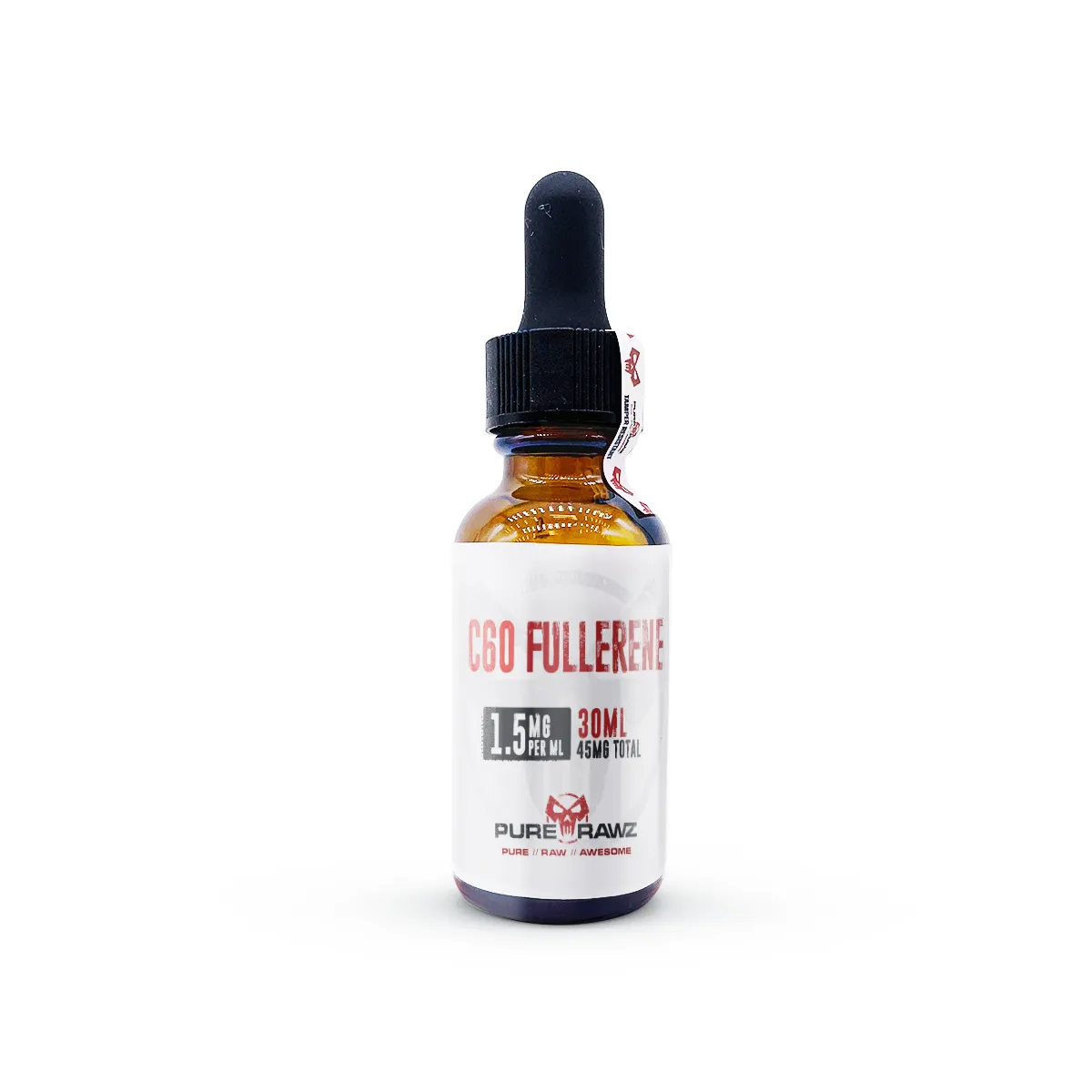


C60 Fullerene
$48.50
Earn 49 points upon purchasing this product.
✅ 99% Purity – Third-Party Tested
🚚 Free U.S. Shipping on Orders $100+
 Proudly Made in the USA
⚡ Fast & Reliable Shipping
🔒 Secure Checkout Guaranteed
All products are strictly intended for laboratory and research purposes only and are not approved for veterinary or human use.
Description
Overview of C60 Fullerene
C60 Fullerene (also known as Buckminsterfullerene or "Buckyball") is an allotrope of carbon composed of 60 carbon atoms arranged in a hollow, spherical cage. It was the first fullerene molecule synthesized, in 1985, by researchers Kroto, Curl, and Smalley.
Researchers study C60 fullerene primarily because its unique closed-cage carbon structure gives it distinctive electron-accepting properties and a documented capacity to interact with reactive oxygen species (ROS).
Researchers believe that C60 fullerene might be a useful compound to study antioxidant mechanisms, mitochondrial bioenergetics, and free radical scavenging processes in experimental models.
C60 Fullerene is intended strictly for laboratory research purposes and is not approved for human or animal consumption.
Proposed Mechanism of Action of C60 Fullerene
Research models have proposed that C60 fullerene's antioxidant activity is based on a proton-absorption mechanism coupled with mild uncoupling of mitochondrial respiration and phosphorylation.
Computational modeling using Density Functional Theory has been used to examine the hypothesis that C60 can acquire a positive charge by absorbing protons internally forming a complex capable of penetrating mitochondrial membranes.
Research on water-soluble pristine C60 fullerene in research models has examined its effects on cell growth inhibition, apoptosis induction, and modulation of glucose-6-phosphate dehydrogenase.
Chemical & Molecular Properties
| Property | Description |
| Common Name | C60 Fullerene |
| Synonyms | Buckminsterfullerene; Buckyball; [60]Fullerene; Footballene; Soccerballene |
| Chemical Classification | Carbon allotrope; closed-cage fullerene |
| Molecular Formula | C₆₀ |
| Molecular Weight | 720.64–720.7 g/mol |
| CAS Number | 99685-96-8 (NTP-confirmed); 131159-39-2 (also used commercially) |
| Appearance | Black to dark brown/black fine powder |
| Density | ~1.6–1.72 g/cm³ |
| Structural Diameter | ~0.7 nm |
| Solubility | Poorly soluble in water; requires solubilization strategies (e.g., fullerenol derivatization, solvent carriers) for aqueous research applications |
| Analytical Characterization | HPLC, UV-Vis spectroscopy, mass spectrometry |
Potential Research Applications of C60 Fullerene
Researchers investigate C60 fullerene under controlled laboratory conditions for the following research applications. Though more extensive study is required.
Antioxidant and Free Radical Scavenging Research
Used as a reference compound to study reactive oxygen species (ROS) scavenging mechanisms and hydroxyl radical inactivation.
Mitochondrial Bioenergetics Research
Investigated for proposed effects on mitochondrial respiration and phosphorylation uncoupling in relation to ROS production.
Aging and Longevity Model Research
Studied in research models in connection with the free-radical theory of aging and comparative lifespan research.
Hepatocellular and Cancer Cell Line Research
Examined in research models for effects on cell growth, apoptosis induction, and redox-related gene expression.
Nanomaterial and Electron-Acceptor Research
Used in materials science research due to its electron-accepting (n-type semiconductor) properties, relevant to organic electronic material studies.
Why Researchers Choose C60 Fullerene Powder from Purerawz?
Purerawz supplies C60 fullerene exclusively for laboratory research and analytical applications. Available product documentation may include batch-specific information, certificates of analysis (CoAs), and analytical characterization data to assist researchers in evaluating material identity and quality for experimental use.
As with all research materials, investigators should independently review the available specifications and supporting documentation to determine whether the material is appropriate for their intended laboratory protocols and research objectives.
Frequently Asked Questions
Why is C60 Fullerene often called a "buckyball"?
C60 Fullerene is nicknamed a buckyball because its molecular structure resembles a geodesic dome, consisting of 60 carbon atoms arranged in interconnected pentagons and hexagons. This unique geometry contributes to its distinctive physical and chemical properties.
Why is C60 Fullerene considered an important nanomaterial?
C60 Fullerene is one of the earliest discovered carbon nanomaterials. Its well-defined spherical structure, nanoscale dimensions, and electronic characteristics have made it a valuable model compound in nanotechnology, materials science, and surface chemistry research.
What analytical techniques are commonly used to characterize C60 Fullerene?
Researchers typically verify the identity and purity of C60 Fullerene using techniques such as high-performance liquid chromatography (HPLC), mass spectrometry (MS), nuclear magnetic resonance (NMR), Raman spectroscopy, ultraviolet-visible (UV-Vis) spectroscopy, and X-ray diffraction (XRD).
Why is C60 Fullerene difficult to dissolve in water?
C60 Fullerene is highly hydrophobic because it consists entirely of carbon atoms with no polar functional groups. As a result, it dissolves much more readily in nonpolar organic solvents such as toluene, benzene, and carbon disulfide than in aqueous solutions.
How is C60 Fullerene used in materials science research?
Researchers investigate C60 Fullerene as a building block for advanced materials, including conductive films, photovoltaic devices, organic semiconductors, molecular electronics, catalysts, and nanocomposites. Its unique electronic structure and stability make it useful for exploring the design of next-generation functional materials.
Reference Links
Chistyakov, V. A., Smirnova, Yu. O., Prazdnova, E. V., & Soldatov, A. V. (2013). Possible mechanisms of fullerene C60 antioxidant action. BioMed Research International, 2013, Article 821498. https://doi.org/10.1155/2013/821498
National Toxicology Program. (2020). NTP technical report on the toxicity studies of fullerene C60 (1 μm and 50 nm) (CASRN 99685-96-8) administered by nose-only inhalation to Wistar Han [Crl:WI (Han)] rats and B6C3F1/N mice: Toxicity Report 87. National Institute of Environmental Health Sciences, National Institutes of Health. https://www.ncbi.nlm.nih.gov/books/NBK561344/
Grebowski, J., Kazmierska, P., & Krokosz, A. (2020). Water-soluble pristine C60 fullerene inhibits liver alterations associated with hepatocellular carcinoma in rat. International Journal of Molecular Sciences. https://www.ncbi.nlm.nih.gov/pmc/articles/PMC7559840/
Halenova, T., et al. (2021). Toxicity and antioxidant activity of fullerenol C60,70 with low number of oxygen substituents. Nanomaterials. https://www.ncbi.nlm.nih.gov/pmc/articles/PMC8232284/
Kroto, H. W., Heath, J. R., O'Brien, S. C., Curl, R. F., & Smalley, R. E. (1985). C60: Buckminsterfullerene. Nature, 318(6042), 162–163. https://doi.org/10.1038/318162a0
Disclaimer:
The products sold by Purerawz are intended solely for laboratory and research purposes. They are not FDA-approved for human or animal consumption, and Purerawz does not sell these compounds for use in humans or animals. All compounds are strictly for use by qualified researchers in controlled, non-clinical laboratory environments in compliance with applicable regulations.

About Team PureRawz
Team PureRawz is dedicated to providing accurate, science-based information on research chemicals, including Peptides, Nootropics, and SARMs. Our team of expert writers, researchers, and editors is committed to delivering reliable, up-to-date content you can trust.
Our mission is to build an educated and informed community spanning researchers, laboratories, and general readers empowering them to make confident, well-informed decisions when selecting the right research chemical.
Related products
-

Stenabolic (SR-9009)
Price range: $39.14 through $195.80 Select options This product has multiple variants. The options may be chosen on the product page -

Yohimbine HCL
Price range: $23.29 through $61.86 Select options This product has multiple variants. The options may be chosen on the product page -

Andarine (S-4)
Price range: $41.97 through $153.54 Select options This product has multiple variants. The options may be chosen on the product page -

Oroxylin A
Price range: $14.48 through $27.79 Select options This product has multiple variants. The options may be chosen on the product page