



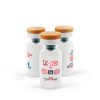
CJC-1295 With DAC
Price range: $44.75 through $117.55
Earn 45 - 118 points upon purchasing this product.
✅ 99% Purity – Third-Party Tested
🚚 Free U.S. Shipping on Orders $100+
 Proudly Made in the USA
⚡ Fast & Reliable Shipping
🔒 Secure Checkout Guaranteed
All products are strictly intended for laboratory and research purposes only and are not approved for veterinary or human use.
Description
CJC-1295 with DAC
CJC-1295 with DAC (Drug Affinity Complex) is a synthetic, long-acting analog of growth hormone-releasing hormone (GHRH). It is classified as a modified peptide hormone.
The compound is structurally derived from the first 29 amino acids of endogenous GHRH, with the addition of a maleimidopropionic acid (MPA) side chain. The side chain is known as the Drug Affinity Complex.
Researchers believe that DAC enables covalent binding to circulating serum albumin. This modification is of considerable preclinical interest due to the dramatically extended half-life it confers relative to unmodified GHRH analogs.
In preclinical models, CJC-1295 with DAC has been investigated for its role in modulating the hypothalamic-pituitary axis, specifically in the context of growth hormone secretion dynamics.
The DAC modification allows the peptide to resist enzymatic cleavage by dipeptidyl peptidase IV (DPP-IV). DPP-IV has made it a valuable investigational compound for researchers studying sustained GHRH receptor activity over extended timeframes.
Researchers study this compound for its potential research in endocrinology and metabolic essays.
Disclaimer:
The products sold by Purerawz are intended solely for laboratory and research purposes. They are not FDA-approved for human or animal consumption, and Purerawz does not sell these compounds for use in humans or animals. All compounds are strictly for use by qualified researchers in controlled, non-clinical laboratory environments in compliance with applicable regulations.
Chemical and Molecular Properties
| Compound Name | CJC-1295 with DAC |
| Compound Classification | Synthetic GHRH (Growth Hormone-Releasing Hormone) Analog |
| PubChem CID | 56841945 |
| Molecular Formula | C₁₆₅H₂₆₉N₄₇O₄₆ |
| Molecular Weight | 3647.2 g/mol |
| Chemical Structure Type | Peptide–Drug Affinity Complex (DAC) Conjugate |
| Mechanistic Classification | Long-Acting GHRH Receptor Agonist Research Peptide |
| DAC Function | Albumin-binding modification designed to extend peptide half-life |
| Biological Half-Life | ~6–8 days (with DAC, albumin-bound); | ~30 minutes (unmodified GHRH(1-29) | analogs for comparison) |
| Solubility | Typically soluble in bacteriostatic water, sterile water, or dilute acetic acid for laboratory preparation |
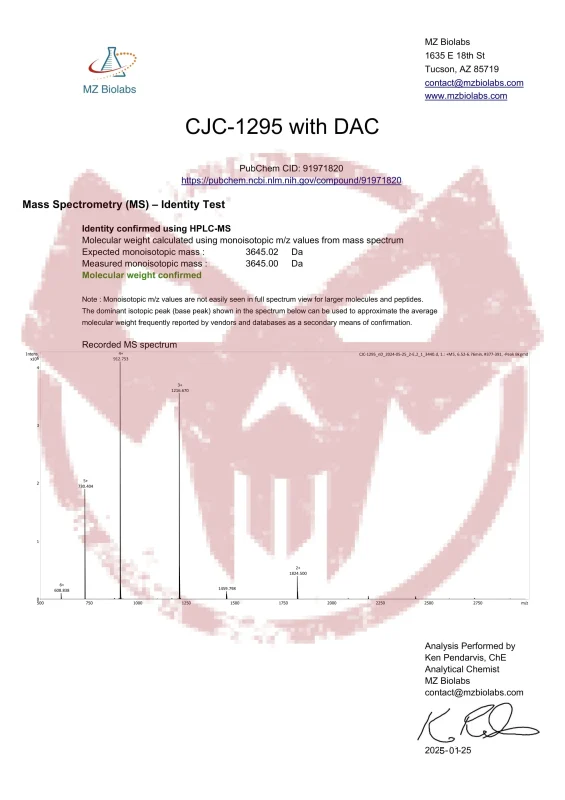
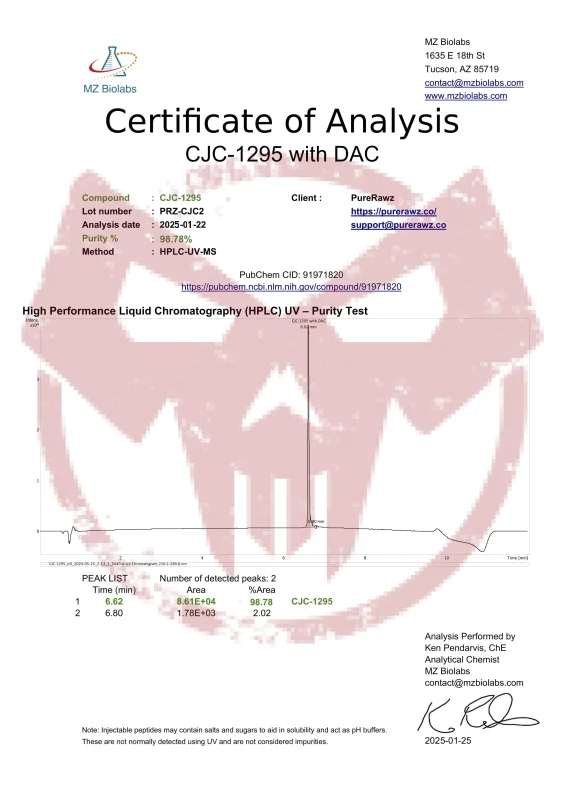
| Purity | 99% by HPLC |
| CAS | 446262-90-4 |
| Synonyms | CJC 1295, DAC:GRF, CJC1295 |
| Peptide Characteristics | Highly flexible synthetic peptide analog with DAC-mediated albumin affinity |
| Primary Research Focus | Somatotropic axis signaling, IGF-1 pathway studies, peptide pharmacokinetics, endocrine signaling research |
Proposed Working Mechanism of CJC-1295 with DAC
Preclinical studies suggest that CJC-1295 with DAC exerts its primary investigational effects through agonist binding at the GHRH receptor (GHRHR), a G protein-coupled receptor expressed on somatotroph cells of the anterior pituitary gland.
Upon receptor binding, research models indicate activation of the adenylyl cyclase–cAMP–PKA signaling pathway, which is associated with stimulation of growth hormone (GH) synthesis and pulsatile secretion in preclinical subjects.
The DAC modification introduces a unique pharmacokinetic profile. The maleimidopropionic acid moiety covalently conjugates with the cysteine-34 residue of endogenous serum albumin in preclinical models.
This albumin-binding mechanism effectively creates a circulating depot of the peptide to prolong receptor engagement and sustain elevated GH pulse amplitude.
Downstream from GHRHR activation, preclinical findings point to downstream effects on insulin-like growth factor 1 (IGF-1) secretion from hepatic research models.
Investigational Scope and Preclinical Research Areas
CJC-1295 with DAC is being studied for the following research applications in investigational models.
-
Somatotropic Axis Activity and Growth Hormone Secretion Research
Preclinical findings suggest CJC-1295 with DAC may function as a sustained GHRH receptor agonist research compound, enabling investigation of pulsatile growth hormone secretion dynamics across extended experimental timeframes in laboratory models.
-
IGF-1 Pathway and Downstream Signaling Investigations
Data from preclinical in vivo studies indicate a correlation between CJC-1295 and DAC administration and elevated IGF-1 levels, supporting its application in research examining hepatic somatotropic signaling, the JAK2/STAT5 pathway, and downstream anabolic signaling mechanisms.
-
Metabolic Regulation Research
Preclinical experimental models have been utilized to investigate the compound’s potential effects on lipid metabolism and lean tissue composition.
-
Somatotropic Axis Function in Maturational Research Models
GHRH analog compounds, including CJC-1295 with DAC, have been examined in preclinical models of age-related growth hormone decline (somatopause), where attenuation of somatotropic axis activity remains an established area of investigational study.
-
Pharmacokinetic Characterization and Albumin-Conjugated Peptide Modeling
The albumin-binding DAC technology has generated investigational interest as a model system for studying the pharmacokinetic behavior of covalently albumin-conjugated peptides, including parameters related to bioavailability, tissue distribution, and enzymatic stability in biological research settings.
Risk and Handling
- Laboratory Safety & Handling Protocol
This compound is for research use only. It should be handled exclusively by qualified researchers in a controlled laboratory environment, in strict compliance with institutional biosafety protocols and applicable regulatory requirements.
- Regulatory Status FDA:
CJC-1295 with DAC is an investigational peptide and is not approved by the U.S. Food and Drug Administration (FDA) for any therapeutic, diagnostic, or prophylactic purpose in humans or animals. It is not classified as a dietary supplement and does not hold IND (Investigational New Drug) status for general research distribution. Researchers operating within the United States must ensure that all handling and use complies with applicable federal, state, and institutional regulations governing investigational compounds.
- Regulatory Status WADA:
The World Anti-Doping Agency (WADA) classifies GHRH analogs, including CJC-1295 with DAC, under Section 2 — Peptide Hormones, Growth Factors, Related Substances and Mimetics of the WADA Prohibited List. This compound is prohibited both in-competition and out-of-competition under the WADA Code. Researchers affiliated with sporting or anti-doping organizations are advised to be aware of institutional compliance obligations when handling this compound in a research context.
Storage Conditions:
- Store lyophilized (powder) form at −20°C in a frost-free freezer, protected from light and moisture.
- Reconstituted solutions should be stored at 2–8°C (refrigerated) and used within the timeframe specified in the applicable SDS.
- Avoid repeated freeze-thaw cycles, which may compromise compound integrity
- Keep in original sealed container until use; store away from oxidizing agents and strong acids
Handling Precautions:
- Appropriate personal protective equipment (PPE) must be worn during all handling procedures, including nitrile gloves, a laboratory coat, and eye protection.
- Work in a laminar flow hood or equivalent controlled environment when reconstituting or aliquoting
- Avoid inhalation of lyophilized powder; use appropriate respiratory precautions if aerosolization risk exists
- Dispose of all materials in accordance with institutional and regulatory waste disposal guidelines for peptide research compounds
Researchers are advised to consult the Safety Data Sheet (SDS) prior to handling this or any investigational compound. All standard laboratory biosafety practices apply.
Why Customers Trust Purerawz for CJC-1295 With DAC
Researchers require compound integrity to be verifiable, not assumed. Each batch of CJC-1295 with DAC supplied by Purerawz undergoes rigorous analytical testing, with a Certificate of Analysis (COA) available for independent verification prior to use.
Purerawz maintains a 99%+ purity standard, confirmed through independent batch testing protocols using high-performance liquid chromatography (HPLC) and mass spectrometry, where applicable.
Researchers can access batch-specific COA documentation to validate compound integrity, molecular identity, and purity levels before incorporating the compound into any investigational protocol. Purerawz supplies CJC-1295 with DAC in both lyophilized powder and solution formats to support varied laboratory workflows, with all materials packaged and labeled in accordance with research-grade handling standards.
Frequently Asked Questions
What is the significance of pulsatile growth hormone secretion in CJC-1295 with DAC research?
Pulsatile growth hormone secretion is considered an important component of normal somatotropic signaling regulation. Researchers investigate CJC-1295 with DAC in experimental models to better understand how sustained GHRH receptor stimulation may influence the timing, amplitude, and frequency of endogenous growth hormone release patterns over extended observation periods.
Why is albumin binding important in peptide-based research compounds?
Albumin binding is frequently studied because it may improve peptide stability and prolong systemic circulation time in biological environments. In the case of CJC-1295 with DAC, the albumin-binding mechanism has attracted research interest for its potential role in reducing enzymatic degradation and supporting sustained pharmacokinetic activity in preclinical models.
How is CJC-1295 with DAC utilized in endocrine signaling investigations?
Researchers commonly employ CJC-1295 with DAC in studies examining interactions between the hypothalamic-pituitary axis, growth hormone signaling pathways, and downstream endocrine mediators. Experimental investigations may focus on feedback regulation mechanisms, receptor activation patterns, and hormone-responsive cellular signaling processes.
What makes long-acting peptide analogs valuable in research environments?
Long-acting peptide analogs are often used in experimental settings where prolonged biological activity is desirable for observing signaling responses across extended timelines. CJC-1295 with DAC is frequently referenced in pharmacokinetic and endocrine research due to its sustained activity profile and relevance in long-duration peptide exposure studies.
What is the difference between CJC-1295 with DAC and CJC-1295 without DAC in preclinical research settings?
CJC-1295 with DAC contains the Drug Affinity Complex modification enabling covalent albumin binding, which extends functional half-life to approximately 6–8 days in investigational models. CJC-1295 without DAC (Modified GRF 1-29) has a half-life of approximately 30 minutes and produces discrete pulsatile GH release patterns. Researchers select between the two based on whether their protocol requires sustained GH elevation or biomimetic pulsatile secretion dynamics.
Disclaimer:
This information is for educational purposes only and not medical advice. Products are for research use only. Research must follow IRB or IACUC guidelines. Verify information independently before purchasing. By ordering, you agree to our Terms and Conditions. If you are not 100% satisfied with the product you received, please contact us at support@PureRawz.co
ATTENTION: All our products are for LABORATORY AND RESEARCH PURPOSES ONLY, not for veterinary or human use
Reference Links
Teichman, S. L., Neale, A., Lawrence, B., Gagnon, C., Castaigne, J. P., & Frohman, L. A. (2006). Prolonged stimulation of growth hormone (GH) and insulin-like growth factor I secretion by CJC-1295, a long-acting analog of growth hormone-releasing hormone, in healthy adults. The Journal of Clinical Endocrinology & Metabolism, 91(3), 799–805. National Institutes of Health. https://pubmed.ncbi.nlm.nih.gov/16352683/
[Cited for receptor pharmacology and pharmacokinetic context only. Documents human clinical research and does not apply to the research-grade formulation supplied here.]
Ionescu, M., Frohman, L. A., & Ho, K. K. Y. (2006). Pulsatile secretion of growth hormone persists during continuous stimulation by CJC-1295. The Journal of Clinical Endocrinology & Metabolism, 91(12), 4792–4797. National Institutes of Health. https://pubmed.ncbi.nlm.nih.gov/17018654/
Chen, K. Y., Muniyappa, R., Abel, B. S., Mullins, K. P., Staker, P., Brychta, R. J., Zhao, X., Ring, M., Psota, T. L., Cone, R. D., & others. (2009). Activation of the GH/IGF-1 axis by CJC-1295 in healthy subjects results in serum protein profile changes. Clinical Proteomics, 5(1–2), 49–58. National Institutes of Health. https://pmc.ncbi.nlm.nih.gov/articles/PMC2787983/
Sackmann-Sala, L., et al. (2009). Activation of the GH/IGF-1 axis by CJC-1295, a long-lasting GHRH analog, results in serum protein profile changes in healthy adults. Growth Hormone & IGF Research, 19(6), 471–477. https://pubmed.ncbi.nlm.nih.gov/19467877/

About Team PureRawz
Team PureRawz is dedicated to providing accurate, science-based information on research chemicals, including Peptides, Nootropics, and SARMs. Our team of expert writers, researchers, and editors is committed to delivering reliable, up-to-date content you can trust.
Our mission is to build an educated and informed community spanning researchers, laboratories, and general readers empowering them to make confident, well-informed decisions when selecting the right research chemical.
Related products
-

Thymalin
Price range: $76.92 through $321.92 Select options This product has multiple variants. The options may be chosen on the product page -

KP-102
Price range: $35.50 through $127.32 Select options This product has multiple variants. The options may be chosen on the product page -

Spartan 1 (Mod GRF 1-29/CJC-1295 No Dac + Hexarelin)
$103.28 Select options This product has multiple variants. The options may be chosen on the product page -
Ipamorelin
Price range: $29.23 through $111.58 Select options This product has multiple variants. The options may be chosen on the product page