

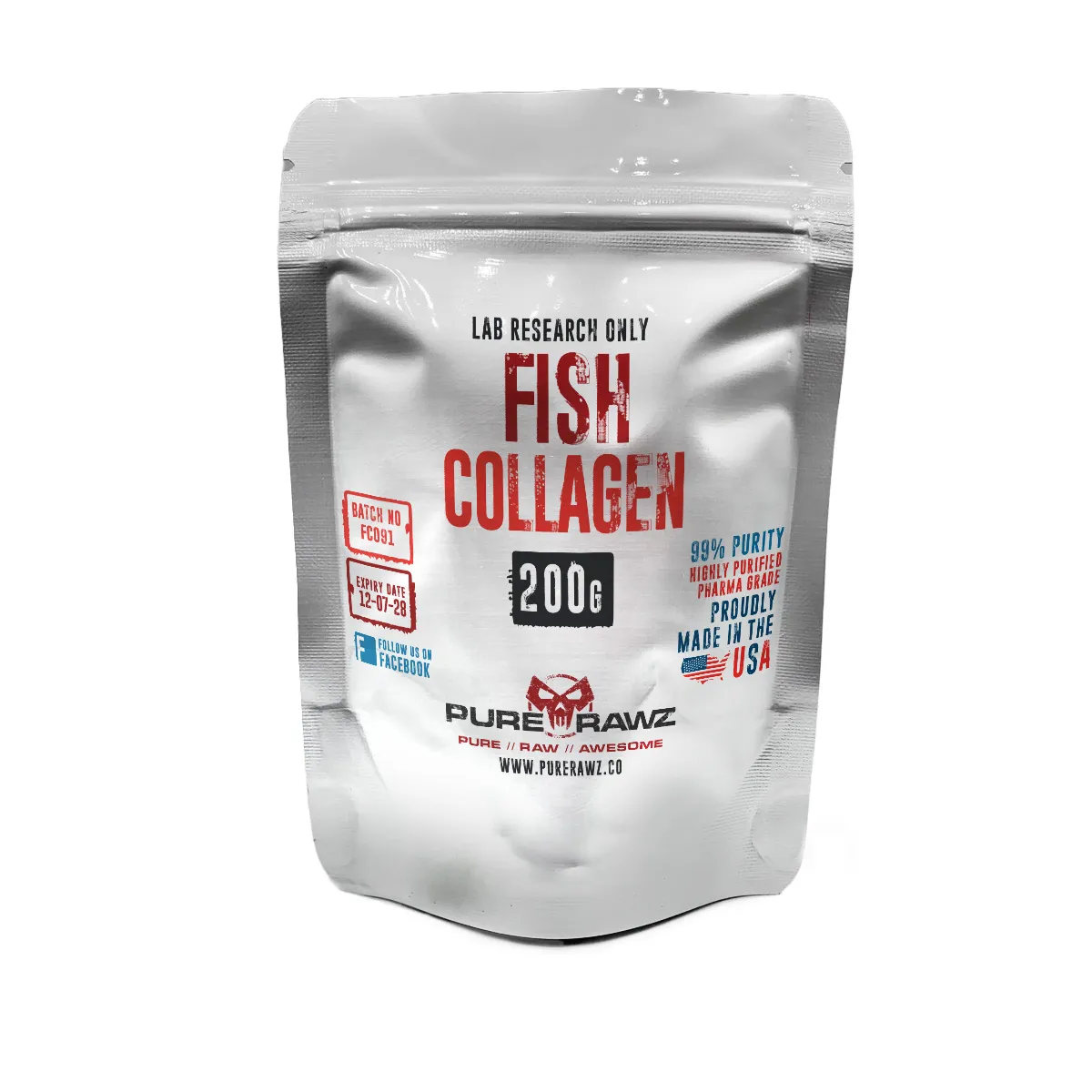

Fish Collagen Powder
$38.50
Earn 39 points upon purchasing this product.
✅ 99% Purity – Third-Party Tested
🚚 Free U.S. Shipping on Orders $100+
 Proudly Made in the USA
⚡ Fast & Reliable Shipping
🔒 Secure Checkout Guaranteed
All products are strictly intended for laboratory and research purposes only and are not approved for veterinary or human use.
Description
Overview of Fish Collagen Powder
Fish collagen powder is a purified collagen ingredient primarily extracted from fish skin, scales, and bones.
Researchers study fish collagen powder because it serves as a marine-derived source of collagen peptides and biomaterial. Researchers use it to investigate extracellular matrix (ECM) biology studies, collagen metabolism investigations, and cell–matrix interactions in preclinical experimental models.
Fish collagen powder is also studied for peptide characterization, bioavailability, and sustainable biomaterial development. These investigations are intended to advance scientific understanding and do not establish therapeutic efficacy or support specific health claims.
About Fish Collagen Powdered Form
Researchers often study fish collagen in powder form because it provides a standardized, stable, and easy-to-handle format for laboratory investigations.
Powdered fish collagen can be accurately weighed, dissolved at defined concentrations, incorporated into cell culture media, hydrogels, and biomaterial scaffolds. Or analyzed for peptide composition, molecular weight distribution, and physicochemical properties.
Its consistent formulation also supports reproducibility across experiments, making it a practical research material for studies involving extracellular matrix biology, biomaterials, tissue engineering, and collagen peptide characterization.
Proposed Mechanism of Action of Fish Collagen Powder
Current evidence suggests that fish collagen peptides may function through several mechanisms. These mechanisms remain under investigation and should not be interpreted as confirmed clinical effects.
1. Extracellular Matrix (ECM) Interactions
Fish collagen is studied for its role as a structural extracellular matrix (ECM) protein.
In experimental models, collagen-derived peptides are investigated for their interactions with fibroblasts and their potential influence on ECM organization, collagen turnover, and matrix remodeling.
Researchers also examine biomarkers such as matrix metalloproteinases (MMPs) and tissue inhibitors of metalloproteinases (TIMPs) to better understand matrix dynamics.
2. Cell Signaling Research
Laboratory studies investigate whether collagen peptides can influence cellular signaling involved in connective tissue biology.
Frequently studied pathways include TGF-β, PI3K/Akt, MAPK, integrin-mediated signaling, and the RUNX2 transcription factor. These studies aim to understand molecular responses and gene regulation in controlled experimental systems.
3. Biomaterial and Tissue Engineering Research
Fish collagen is investigated as a biocompatible and biodegradable biomaterial. Researchers evaluate its scaffold-forming properties and mechanical characteristics.
The type 1 peptide is also being researched for its ability to support cell attachment in tissue engineering, regenerative medicine, and three-dimensional cell culture research.
These investigations focus on material performance rather than therapeutic applications.
Potential Research Applications of Fish Collagen Powder
Fish collagen powder is commonly used in research for the following applications:
-
Biomaterials Research:
Investigating collagen-based hydrogels, films, sponges, and scaffold materials for laboratory studies.
-
Protein Characterization:
Analyzing collagen peptide composition, molecular weight distribution, amino acid profiles, and structural properties.
-
Analytical Method Development:
Validating collagen extraction, purification, and characterization techniques using methods such as HPLC, mass spectrometry (MS), FTIR, SDS-PAGE, and SEM.
-
Cell Culture Research:
Using collagen-coated surfaces and matrices to investigate cell adhesion, proliferation, migration, and differentiation under controlled laboratory conditions.
-
Biomaterial Engineering:
Studying material properties such as biocompatibility, biodegradability, mechanical strength, and cross-linking efficiency.
-
Marine Biomaterials Research:
Exploring fish-derived collagen as a sustainable biomaterial obtained from marine processing by-products.
-
Quality Control Research:
Assessing purity, physicochemical characteristics, and batch-to-batch consistency for research-grade collagen materials.
Why Researchers Trust Purerawz for Online Fish Collagen Powder?
Purerawz supplies fish collagen powder for both individual and bulk purchase requirements. We provide product details to help customers understand the available options and place orders based on their specific needs. Whether you are purchasing for personal use, retail, or manufacturing, our goal is to offer a straightforward ordering process and reliable product information.
FAQs
Why is fish collagen powder preferred in biomaterials research?
Fish collagen powder is widely studied because it is easy to process into hydrogels, films, sponges, and three-dimensional scaffolds. Its biocompatibility and biodegradability make it a valuable material for biomaterials and tissue engineering research.
What type of collagen is found in fish collagen powder?
Fish collagen powder predominantly contains Type I collagen, the most abundant collagen type in fish skin, scales, and bones. Researchers commonly use it to study collagen structure, peptide composition, and extracellular matrix (ECM) biology.
What Is Fish Collagen Made Of?
Fish collagen consists of long protein chains rich in glycine, proline, and hydroxyproline, which form a characteristic triple-helical structure. These amino acids contribute to collagen's structural stability and mechanical properties. Researchers analyze its amino acid composition, molecular weight, and physicochemical characteristics using various laboratory techniques.
How Is Fish Collagen Extracted?
Fish collagen is extracted from fish skin, scales, or bones using acid extraction, enzymatic extraction, or a combination of both methods. The extracted collagen is then purified, filtered, and dried into powder form. Additional enzymatic hydrolysis may be performed to produce lower-molecular-weight collagen peptides for laboratory research.
How Does Fish Collagen Compare With Other Collagen Sources?
Fish collagen is comparable to bovine and porcine collagen but is derived from marine sources. It primarily contains Type I collagen and generally has lower thermal stability due to differences in amino acid composition. Researchers compare collagen sources based on their structural properties, extraction methods, and suitability for specific biomaterial and laboratory applications.
Is fish collagen powder assigned a PubChem CID?
No. Fish collagen powder is a complex mixture of collagen proteins and peptides rather than a single defined chemical compound. Therefore, it does not have a unique PubChem Compound CID.
FDA Status
Fish collagen powder is generally marketed as a dietary supplement or food ingredient, not as an FDA-approved medication.
Disclaimer
This information is provided for educational and scientific reference purposes only.
All products sold by PureRawz are intended strictly for laboratory and research use. These materials are not approved by the U.S. Food and Drug Administration (FDA) for human or veterinary use.
Any research involving this compound should be conducted by qualified professionals and must comply with applicable regulatory guidelines, including Institutional Review Board (IRB) or Institutional Animal Care and Use Committee (IACUC) oversight where required.
By completing a purchase, you agree to the PureRawz Terms and Conditions.
To know more about the product, contact: support@purerawz.co
Reference Links
Carvalho, A. M., & Marques, A. P. (2020). Fish collagen-based biomaterials for tissue engineering and regenerative medicine. Marine Drugs, 18(8), 408. National Center for Biotechnology Information. https://pmc.ncbi.nlm.nih.gov/articles/PMC7460559/
Felician, F. F., Xia, C., Qi, W., Xu, H., Collin, A., & others. (2020). Collagen from marine biological sources and medical applications. Chemosphere, 260, 127617. National Library of Medicine. https://pubmed.ncbi.nlm.nih.gov/32345036/
Silva, T. H., Moreira-Silva, J., Marques, A. L. P., Domingues, A., Bayon, Y., & Reis, R. L. (2014). Marine origin collagens and its potential applications. Marine Drugs, 12(12), 5881–5901. National Center for Biotechnology Information. https://pmc.ncbi.nlm.nih.gov/articles/PMC4274690/

About Team PureRawz
Team PureRawz is dedicated to providing accurate, science-based information on research chemicals, including Peptides, Nootropics, and SARMs. Our team of expert writers, researchers, and editors is committed to delivering reliable, up-to-date content you can trust.
Our mission is to build an educated and informed community spanning researchers, laboratories, and general readers empowering them to make confident, well-informed decisions when selecting the right research chemical.
Related products
-

Hexarelin
Price range: $34.98 through $72.86 Select options This product has multiple variants. The options may be chosen on the product page -

IGF-1 DES
Price range: $109.93 through $138.42 Select options This product has multiple variants. The options may be chosen on the product page -

Thymosin Alpha 1
Price range: $79.45 through $424.10 Select options This product has multiple variants. The options may be chosen on the product page -

Adipotide
Price range: $50.62 through $119.07 Select options This product has multiple variants. The options may be chosen on the product page