

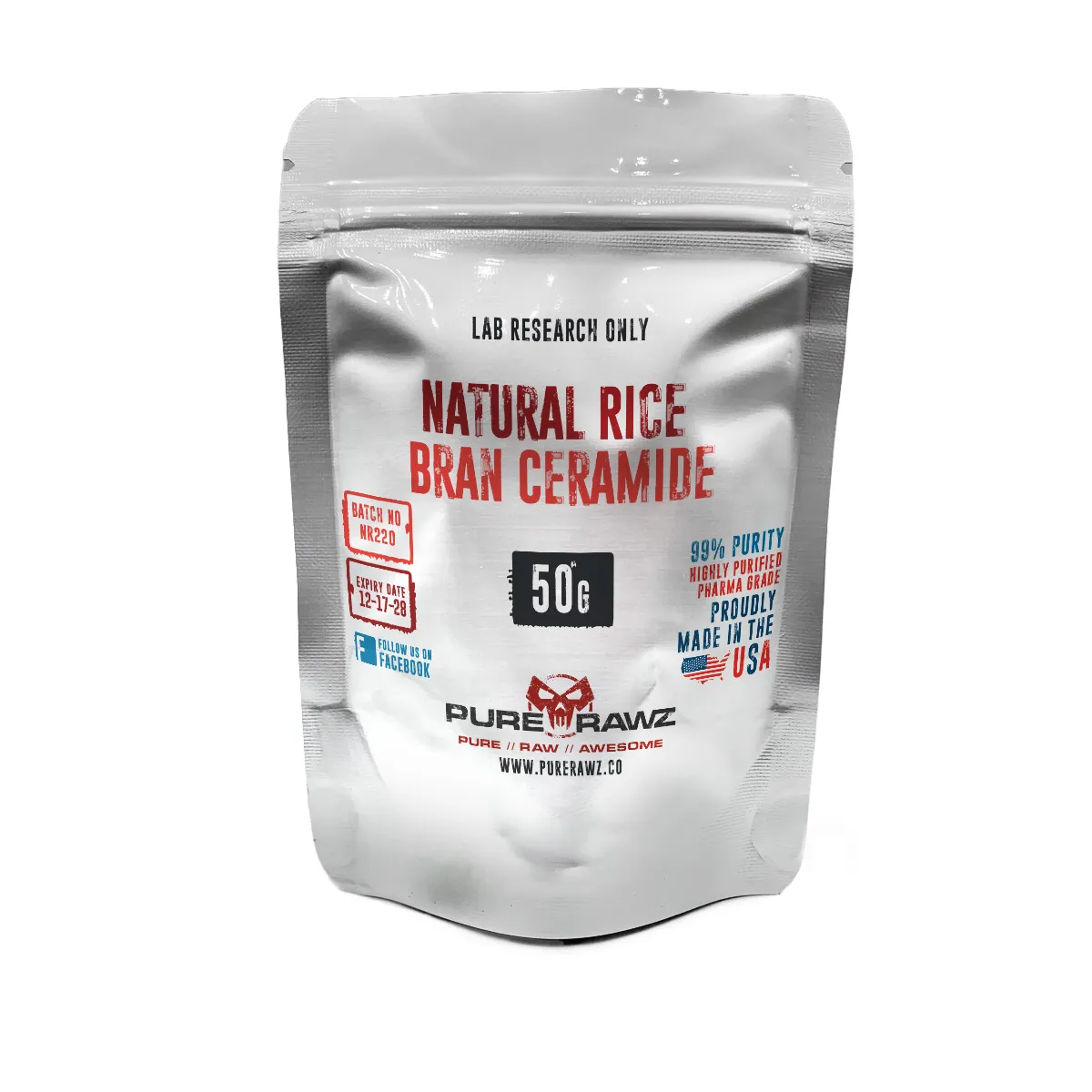

Natural Rice Bran Ceramide
$47.50
Earn 48 points upon purchasing this product.
✅ 99% Purity – Third-Party Tested
🚚 Free U.S. Shipping on Orders $100+
 Proudly Made in the USA
⚡ Fast & Reliable Shipping
🔒 Secure Checkout Guaranteed
All products are strictly intended for laboratory and research purposes only and are not approved for veterinary or human use.
Description
Natural Rice Bran Ceramide Overview
Natural Rice Bran Ceramide is a plant-derived complex of ceramides and glucosylceramides naturally found in the bran layer of Oryza sativa (rice).
These sphingolipids are structural membrane lipids that have attracted scientific interest for their role in skin barrier studies, sphingolipid metabolism investigations, and lipid signaling studies.
The ingredient is also evaluated in cosmetic science, formulation research, and plant sphingolipid studies to characterize its physicochemical properties and potential applications in laboratory settings.
Unlike single purified compounds, natural rice bran ceramide consists of multiple molecular species that vary in sphingoid base composition, fatty acid chain length, and degree of hydroxylation. This molecular diversity is an important consideration during analytical characterization and experimental research.
Note:
Natural Rice Bran Ceramide is discussed here for educational and research purposes only. Current evidence includes laboratory, analytical, and limited clinical research. This information should not be interpreted as medical advice or as evidence of disease treatment, prevention, or therapeutic efficacy.
Proposed Mechanism of Action of Natural Rice Bran Ceramide
Current laboratory, and analytical research has investigated whether rice bran-derived ceramides and glucosylceramides may support epidermal lipid organization and skin barrier function.
However, the underlying biological mechanisms remain under investigation, and available evidence is still evolving.
Laboratory studies investigate its interactions with keratinocytes, the stratum corneum, lipid lamellae, and sphingolipid metabolism. This includes enzymes such as ceramide synthase, glucosylceramide synthase, and sphingomyelinase.
Researchers also evaluate biomarkers including transepidermal water loss (TEWL), skin hydration, and lipidomic profiles using techniques such as LC-MS/MS and UHPLC-MS/MS.
These proposed mechanisms are based on experimental research and remain under investigation.
Chemical and Molecular Properties of Natural Rice Bran Ceramide
| Property | Description |
| Common Name | Natural Rice Bran Ceramide |
| Source | Rice bran (Oryza sativa) |
| Chemical Classification | Plant-derived sphingolipid complex |
| Major Components | Ceramides and glucosylceramides |
| PubChem CID | Not available (complex natural mixture; no single CID assigned) |
| PubMed Search | https://pubmed.ncbi.nlm.nih.gov/?term=rice+bran+ceramide |
| PubChem Search | https://pubchem.ncbi.nlm.nih.gov/?term=ceramide |
| Molecular Formula | Not applicable (composition varies among ceramide species) |
| Molecular Weight | Variable (approximately 500–900 Da depending on individual ceramide species) |
| CAS Number | No universal CAS number for the natural mixture |
| Appearance | White to off-white powder |
| Odor | Mild to odorless |
| Solubility | Soluble in ethanol, methanol, chloroform, and DMSO; poorly soluble in water |
| Chemical Nature | Amphiphilic lipid |
| Functional Groups | Amide bond, hydroxyl groups, long-chain fatty acid residues |
| Backbone Structure | Sphingoid (phytosphingosine) backbone linked to fatty acids |
| Lipophilicity | High |
| Water Solubility | Very low |
| Melting Point | Variable depending on molecular species |
| Stability | Stable under cool, dry conditions; protect from heat, moisture, and oxidation |
| Analytical Characterization | Typically characterized using LC-MS/MS, UHPLC-MS/MS, HPLC, and lipidomic analysis |
Experimental Research Applications of Natural Rice Bran Ceramide
Researchers investigate this plant-derived sphingolipid complex to understand its physicochemical properties in experimental models better.
-
Epidermal Barrier Research
Researchers investigate Natural Rice Bran Ceramide to understand epidermal lipid organization, stratum corneum structure, and barrier-related biomarkers such as transepidermal water loss (TEWL) in experimental models.
-
Sphingolipid Metabolism Research:
Studies examine how plant-derived ceramides and glucosylceramides interact with sphingolipid metabolism, including enzymes such as ceramide synthase and glucosylceramide synthase.
-
Keratinocyte Research:
Laboratory models use rice bran ceramides to explore keratinocyte differentiation, membrane lipid composition, and cellular signaling involved in epidermal homeostasis.
-
Lipidomics and Analytical Science:
Researchers characterize ceramide molecular species using LC-MS/MS, UHPLC-MS/MS, and other lipidomic techniques to identify and quantify sphingolipids.
-
Cosmetic Formulation Research:
Experimental studies evaluate compatibility with topical formulations, emulsion stability, and interactions with other skin barrier lipids during product development.
-
Plant Lipid Research:
Rice bran ceramides are studied as naturally occurring plant sphingolipids to compare their composition, structure, and physicochemical properties with ceramides from other botanical sources.
Educational Use Only: These research applications are based on laboratory and analytical studies and should not be interpreted as evidence of clinical efficacy or therapeutic benefit.
Most published evidence regarding Natural Rice Bran Ceramide originates from laboratory investigations, analytical studies, and limited clinical research. Experimental findings may not directly translate to human biological outcomes. Variability in extraction methods, rice cultivar, analytical methodology, and ceramide composition can also influence reported results. Additional well-designed clinical studies are necessary to further characterize its biological properties.
Why Buy Natural Rice Bran Ceramide from Purerawz?
Purerawz offers Natural Rice Bran Ceramide for research and laboratory applications, with an emphasis on product transparency and quality documentation.
Product specifications, batch information, and available analytical data help researchers evaluate material suitability for their intended studies.
As with all research materials, users should review the product documentation to ensure it meets the requirements of their specific application.
FAQs
How is Natural Rice Bran Ceramide extracted for research?
Researchers commonly isolate rice bran ceramides using solvent extraction followed by purification and analytical characterization. The extraction method can influence the resulting sphingolipid profile.
Why is lipidomics important in Natural Rice Bran Ceramide research?
Lipidomics enables researchers to identify and quantify individual ceramide species, compare molecular profiles, and study changes in sphingolipid composition using advanced mass spectrometry.
What is the difference between ceramides and glucosylceramides?
Ceramides are core sphingolipids, while glucosylceramides contain an attached glucose molecule. Both occur naturally in rice bran and are investigated for their structural and biological properties.
Why is molecular diversity important in rice-derived ceramides?
Rice bran contains multiple ceramide molecular species that differ in sphingoid bases and fatty acid chains. Researchers investigate this diversity to better understand sphingolipid composition and physicochemical characteristics.
What factors can influence the composition of Natural Rice Bran Ceramide?
The ceramide profile may vary depending on rice variety, cultivation conditions, extraction methods, processing techniques, and storage conditions.
How is Natural Rice Bran Ceramide characterized in the laboratory?
Scientists combine chromatographic techniques with mass spectrometry to identify individual sphingolipid species, determine molecular composition, and evaluate batch consistency.
What makes rice bran a valuable source of plant sphingolipids?
Rice bran naturally contains diverse sphingolipids, including ceramides and glucosylceramides, making it a useful source for investigating plant lipid composition and membrane biology.
Disclaimer
All products sold by Purerawz are intended for laboratory and research purposes only and are not approved for human consumption, veterinary use, or any other use. Products are not evaluated by the FDA and are not intended to diagnose, treat, cure, or prevent any disease. Customers assume full responsibility for the lawful use of these products in accordance with all applicable federal, state, and local regulations.
Reference Links
Bouwstra, J. A., & Ponec, M. (2006). The skin barrier in healthy and diseased state. Biochimica et Biophysica Acta (BBA) - Biomembranes, 1758(12), 2080–2095. https://pubmed.ncbi.nlm.nih.gov/16945325/
Merrill, A. H., Jr. (2011). Sphingolipid and glycosphingolipid metabolic pathways in the era of sphingolipidomics. Chemical Reviews, 111(10), 6387–6422. https://pubmed.ncbi.nlm.nih.gov/21942574/
Leo, T. K., Tan, E. S. S., Amini, F., Rehman, N., Ng, E. S. C., & Tan, C. K. (2022). Effect of Rice (Oryza sativa L.) Ceramides Supplementation on Improving Skin Barrier Functions and Depigmentation: An Open-Label Prospective Study. Nutrients, 14(13), 2737. https://doi.org/10.3390/nu14132737
Ronie, M. E., Mamat, H., Aziz, A. H. A., Sarjadi, M. S., Mokhtar, R. A. M., & Putra, N. R. (2024). Rice bran as a potent ingredient: unveiling its potential for value-added applications. Food Science and Biotechnology. https://doi.org/10.1007/s10068-024-01709-7

About Team PureRawz
Team PureRawz is dedicated to providing accurate, science-based information on research chemicals, including Peptides, Nootropics, and SARMs. Our team of expert writers, researchers, and editors is committed to delivering reliable, up-to-date content you can trust.
Our mission is to build an educated and informed community spanning researchers, laboratories, and general readers empowering them to make confident, well-informed decisions when selecting the right research chemical.
Related products
-

Thymalin
Price range: $76.92 through $321.92 Select options This product has multiple variants. The options may be chosen on the product page -

IGF-1 LR3
Price range: $49.49 through $386.03 Select options This product has multiple variants. The options may be chosen on the product page - Sale!

FOXO4-DRI (Proxofim)
Original price was: $327.39.$271.69Current price is: $271.69. Select options This product has multiple variants. The options may be chosen on the product page -

Sermorelin + GHRP-6 Blend
$97.81 Select options This product has multiple variants. The options may be chosen on the product page