

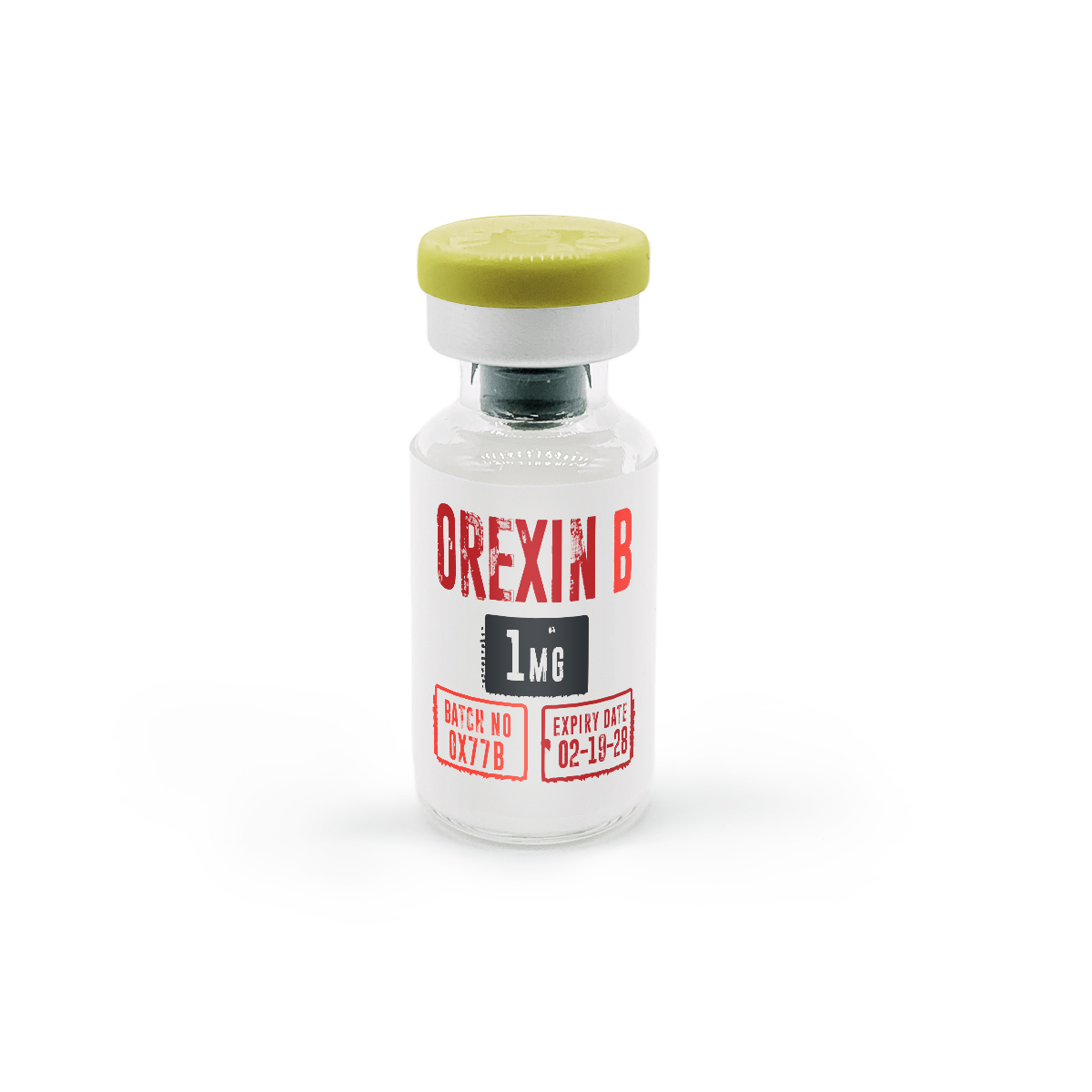


Orexin B
Price range: $159.61 through $262.08
Earn 160 - 262 points upon purchasing this product.
✅ 99% Purity – Third-Party Tested
🚚 Free U.S. Shipping on Orders $100+
 Proudly Made in the USA
⚡ Fast & Reliable Shipping
🔒 Secure Checkout Guaranteed
All products are strictly intended for laboratory and research purposes only and are not approved for veterinary or human use.
Description
Orexin-B (Hypocretin-2) Overview
Orexin-B, also known as Hypocretin-2, is a neuropeptide derived from the precursor protein prepro-orexin (HCRT). It belongs to the orexin/hypocretin peptide family, which has been studied in relation to neuronal signaling processes associated with arousal regulation, energy homeostasis, and neuroendocrine signaling in preclinical and experimental models. Orexin peptides are synthesized primarily in specialized neuronal populations within the hypothalamus and participate in complex neural signaling networks.
In investigational research, Orexin-B is frequently studied to examine orexin receptor signaling mechanisms, neuropeptide-mediated neurotransmission, and hypothalamic regulatory pathways. The peptide interacts with orexin receptor type 2 (OX2R), a G-protein-coupled receptor (GPCR) involved in intracellular signaling cascades associated with neuronal activation and synaptic communication.
Chemical and Molecular Properties
| PubChem CID | 44404987 |
| Molecular Formula | C126H212N44O35S |
| Molecular Weight | 2899.36 g/mol |
| Synonyms | [D-Ala22]orexin-B [Ala11,D-Leu15]-Orexin B [D-Leu7]orexin-B |
| IUPAC | H-Arg-Pro-Gly-Pro-Pro-Gly-Leu-Gln-Gly-Arg-Leu-Gln-Arg-Leu-Leu-Gln-Ala-Asn-Gly-Asn-His-Ala-Ala-Gly-Ile-Leu-Thr-Met-NH2 |
| CAS | 205640-91-1 |
| Labeling | Research Use Only (RUO), not for human or animal consumption |
| Chemical Structure Depiction | |
| Purity | 99% |
| Classification | Research Use Only (RUO) |
| Storage Temperature | Store at -20°C (-4°F) for long-term stability |
| Solubility | Water, DMSO (research-grade solvents) |
| Safety | Handle with gloves, a lab coat, eye protection; use a fume hood if dust/aerosol is possible |
Mechanisms of Action
Orexin-B has been characterized in experimental models as a ligand for orexin receptors, which are G-protein-coupled receptors involved in neuronal signaling pathways.
Receptor Interaction
Orexin-B has been shown in experimental studies to interact predominantly with orexin receptor type-2 (OX2R). Upon binding, the receptor undergoes conformational activation, which initiates intracellular signal transduction through heterotrimeric G proteins.
Intracellular Signal Transduction
Activation of OX2R may stimulate multiple signaling pathways, including:
- Phospholipase C (PLC) activation
- Increased inositol trisphosphate (IP3) and diacylglycerol (DAG) production
- Intracellular calcium mobilization
- Activation of protein kinase signaling pathways
These signaling cascades contribute to modulation of neuronal excitability and synaptic signaling in experimental neural systems.
Neuropeptide Signaling Networks
Within experimental research models, orexin peptides have been investigated for their role in modulating neural circuits in preclinical studies. Orexin-B has been studied for its potential role in these pathways, including effects on neuronal activity through receptor-mediated mechanisms and downstream transcriptional signaling in experimental models.
Potential Research Applications
Neuropeptide Signaling Research
Orexin-B is commonly utilized in experimental neuroscience studies examining neuropeptide-mediated signaling pathways. In in vitro research models, the peptide is used to analyze:
- orexin receptor activation dynamics
- receptor-ligand binding mechanisms
- intracellular GPCR signaling cascades
Circadian Rhythm and Neural Network Studies
Orexin peptides have been widely studied in relation to circadian regulatory pathways in experimental models. In preclinical and cellular research models, Orexin-B is studied to investigate:
- hypothalamic signaling pathways involved in circadian rhythm regulation
- interactions between orexin neurons and other neurotransmitter systems
- transcriptional regulation of genes involved in neural timing mechanisms
Neuroendocrine Signaling Investigations
In experimental molecular biology research, Orexin-B is used to evaluate interactions between neuropeptides and neuroendocrine regulatory networks. Investigations typically focus on:
- signaling cross-talk between orexin receptors and other GPCR pathways
- modulation of intracellular calcium signaling systems
- transcriptional responses triggered by orexin receptor activation
Disclaimer
This information is for educational purposes only and not medical advice. Products are for research use only. Research must follow IRB or IACUC guidelines. Verify information independently before purchasing. By ordering, you agree to our Terms and Conditions. If you are not 100% satisfied with the product you received, please contact us at support@purerawz.co
ATTENTION: All our products are for LABORATORY AND RESEARCH PURPOSES ONLY, not for veterinary or human use
References:
- Date, Y., Mondal, M. S., Matsukura, S., & Nakazato, M. (2000). Distribution of orexin-A and orexin-B (hypocretins) in the rat spinal cord. Neuroscience Letters, 288(2), 87-90. https://doi.org/10.1016/s0304-3940(00)01195-2
- Scammell, T. E., & Winrow, C. J. (2011). Orexin Receptors: Pharmacology and Therapeutic Opportunities. Annual Review of Pharmacology and Toxicology, 51(1), 243-266. https://doi.org/10.1146/annurev-pharmtox-010510-100528

About Team PureRawz
Team PureRawz is dedicated to providing accurate, science-based information on research chemicals, including Peptides, Nootropics, and SARMs. Our team of expert writers, researchers, and editors is committed to delivering reliable, up-to-date content you can trust.
Our mission is to build an educated and informed community spanning researchers, laboratories, and general readers empowering them to make confident, well-informed decisions when selecting the right research chemical.
Related products
-

Adipotide
Price range: $50.62 through $119.07 Select options This product has multiple variants. The options may be chosen on the product page -

CJC-1295 With DAC
Price range: $44.75 through $117.55 Select options This product has multiple variants. The options may be chosen on the product page -

BPC-157 ARG
Price range: $85.34 through $462.55 Select options This product has multiple variants. The options may be chosen on the product page -

Spartan 1 (Mod GRF 1-29/CJC-1295 No Dac + Hexarelin)
$103.28 Select options This product has multiple variants. The options may be chosen on the product page