

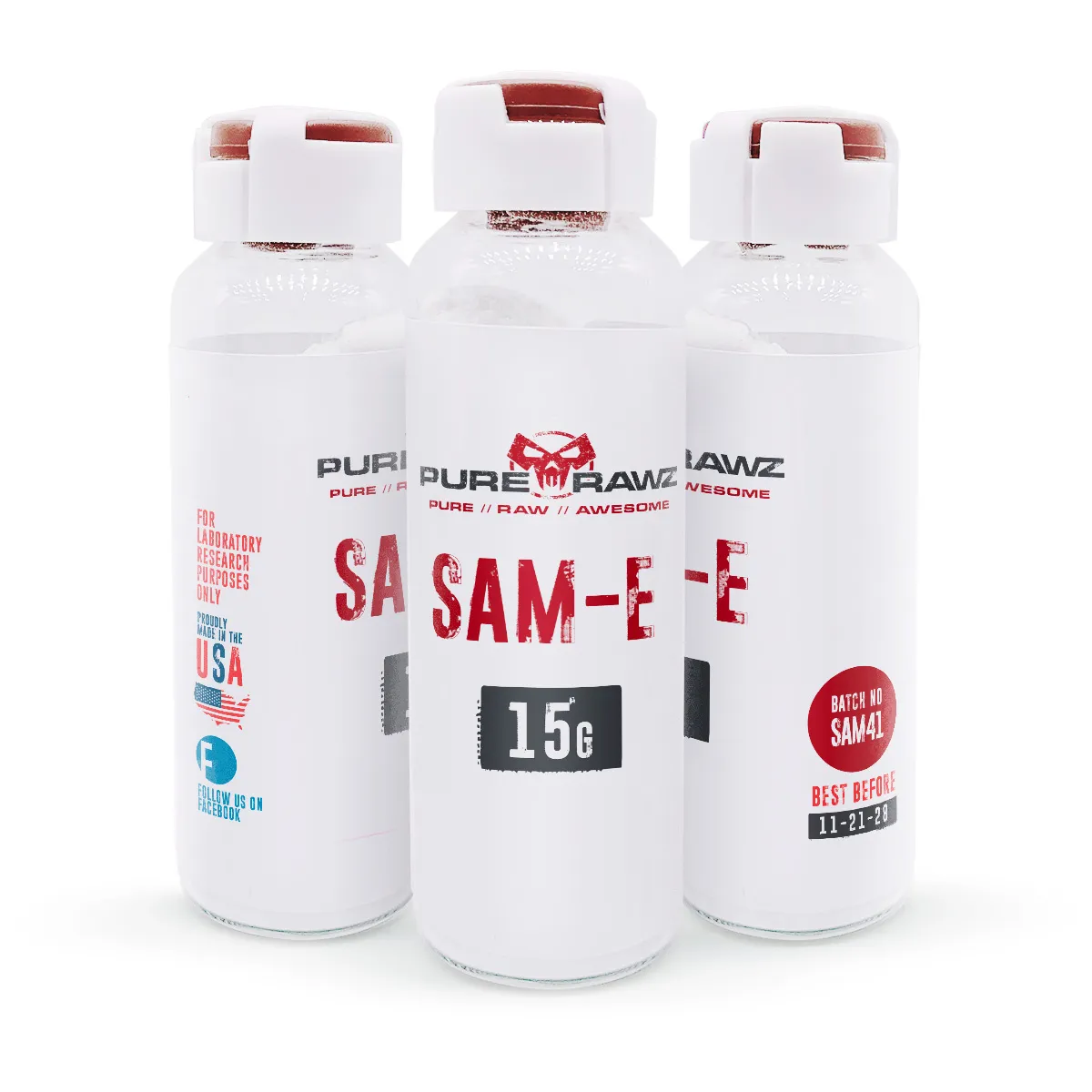


SAM-e Powder
$28.50
Earn 29 points upon purchasing this product.
✅ 99% Purity – Third-Party Tested
🚚 Free U.S. Shipping on Orders $100+
 Proudly Made in the USA
⚡ Fast & Reliable Shipping
🔒 Secure Checkout Guaranteed
All products are strictly intended for laboratory and research purposes only and are not approved for veterinary or human use.
Description
Overview of S-Adenosylmethionine (SAM-e) Powder
S-Adenosylmethionine (SAM-e, also referred to as AdoMet) is a naturally occurring sulfonium compound synthesized from L-methionine and adenosine triphosphate (ATP). This happened in a reaction catalyzed by methionine adenosyltransferase (MAT) enzymes, encoded by the MAT1A and MAT2A genes.
it is commonly supplied and studied in stabilized salt forms, such as the disulfate tosylate or 1,4-butanedisulfonate salts.
Researchers study SAM-e primarily because it functions as the principal methyl-group donor cellular metabolism, positioning it at the intersection of the methionine cycle, the transsulfuration pathway, and polyamine biosynthesis.
Researchers believe that SAM-e powder might be a useful compound to study DNA, RNA, and protein methylation, glutathione (GSH) biosynthesis, and homocysteine metabolism in experimental models.
SAM-e is intended strictly for laboratory research purposes and is not approved for human or animal consumption.
Proposed Mechanism of Action of SAM-e Powder
Research models have characterized SAM-e powder as the methyl donor for more than 40 distinct methyltransferase reactions. They act on substrates including nucleic acids, proteins, lipids, and secondary metabolites.
Investigations into DNA methyltransferase (DNMT) activity have shown that SAM-ecpowder transfers its methyl group to cytosine residues at CpG sites, a mechanism studied in relation to chromatin accessibility and transcriptional regulation.
Following methyl-group donation, SAM-e is converted to S-adenosylhomocysteine (SAH), which research models have identified as a potent inhibitor of further transmethylation reactions.
SAH is subsequently converted to homocysteine (HCY) via a specific hydrolase enzyme, a step studied in connection with the methionine cycle and its downstream effects on cellular redox balance.
Separate research has examined SAM-e's role in the transsulfuration pathway, where it has been studied in relation to the biosynthesis of reduced glutathione (GSH), and in polyamine synthesis pathways.
Enzymatic studies using SAM-e analogs have also been used to identify novel methyltransferase substrates, such as research demonstrating a seven-beta-strand methyltransferase's lysine methylation activity on a non-histone protein target.
Chemical & Molecular Properties
| Property | Description |
| Common Name | S-Adenosylmethionine (SAM-e); AdoMet |
| Synonyms | Ademetionine; S-(5'-Adenosyl)-L-methionine |
| Chemical Classification | Sulfonium-based nucleoside derivative; methyl-donor cofactor |
| Molecular Weight | 398.44 g/mol |
| CAS Number | 29908-03-0 |
| DrugBank ID | DB00118 |
| Chemical Nature | Unstable free-base form; commonly supplied as stabilized salts (e.g., tosylate, disulfate, 1,4-butanedisulfonate) |
| Appearance | White to off-white powder (salt-dependent) |
| Storage Stability | Store sealed, protected from heat and moisture; unstable above 0°C in free-base form |
| Analytical Characterization | HPLC, mass spectrometry |
Potential Research Applications of SAM-e Powder
Researchers investigate SAM-e powder under controlled laboratory conditions for the following research applications. Though more extensive study is required.
-
DNA, RNA, and Protein Methylation Research
Used as a methyl donor substrate to study methyltransferase enzyme activity and epigenetic regulation in cell-based and enzymatic assay models.
-
Methionine Cycle and Homocysteine Metabolism Research
Investigated for its role in the conversion pathway from methionine to SAH to homocysteine, relevant to cellular redox and metabolic research.
-
Polyamine Synthesis Research
Used to examine SAM-e's role as a precursor in polyamine biosynthesis pathways relevant to cell proliferation research.
-
Enzyme and Methyltransferase Substrate-Identification Research
Used alongside synthetic SAM-e analogs to identify and characterize novel methyltransferase enzyme targets in research models.
Why Researchers Buy SAM-e Powder from Purerawz?
Purerawz supplies SAM-e powder exclusively for laboratory research and analytical applications. Available product documentation may include batch-specific information, certificates of analysis (CoAs), and analytical characterization data to assist researchers in evaluating material identity and quality for experimental use.
As with all research materials, investigators should independently review the available specifications and supporting documentation to determine whether the material is appropriate for their intended laboratory protocols and research objectives.
Frequently Asked Questions
Why is SAM-e typically studied in a stabilized salt form rather than its free base?
The free-base form of SAM-e degrades readily above 0°C or in the presence of moisture, and can also racemize into an inactive stereoisomer, so stabilized salt forms are used in research to maintain a defined, reproducible molecular identity across experiments.
Why does SAH matter in SAM-e methylation research, rather than just SAM-e itself?
SAH is the direct byproduct of SAM-e's methyl-donation reaction and functions as a potent inhibitor of further transmethylation, so researchers track SAM-e/SAH ratios as an indicator of overall cellular methylation capacity.
How can SAM-e be relevant to both DNA methylation and glutathione biosynthesis research?
These represent two separate downstream branches of the same methionine cycle — one through direct methyl-group transfer to DNA, and the other through the transsulfuration pathway that converts SAM-e-derived homocysteine into glutathione precursors.
Why are synthetic SAM-e analogs used in some methyltransferase research instead of native SAM-e?
Chemically modified SAM-e analogs, such as selenium-based or alkyne-tagged versions, allow researchers to trace and identify previously unknown methyltransferase enzyme targets that would be difficult to detect using native SAM-e alone.
Reference Links
Cantoni, G. L. (1953). S-Adenosylmethionine: A new intermediate formed enzymatically from L-methionine and adenosinetriphosphate. Journal of Biological Chemistry, 204(1), 403–416. https://doi.org/10.1016/S0021-9258(18)66148-4
Shimazu, T., Barjau, J., Sohtome, Y., Sodeoka, M., & Shinkai, Y. (2014). Selenium-based S-adenosylmethionine analog reveals the mammalian seven-beta-strand methyltransferase METTL10 to be an EF1A1 lysine methyltransferase. PLOS ONE, 9(8), e105394. https://doi.org/10.1371/journal.pone.0105394
Guo, T., Chang, L., Xiao, Y., & Liu, Q. (2015). S-Adenosyl-L-methionine for the treatment of chronic liver disease: A systematic review and meta-analysis. PLOS ONE, 10(3), e0122124. https://doi.org/10.1371/journal.pone.0122124
Rodríguez-Vázquez, M., et al. (2025). S-Adenosylmethionine: A multifaceted regulator in cancer pathogenesis and therapy. Cancers, 17(4), 535. https://www.ncbi.nlm.nih.gov/pmc/articles/PMC11816870/
Wishart, D. S., et al. (n.d.). Human Metabolome Database: Metabocard for S-Adenosylmethionine (HMDB0001185). Human Metabolome Database. https://www.hmdb.ca/metabolites/HMDB0001185
Disclaimer:
The products sold by Purerawz are intended solely for laboratory and research purposes. They are not FDA-approved for human or animal consumption, and Purerawz does not sell these compounds for use in humans or animals. All compounds are strictly for use by qualified researchers in controlled, non-clinical laboratory environments in compliance with applicable regulations.

About Team PureRawz
Team PureRawz is dedicated to providing accurate, science-based information on research chemicals, including Peptides, Nootropics, and SARMs. Our team of expert writers, researchers, and editors is committed to delivering reliable, up-to-date content you can trust.
Our mission is to build an educated and informed community spanning researchers, laboratories, and general readers empowering them to make confident, well-informed decisions when selecting the right research chemical.
Related products
-

Agrocybe 30% Bisporiust
Price range: $26.77 through $56.28 Select options This product has multiple variants. The options may be chosen on the product page - Sale!

7,8 Dihydroxyflavone
Original price was: $27.31.$22.69Current price is: $22.69. Select options This product has multiple variants. The options may be chosen on the product page -

Sulbutiamine
Price range: $17.47 through $61.76 Select options This product has multiple variants. The options may be chosen on the product page -

Fonturacetam Phenylpiracetam Hydrazide 98%
Price range: $25.68 through $71.05 Select options This product has multiple variants. The options may be chosen on the product page