

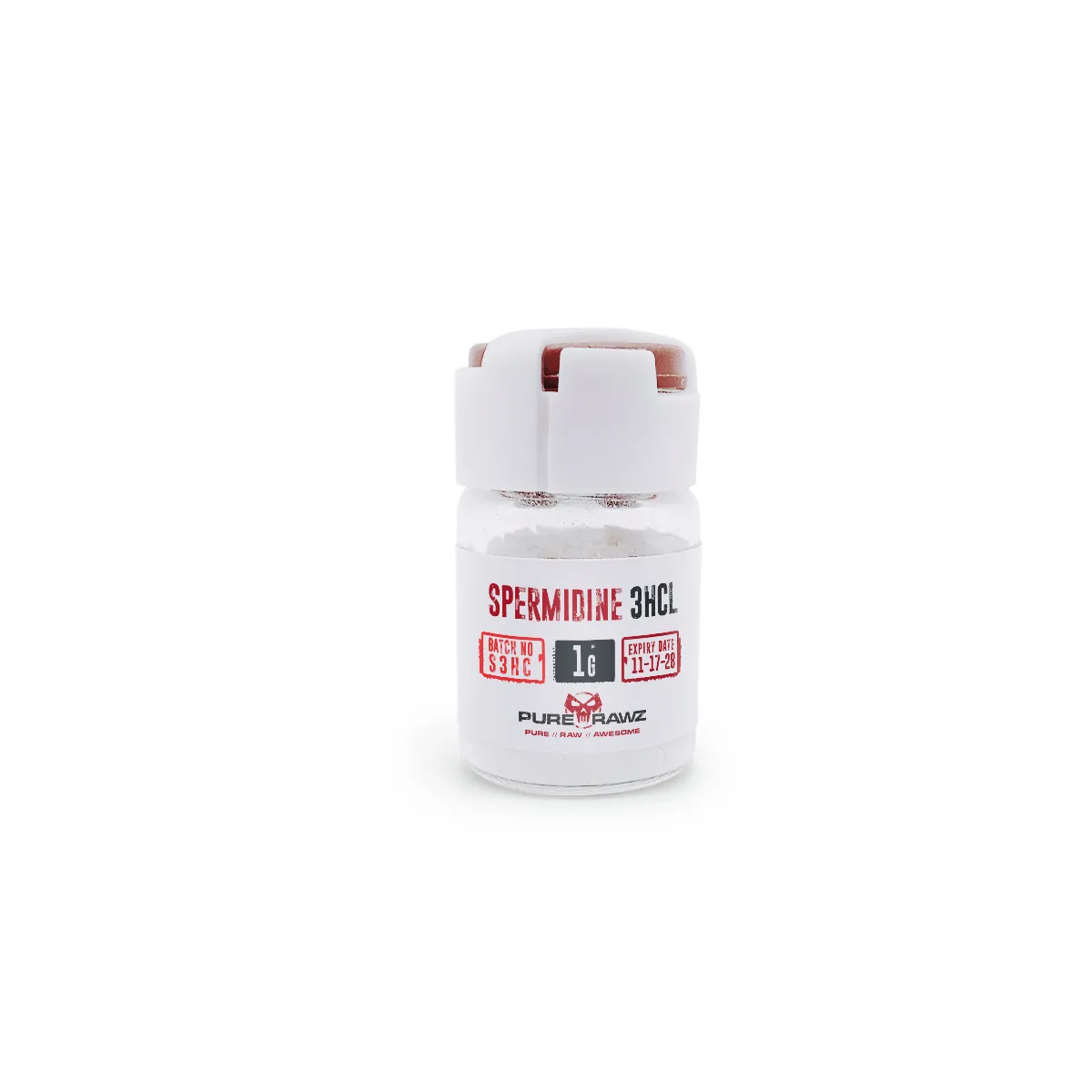


Spermidine 3HCl
$24.50
Earn 25 points upon purchasing this product.
✅ 99% Purity – Third-Party Tested
🚚 Free U.S. Shipping on Orders $100+
 Proudly Made in the USA
⚡ Fast & Reliable Shipping
🔒 Secure Checkout Guaranteed
All products are strictly intended for laboratory and research purposes only and are not approved for veterinary or human use.
Description
What Is Spermidine?
Spermidine is a naturally occurring polyamine synthesized within cells through the polyamine biosynthetic pathway and found in bacteria, fungi, plants, and animals, including humans. Produced from putrescine by spermidine synthase (SRM), it serves as a precursor to spermine and participates in polyamine metabolism and multiple cellular processes. Researchers investigate spermidine because of its involvement in eIF5A hypusination, protein translation, nucleic acid interactions, chromatin organization, autophagy, and cellular homeostasis.
Scientific Overview of Spermidine·3HCl
Spermidine·3HCl is the trihydrochloride salt form of spermidine, developed for laboratory applications requiring improved aqueous solubility, chemical stability, and handling characteristics. Experimental studies use Spermidine·3HCl to investigate molecular pathways associated with polyamine metabolism, eIF5A hypusination, protein translation, proteostasis, mitochondrial function, cellular senescence, and stress-response mechanisms. This overview summarizes its chemical properties, proposed molecular mechanisms, and experimental research applications based on published scientific literature. Spermidine·3HCl is intended exclusively for laboratory research and is not approved for clinical or therapeutic use.
This structure is stronger for semantic SEO because it first establishes what spermidine is (the biological molecule) before introducing Spermidine·3HCl (the research-grade salt form), creating a clearer entity hierarchy that search engines can better understand.
Proposed Mechanisms of Action of Spermidine·3HCl
Experimental evidence indicates that spermidine participates in endogenous polyamine metabolism and contributes to multiple polyamine-dependent cellular processes.
Moreover, researchers have investigated its role as the aminobutyl donor required for the hypusination of eukaryotic translation initiation factor 5A (eIF5A). Hypusination is a unique post-translational modification required for normal eIF5A function during protein translation.
Experimental studies have also examined potential interactions between intracellular spermidine availability and molecular pathways associated with autophagy, polyamine homeostasis, chromatin organization, and cellular stress responses.
These proposed mechanisms are derived from laboratory and preclinical investigations and remain areas of ongoing scientific research.
Chemical and Molecular Properties
| Property | Description |
| Common Name | Spermidine·3HCl |
| Chemical Classification | Polyamine hydrochloride salt |
| Molecular Weight | 254.63 g/mol |
| Appearance | White to off-white crystalline powder |
| Odor | Odorless |
| Solubility | Highly soluble in water; soluble in methanol |
| Functional Groups | Primary amines, secondary amine |
| Backbone Structure | Linear aliphatic polyamine |
| Charge Characteristics | Polycationic under physiological pH |
| Stability | Stable under recommended laboratory storage conditions; protect from moisture and prolonged exposure to light |
| Storage | Store tightly sealed in a cool, dry environment |
Experimental Research Applications of Spermidine·3HCl
Researchers investigate Spermidine·3HCl in various research models under controlled laboratory settings for the following applications.
- Studied for Polyamine Metabolism Research
Researchers investigate Spermidine·3HCl to examine intracellular polyamine metabolism, biosynthetic and catabolic pathways, polyamine transport mechanisms, and the regulation of cellular polyamine homeostasis in experimental models.
-
Autophagy Research
Experimental studies investigate Spermidine·3HCl as a laboratory research tool for examining molecular mechanisms associated with autophagy, intracellular recycling, protein turnover, and cellular homeostasis.
-
Research on Cellular Senescence and Age-Associated Molecular Pathways
Researchers investigate Spermidine·3HCl in experimental models to examine molecular pathways associated with cellular senescence, proteostasis, and age-associated cellular processes.
-
Mitochondrial Research
Experimental investigations examine potential interactions between Spermidine·3HCl and molecular pathways involved in mitochondrial function, mitochondrial quality control, oxidative metabolism, and cellular bioenergetics.
-
Research on Cell Proliferation, Differentiation, and Cellular Homeostasis
Researchers investigate potential relationships between spermidine metabolism and cellular processes including proliferation, differentiation, apoptosis, and intracellular signaling in experimental models.
-
Neuroscience Research
Experimental studies investigate Spermidine·3HCl for polyamine metabolism within neuronal systems, including its relationship with neuronal physiology, protein homeostasis, and cellular stress responses in laboratory models.
-
Microbiology Research
Experimental investigations examine the role of Spermidine·3HCl in bacterial, fungal, and yeast systems.
-
Epigenetics and Gene Regulation Research
Researchers investigate this compound to examine potential relationships among intracellular polyamine availability, chromatin organization, transcriptional regulation, histone modifications, and gene expression.
-
Analytical Chemistry
Researchers utilize HPLC, UHPLC, LC-MS/MS, GC-MS, NMR spectroscopy, and related analytical techniques to evaluate Spermidine·3HCl purity, stability, quantitative analysis, and analytical method validation.
Purerawz Offers First- and Third-Party Tested Spermidine-3HCl for Research Purposes Only
Purerawz offers Spermidine-3HCl exclusively for laboratory and research applications, with an emphasis on product transparency and analytical quality documentation.
Available analytical documentation, including product specifications and batch data where applicable, may assist researchers in evaluating material suitability for laboratory applications.
As with all research materials, investigators should review the accompanying documentation to determine whether the material meets the requirements of their intended research application.
FAQs
Why is spermidine considered an important molecule in polyamine research?
Spermidine is one of the principal naturally occurring polyamines investigated in cellular biology. Experimental studies examine its involvement in intracellular polyamine metabolism, nucleic acid interactions, protein synthesis, and cellular homeostasis. Because polyamine metabolism is highly conserved across many organisms, spermidine is widely used as a laboratory reagent for investigating polyamine-dependent molecular processes.
What is the relationship between spermidine and eIF5A hypusination?
Experimental evidence indicates that spermidine serves as the aminobutyl donor required for the hypusination of eukaryotic translation initiation factor 5A (eIF5A). This unique post-translational modification is catalyzed by deoxyhypusine synthase and deoxyhypusine hydroxylase and is investigated for its relationship with protein translation and cellular physiology under experimental conditions.
Why is Spermidine·3HCl commonly used instead of the free-base form?
The trihydrochloride salt form generally exhibits improved aqueous solubility and handling characteristics compared with the free-base compound. These physicochemical properties facilitate solution preparation, analytical testing, and routine laboratory applications while maintaining the chemical identity of spermidine.
How is spermidine different from other naturally occurring polyamines?
Spermidine belongs to a family of naturally occurring polyamines that also includes putrescine and spermine. Researchers investigate these molecules because they participate in interconnected metabolic pathways and exhibit distinct biochemical properties, allowing experimental studies to examine polyamine biosynthesis, interconversion, transport, and cellular regulation.
What experimental factors may influence studies involving Spermidine·3HCl?
Researchers evaluate multiple experimental variables, including cell type, culture conditions, intracellular polyamine metabolism, treatment duration, compound concentration, media composition, and analytical methodology. These factors may influence experimental observations and should be considered during study design and data interpretation.
Which analytical techniques are commonly used to characterize Spermidine·3HCl?
Researchers commonly employ high-performance liquid chromatography (HPLC), ultra-high-performance liquid chromatography (UHPLC), liquid chromatography–mass spectrometry (LC-MS/MS), nuclear magnetic resonance (NMR) spectroscopy, high-resolution mass spectrometry (HRMS), and capillary electrophoresis to evaluate compound identity, purity, stability, and quantitative analysis during laboratory investigations.
Disclaimer
This scientific monograph is intended solely for educational, informational, and laboratory reference purposes. The information summarizes findings from published scientific literature and experimental investigations. Spermidine·3HCl is intended only for legitimate laboratory research conducted by qualified professionals in accordance with applicable regulations and institutional guidelines. Statements describing experimental observations should not be interpreted as evidence of clinical efficacy, safety, or therapeutic benefit.
Reference Links
- Pegg, A. E. (2016). Functions of polyamines in mammals. Journal of Biological Chemistry, 291(29), 14904–14912. https://doi.org/10.1074/jbc.R116.731661
- Miller-Fleming, L., Olin-Sandoval, V., Campbell, K., & Ralser, M. (2015). Remaining mysteries of molecular biology: The role of polyamines in the cell. Trends in Biochemical Sciences, 40(9), 524–539. https://doi.org/10.1016/j.tibs.2015.06.001
- Park, M. H., Nishimura, K., Zanelli, C. F., & Valentini, S. R. (2010). Functional significance of eIF5A and its hypusine modification in eukaryotes. Amino Acids, 38(2), 491–500. https://doi.org/10.1007/s00726-009-0408-7
- Pegg, A. E. (2009). Mammalian polyamine metabolism and function. IUBMB Life, 61(9), 880–894. https://doi.org/10.1002/iub.230
- Igarashi, K., & Kashiwagi, K. (2010). Modulation of cellular function by polyamines. International Journal of Biochemistry & Cell Biology, 42(1), 39–51. https://doi.org/10.1016/j.biocel.2009.07.009
- Madeo, F., Bauer, M. A., Carmona-Gutierrez, D., & Kroemer, G. (2019). Spermidine: A physiological autophagy inducer acting as an anti-aging vitamin in humans? Autophagy, 15(1), 165–168. https://doi.org/10.1080/15548627.2018.1530929
- Chrysostomou, P. P., Freeman, E. L., Murphy, M. M., Pereira, R., Esdaile, D. J., & Keohane, P. (2023). A toxicological assessment of spermidine trihydrochloride produced using an engineered strain of Saccharomyces cerevisiae. Food and Chemical Toxicology, 184, 114428. https://doi.org/10.1016/j.fct.2023.114428

About Team PureRawz
Team PureRawz is dedicated to providing accurate, science-based information on research chemicals, including Peptides, Nootropics, and SARMs. Our team of expert writers, researchers, and editors is committed to delivering reliable, up-to-date content you can trust.
Our mission is to build an educated and informed community spanning researchers, laboratories, and general readers empowering them to make confident, well-informed decisions when selecting the right research chemical.
Related products
-

PRL-8-53
Price range: $57.37 through $92.36 Select options This product has multiple variants. The options may be chosen on the product page -

L-Theanine
Price range: $11.45 through $24.57 Select options This product has multiple variants. The options may be chosen on the product page -

HBT1
$92.36 Select options This product has multiple variants. The options may be chosen on the product page -

CDP Choline (Citicoline)
$28.41 Select options This product has multiple variants. The options may be chosen on the product page