

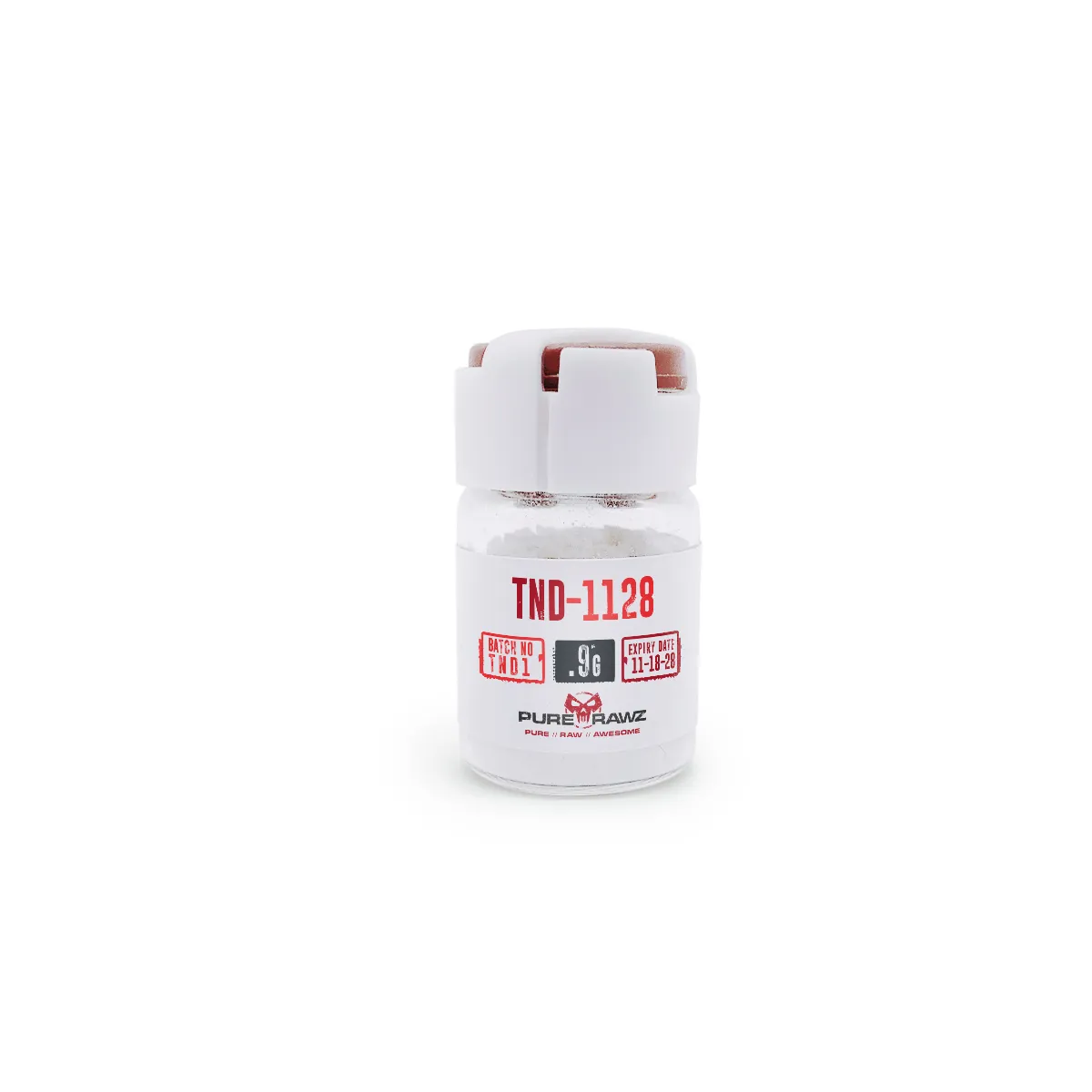


TND-1128
$29.30
Earn 29 points upon purchasing this product.
✅ 99% Purity – Third-Party Tested
🚚 Free U.S. Shipping on Orders $100+
 Proudly Made in the USA
⚡ Fast & Reliable Shipping
🔒 Secure Checkout Guaranteed
All products are strictly intended for laboratory and research purposes only and are not approved for veterinary or human use.
Description
Overview of TND-1128
TND-1128 (3-methyl-10-ethyl-5-deazaflavin) is a synthetic 5-deazaflavin derivative. It is structurally related to 5-deazaflavin, a class of compounds involved in oxidation-reduction (redox) chemistry.
Researchers believe it's a deazaflavin compound. It is investigated to support cellular energy metabolism, although these claims are not well established in clinical research.
TND-1128 is intended strictly for laboratory research purposes and is not approved for human or animal consumption.
Proposed Working Mechanism of TN-1128
Preclinical research has characterized TND-1128 as a compound exhibiting a strong NAD⁺-mimetic effect. It is studied in the context of mitochondrial dysfunction research, which has been linked in the literature to chronic inflammation and aging-associated conditions.
A peer-reviewed cytoprotection study found that TND-1128 was cytoprotective against hydrogen peroxide (H₂O₂)-induced oxidative stress in cell-based research models.
In that study, TND-1128 and related deazaflavin hybrid analogs were evaluated alongside β-nicotinamide mononucleotide (β-NMN) as a positive control. β-NMN's established role as an NAD⁺ precursor involved in sirtuin- and PARP-mediated DNA repair pathways.
Chemical & Molecular Properties
| Property | Description |
| Common Name | TND-1128 |
| Chemical Name | 3-Methyl-10-ethyl-5-deazaflavin |
| Chemical Classification | Synthetic 5-deazaflavin derivative |
| Molecular Formula | C₁₄H₁₃N₃O₂ |
| Molecular Weight | 255.27 g/mol |
| CAS Number | 59997-14-7 |
| Structural Basis | Pyrimido[4,5-b]quinoline-2,4(3H,10H)-dione core; nitrogen substituted at position 5 of the riboflavin-related flavin skeleton |
| Appearance | Bright yellow crystalline powder |
| Solubility | Soluble in DMF and DMSO; sparingly soluble in ethanol |
| Storage Stability | Store tightly sealed, away from light, moisture, and heat |
| Analytical Characterization | HPLC |
Possible Research Applications OF TND-1128
Researchers investigate TND-1128 under controlled laboratory conditions for the following research applications. Though more extensive study is required.
- NAD⁺ Pathway and Mitochondrial Research — Studied for NAD⁺-mimetic activity relevant to sirtuin and PARP enzyme research.
- Oxidative Stress and Cytoprotection Studies — Investigated for protective effects against H₂O₂-induced oxidative damage in cell culture models.
- Comparative Deazaflavin Analog Research — Used alongside other 5-deazaflavin hybrid compounds and β-NMN as a reference in structure-activity comparisons.
- Mitochondrial Dysfunction and Aging Biology Research — Explored in the research context of mitochondrial reactivation strategies linked to aging and chronic disease.
Buy TND-1128 from Purerawz for Better Research
Purerawz offers batch-specific Certificates of Analysis (COAs), detailed product specifications, and third-party testing information to support informed purchasing decisions.
These measures are intended to promote transparency and quality assurance and should not be interpreted as evidence of clinical efficacy or safety. TND-1128 is supplied for research purposes only and is not approved for the diagnosis, treatment, cure, or prevention of any disease.
Frequently Asked Questions
Why is TND-1128 tested against H₂O₂-induced oxidative stress specifically?
H₂O₂ challenge is a standard, controlled way to model oxidative damage in cells, letting researchers isolate a cytoprotective signal against a defined stressor rather than a vague "general health" outcome.
Why is β-NMN used as the comparison compound in TND-1128 studies rather than NAD⁺ itself?
β-NMN is a direct NAD⁺ precursor with established sirtuin- and PARP-related activity, making it a more practical positive control for isolating whether TND-1128 shares that same downstream pathway effect.
What does "5-deazaflavin" actually mean structurally, and why does that modification matter?
It refers to replacing nitrogen at position 5 of the flavin (riboflavin-related) ring system — this specific substitution is what gives deazaflavin compounds their redox and NAD⁺-mimetic behavior distinct from natural riboflavin.
Does a strong effect at low micromolar concentrations tell researchers anything about mechanism?
Potency at low concentrations suggests a specific, targeted interaction rather than a broad, non-specific antioxidant effect — but concentration-response data alone doesn't confirm the exact molecular target.
Why are TND-1128 and its "hybrid analogs" studied together rather than individually?
Comparing structurally related analogs side-by-side in the same assay helps researchers isolate which part of the deazaflavin scaffold drives the cytoprotective effect, rather than attributing it to the molecule as a whole.
Disclaimer:
The products sold by Purerawz are intended solely for laboratory and research purposes. They are not FDA-approved for human or animal consumption, and Purerawz does not sell these compounds for use in humans or animals. All compounds are strictly for use by qualified researchers in controlled, non-clinical laboratory environments in compliance with applicable regulations.
Reference Links
Chihiro, K., et al. (2024). TND1128, a 5-deazaflavin derivative with auto-redox ability, facilitates polarization of mitochondrial membrane potential (ΔΨm) and on-demand ATP synthesis in mice brain slices. Journal of Pharmacological Sciences. Retrieved from PubMed: https://pubmed.ncbi.nlm.nih.gov/39608846/
Kimura, N., et al. (2023). Effects of TND1128 (a 5-deazaflavin derivative), with self-redox ability, on mitochondrial function and neuronal protection. Journal of Pharmacological Sciences. Retrieved from PubMed: https://pubmed.ncbi.nlm.nih.gov/36707184/
National Center for Biotechnology Information. (n.d.). 5-Deazaflavin, CID 5376058. PubChem Compound Database. National Library of Medicine, National Institutes of Health. https://pubchem.ncbi.nlm.nih.gov/compound/5-Deazaflavin
Yamamoto, M., et al. (2024). 5-Deazaflavin (TND1128) and its hybrid analogs are cytoprotective against hydrogen peroxide (H₂O₂)-induced oxidative stress. bioRxiv (preprint, hosted via NIH-affiliated repository indexing). https://doi.org/10.1101/2024.05.07.592882
National Center for Biotechnology Information. (n.d.). PubMed Central: Search results for "TND1128 5-deazaflavin mitochondrial". National Library of Medicine, National Institutes of Health. https://www.ncbi.nlm.nih.gov/pmc/?term=TND1128

About Team PureRawz
Team PureRawz is dedicated to providing accurate, science-based information on research chemicals, including Peptides, Nootropics, and SARMs. Our team of expert writers, researchers, and editors is committed to delivering reliable, up-to-date content you can trust.
Our mission is to build an educated and informed community spanning researchers, laboratories, and general readers empowering them to make confident, well-informed decisions when selecting the right research chemical.
Related products
-

L-Theanine
Price range: $11.45 through $24.57 Select options This product has multiple variants. The options may be chosen on the product page -

Nooglutyl
$26.22 Select options This product has multiple variants. The options may be chosen on the product page -

Emoxypine Succinate
$22.93 Select options This product has multiple variants. The options may be chosen on the product page -

Methylene Blue
Price range: $14.91 through $178.19 Select options This product has multiple variants. The options may be chosen on the product page