

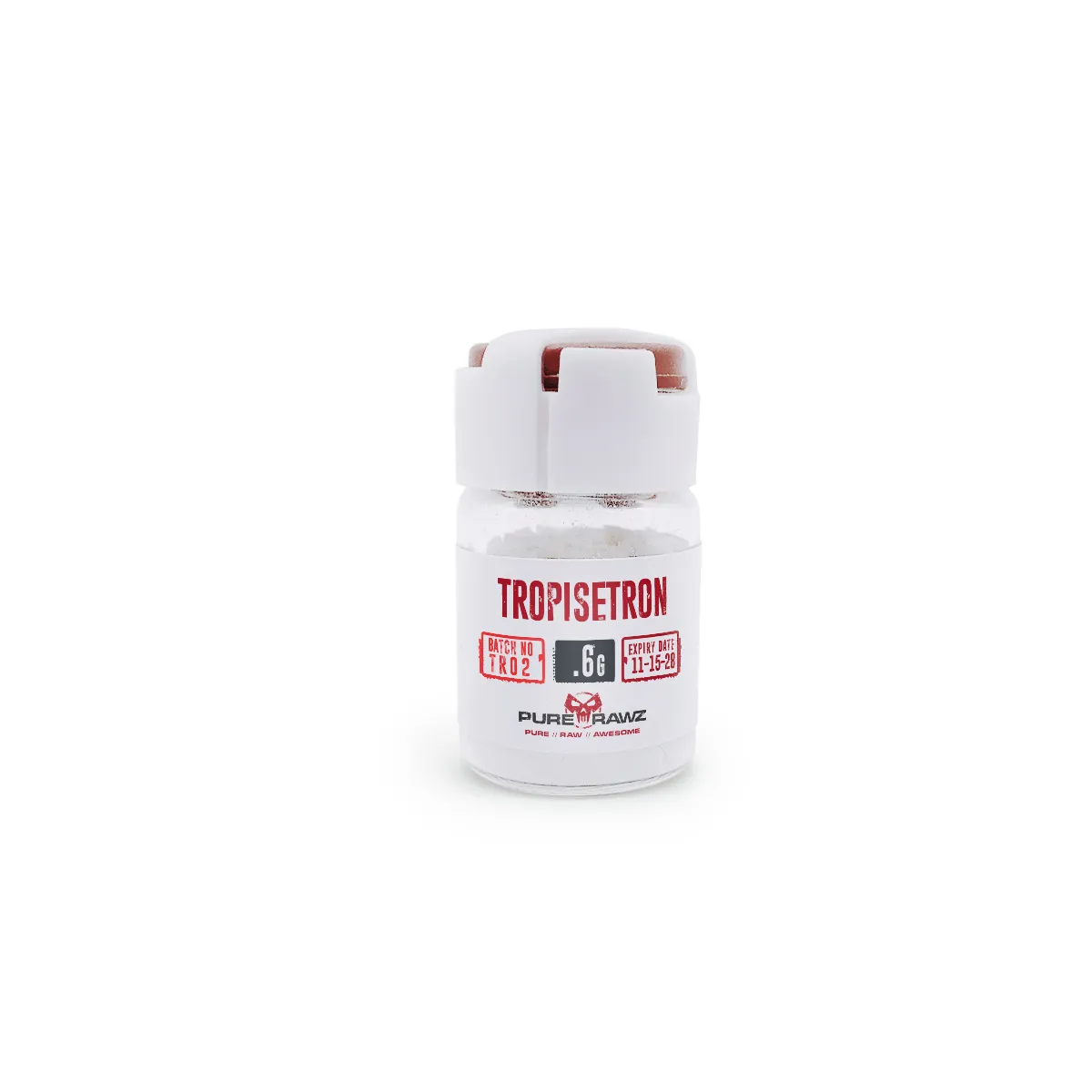


Tropisetron
$58.72
Earn 554 points upon purchasing this product.
✅ 99% Purity – Third-Party Tested
🚚 Free U.S. Shipping on Orders $100+
 Proudly Made in the USA
⚡ Fast & Reliable Shipping
🔒 Secure Checkout Guaranteed
All products are strictly intended for laboratory and research purposes only and are not approved for veterinary or human use.
Description
Overview of Tropisetron
Tropisetron is a synthetic indole-derived compound that belongs to the class of selective 5-hydroxytryptamine type 3 (5-HT<sub>3</sub>) receptor antagonists.
The 5-HT<sub>3</sub> receptor is the only serotonin receptor subtype that functions as a ligand-gated ion channel.
Researchers suggested that it belongs to the Cys-loop receptor superfamily, distinguishing it from the G protein-coupled serotonin receptor family.
In addition to its interaction with 5-HT<sub>3</sub> receptors, experimental studies have investigated potential interactions with α7 nicotinic acetylcholine receptors (α7 nAChRs), although the biological significance of these findings continues to be evaluated.
Researchers utilize tropisetron to investigate 5-HT<sub>3</sub> receptor pharmacology, serotonergic neurotransmission, and receptor binding kinetics.
Moreover, researchers explore ligand-receptor interactions, ion channel function, electrophysiological responses, and downstream intracellular signaling in experimental systems.
Proposed Mechanism of Action of Tropisetron
Experimental evidence demonstrates that tropisetron binds with high affinity to the orthosteric binding site of the 5-HT<sub>3</sub> receptor. Researchers believe that, by doing so, it competitively inhibits serotonin-mediated receptor activation and prevents ligand-gated cation influx.
Researchers investigate this interaction using receptor binding assays, electrophysiological techniques, and molecular pharmacology models to characterize receptor function and ligand affinity.
Researchers investigate this interaction to examine serotonergic neurotransmission, receptor pharmacology, and downstream cellular signaling in experimental models.
Additional investigations have evaluated potential interactions between tropisetron and α7 nicotinic acetylcholine receptors, including potential receptor modulation and cholinergic signaling pathways.
These proposed mechanisms are derived from laboratory and preclinical investigations and continue to be studied.
Chemical and Molecular Properties
| Property | Description |
| Common Name | Tropisetron |
| Chemical Name | (1R,5S)-8-Methyl-8-azabicyclo[3.2.1]oct-3-yl 1-methyl-1H-indole-3-carboxylate |
| Chemical Classification | Indole derivative; selective 5-HT<sub>3</sub> receptor antagonist |
| Molecular Formula | C17H20N2O2 |
| Molecular Weight | 284.35 g/mol |
| CAS Number | 89565-68-4 |
| PubChem CID | 5379 |
| Appearance | White to off-white crystalline powder |
| Odor | Odorless |
| Chemical Nature | Synthetic heterocyclic compound |
| Functional Groups | Indole ring, ester group, tertiary amine |
| Backbone Structure | Indole ester linked to a tropane-derived bicyclic amine |
| Stability | Stable under recommended laboratory storage conditions; protect from moisture and prolonged light exposure |
| Analytical Characterization | HPLC, UHPLC, LC-MS/MS, GC-MS, NMR spectroscopy, HRMS |
Potential Research Applications of Tropisetron
Researchers investigate tropisetron under controlled laboratory conditions for the following research applications. Though more extensive study is required.
-
5-hydroxytryptamine type 3 (5-HT₃) Receptor Pharmacology
Researchers utilize tropisetron as a reference antagonist for investigating receptor binding, receptor selectivity, ligand affinity, and signal transduction mediated by 5-HT<sub>3</sub> receptors.
-
Ligand-Gated Cation Channel Pharmacology
Experimental studies investigate tropisetron to examine the molecular pharmacology of ligand-gated ion channels, including receptor activation, ion channel conductance, and receptor desensitization mechanisms.
-
Cholinergic Signaling Research
Experimental investigations have evaluated potential interactions between tropisetron and α7 nicotinic acetylcholine receptors to examine receptor pharmacology and cholinergic signaling pathways. These findings remain an area of ongoing investigation.
-
Receptor Binding Studies
Experimental investigations employ tropisetron in radioligand binding assays, receptor occupancy studies, competitive binding experiments, and structure-activity relationship (SAR) research involving serotonergic ligands.
-
Structure–Activity Relationship (SAR) Research
Researchers use tropisetron as a reference compound in studies examining receptor selectivity, ligand optimization, molecular modeling, and structure-activity relationships for 5-HT<sub>3</sub> receptor ligands.
-
Analytical Chemistry
Experimental studies employ HPLC, UHPLC, LC-MS/MS, GC-MS, NMR spectroscopy, and high-resolution mass spectrometry to evaluate compound identity, purity, quantitative and analytical method validation.
Educational Use Only
The research applications described above are based on published laboratory and preclinical investigations. They are intended solely for scientific and educational purposes and should not be interpreted as evidence of efficacy, safety, or suitability for any clinical, veterinary, or therapeutic application.
FAQs
Why is the 5-HT<sub>3</sub> receptor unique among serotonin receptor subtypes?
The 5-HT<sub>3</sub> receptor is the only serotonin receptor subtype that functions as a ligand-gated cation channel, whereas the remaining serotonin receptor subtypes primarily signal through G protein-coupled receptor (GPCR) mechanisms. Researchers investigate this distinctive receptor biology to examine receptor activation, ion channel function, and serotonergic neurotransmission in experimental systems.
Why are radioligand binding assays commonly used in tropisetron research?
Researchers use radioligand binding assays to characterize receptor–ligand interactions, receptor binding affinity, competitive antagonism, and receptor occupancy. These techniques are widely employed to evaluate the pharmacological properties of 5-HT<sub>3</sub> receptor ligands under controlled laboratory conditions.
How do receptor binding studies differ from functional receptor assays?
Receptor binding studies measure the interaction between a compound and its target receptor, including binding affinity and receptor occupancy. Functional receptor assays evaluate the biological response that occurs following receptor activation or inhibition, allowing researchers to investigate the pharmacological activity of receptor ligands.
Why is tropisetron frequently included in structure–activity relationship (SAR) research?
Researchers use tropisetron as a reference compound in structure–activity relationship (SAR) investigations to examine how chemical modifications influence receptor affinity, ligand selectivity, and molecular recognition. These studies support experimental medicinal chemistry and receptor pharmacology research.
Why are α7 nicotinic acetylcholine receptors investigated in tropisetron research?
In addition to its established activity at the 5-HT<sub>3</sub> receptor, experimental studies have investigated potential interactions between tropisetron and α7 nicotinic acetylcholine receptors. Researchers continue to evaluate the molecular basis and pharmacological significance of these interactions using experimental models.
Why Researchers Source Tropisetron from Purerawz?
Purerawz supplies tropisetron exclusively for laboratory research and analytical applications. Available product documentation may include batch-specific information, certificates of analysis (CoAs), and analytical characterization data to assist researchers in evaluating material identity and quality for experimental use.
As with all research materials, investigators should independently review the available specifications and supporting documentation to determine whether the material is appropriate for their intended laboratory protocols and research objectives.
Disclaimer
This information is for educational purposes only and not medical advice. Products are for research use only. Research must follow IRB or IACUC guidelines. Verify information independently before purchasing. By ordering, you agree to our Terms and Conditions. If you are not 100% satisfied with the product you received, please contact us at support@PureRawz.co
ATTENTION: All our products are for LABORATORY AND RESEARCH PURPOSES ONLY, not for veterinary or human use
Reference Links
Lee, C. R., Plosker, G. L., & McTavish, D. (1993). Tropisetron: A review of its pharmacodynamic and pharmacokinetic properties, and therapeutic potential as an antiemetic. Drugs, 46(5), 925–943. https://doi.org/10.2165/00003495-199346050-00009
Kutz, K. (1993). Pharmacology, toxicology and human pharmacokinetics of tropisetron. Annals of Oncology, 4(Suppl. 3), S15–S18. https://doi.org/10.1093/annonc/4.suppl_3.s15
Walstab, J., Rappold, G., & Niesler, B. (2010). 5-HT3 receptors: Role in disease and target of drugs. Pharmacology & Therapeutics, 128(1), 146–169. https://doi.org/10.1016/j.pharmthera.2010.05.006
Papke, R. L., Schiff, H. C., Jack, B. A., & Horenstein, N. A. (2005). Molecular dissection of tropisetron, an α7 nicotinic acetylcholine receptor-selective partial agonist. Neuroscience Letters, 378(3), 140–144. https://doi.org/10.1016/j.neulet.2004.12.025

About Team PureRawz
Team PureRawz is dedicated to providing accurate, science-based information on research chemicals, including Peptides, Nootropics, and SARMs. Our team of expert writers, researchers, and editors is committed to delivering reliable, up-to-date content you can trust.
Our mission is to build an educated and informed community spanning researchers, laboratories, and general readers empowering them to make confident, well-informed decisions when selecting the right research chemical.
Related products
- Sale!

7,8 Dihydroxyflavone
Original price was: $27.31.$22.69Current price is: $22.69. Select options This product has multiple variants. The options may be chosen on the product page -

Aniracetam
Price range: $60.24 through $130.25 Select options This product has multiple variants. The options may be chosen on the product page -

Galantamine Hydrobromide
$57.37 Select options This product has multiple variants. The options may be chosen on the product page -

Pramiracetam
Price range: $8.59 through $18.91 Select options This product has multiple variants. The options may be chosen on the product page