

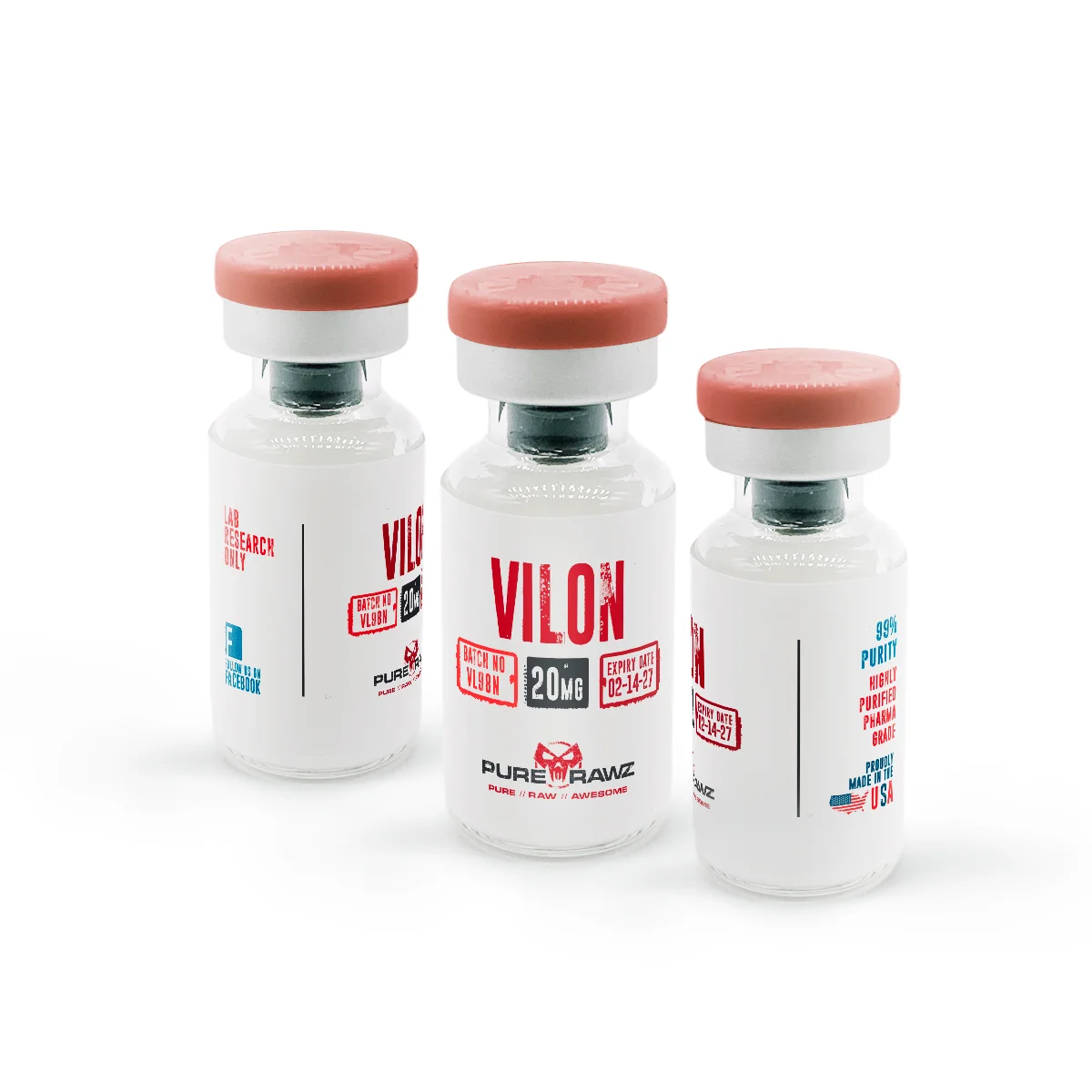
Vilon
$64.87
Earn 65 points upon purchasing this product.
Note: We recommend using sterile Bacteriostatic Water for reconstitution.
✅ 99% Purity – Third-Party Tested
🚚 Free U.S. Shipping on Orders $100+
 Proudly Made in the USA
⚡ Fast & Reliable Shipping
🔒 Secure Checkout Guaranteed
All products are strictly intended for laboratory and research purposes only and are not approved for veterinary or human use.
Description
Vilon (Lysyl-Glutamic Acid)
Overview
Vilon is a synthetic dipeptide bioregulator composed of the amino acids L-lysine and L-glutamic acid. It is structurally modeled after peptide fragments associated with thymic regulatory peptides and is investigated in experimental and preclinical research models focusing on cellular regulation and molecular signaling.
Within investigational research environments, Vilon is studied for its potential involvement in gene regulatory processes, chromatin structure interactions, and intracellular signaling pathways associated with immune-related cellular systems. Peptides in this class are often examined in in vitro studies to understand how short amino-acid sequences interact with transcriptional regulatory regions of DNA and influence cellular homeostasis
Chemical and Molecular Properties
| Property | Verified Information |
| Compound Name | Vilon |
| Chemical Name | L-lysyl-L-glutamic acid |
| Synonyms | Lys-Glu; Lysylglutamic acid |
| PubChem CID | 7010502 |
| Chemical Structure Description | |
| CAS Number | 45234-02-4 |
| Molecular Formula | C₁₁H₂₁N₃O₅ |
| Molecular Weight | 275.30 g/mol |
| Chemical Classification | Synthetic dipeptide |
| IUPAC Name | L-lysyl-L-glutamic acid |
| Physical Form | Typically supplied as a lyophilized peptide powder in research-grade preparations |
Working Mechanism
Cellular Uptake and Nuclear Interaction
In laboratory studies, small peptides may enter cells through membrane transport systems or peptide transporters. Following cellular uptake, peptide bioregulators can localize within intracellular compartments associated with transcriptional regulation.
Interaction with Chromatin and DNA Regulatory Regions
Experimental research suggests that certain short peptides may interact with chromatin-associated proteins and DNA regulatory sequences, potentially influencing transcriptional activity. These interactions may alter chromatin accessibility and regulate transcription factor binding.
Regulation of Gene Expression Pathways
Through chromatin-associated mechanisms, Vilon may influence transcription of genes involved in cellular regulatory pathways, including:
- Cellular differentiation signaling
- Intracellular protein synthesis pathways
- Regulatory signaling networks associated with immune-related cells
- Cell cycle regulatory mechanisms
These processes are examined primarily through gene expression assays and molecular signaling studies conducted in controlled laboratory environments.
Bioregulatory Peptide Signaling
Unlike compounds that directly stimulate receptor-mediated responses, peptide bioregulators are often investigated for their modulatory effects on transcriptional regulation and intracellular signaling stability. This regulatory activity is studied through molecular biology techniques such as transcriptional profiling and chromatin interaction analysis.
Research Applications of the Product in Laboratory Settings
Peptide Bioregulator Research
Vilon is studied in experimental molecular biology models to examine how short peptides influence regulatory processes within cells, particularly those associated with thymic peptide signaling.
Gene Expression and Chromatin Interaction Studies
Researchers use Vilon in in vitro transcriptional assays to investigate potential interactions between peptide fragments and DNA regulatory regions involved in cellular signaling networks.
Cellular Differentiation and Regulatory Pathway Studies
In experimental cell culture systems, Vilon may be used to analyze intracellular pathways associated with differentiation and cellular regulatory processes.
Immune-Related Cellular Signaling Research
Investigational studies may examine how peptide bioregulators influence gene expression pathways associated with immune-related cell populations within controlled laboratory environments.
Molecular Aging and Cellular Regulation Research
Some preclinical investigations explore peptide-mediated regulatory pathways involved in cellular homeostasis and transcriptional stability as part of broader research into biological regulatory mechanisms.
Why Choose Purerawz for Vilon?
Buy Vilon for laboratory research use from our online shop. At Purerawz, we provide high-quality reference materials. Each research compound comes with a Certificate of Analysis for verification of purity and concentration.
Disclaimer
This information is for educational purposes only and not medical advice. Products are for research use only. Research must follow IRB or IACUC guidelines. Verify information independently before purchasing. By ordering, you agree to our Terms and Conditions. If you are not 100% satisfied with the product you received, please contact us at support@purerawz.co
Reference Links
Avolio, F., Martinotti, S., Khavinson, V. K., Esposito, J. E., Giambuzzi, G., Marino, A., Mironova, E., Pulcini, R., Robuffo, I., Bologna, G., Simeone, P., Lanuti, P., Guarnieri, S., Trofimova, S., Procopio, A. D., & Toniato, E. (2022). Peptides regulating proliferative activity and inflammatory pathways in the Monocyte/Macrophage THP-1 cell line. International Journal of Molecular Sciences, 23(7), 3607. https://doi.org/10.3390/ijms23073607

About Team PureRawz
Team PureRawz is dedicated to providing accurate, science-based information on research chemicals, including Peptides, Nootropics, and SARMs. Our team of expert writers, researchers, and editors is committed to delivering reliable, up-to-date content you can trust.
Our mission is to build an educated and informed community spanning researchers, laboratories, and general readers empowering them to make confident, well-informed decisions when selecting the right research chemical.
Related products
-

Spartan 3 (Mod GRF 1-29 + GHRP-6)
$97.81 Select options This product has multiple variants. The options may be chosen on the product page -

Sermorelin + Ipamorelin Blend
Price range: $120.93 through $241.86 Select options This product has multiple variants. The options may be chosen on the product page -

PNC-27
$163.40 Select options This product has multiple variants. The options may be chosen on the product page -

Sermorelin + GHRP-6 Blend
$97.81 Select options This product has multiple variants. The options may be chosen on the product page