

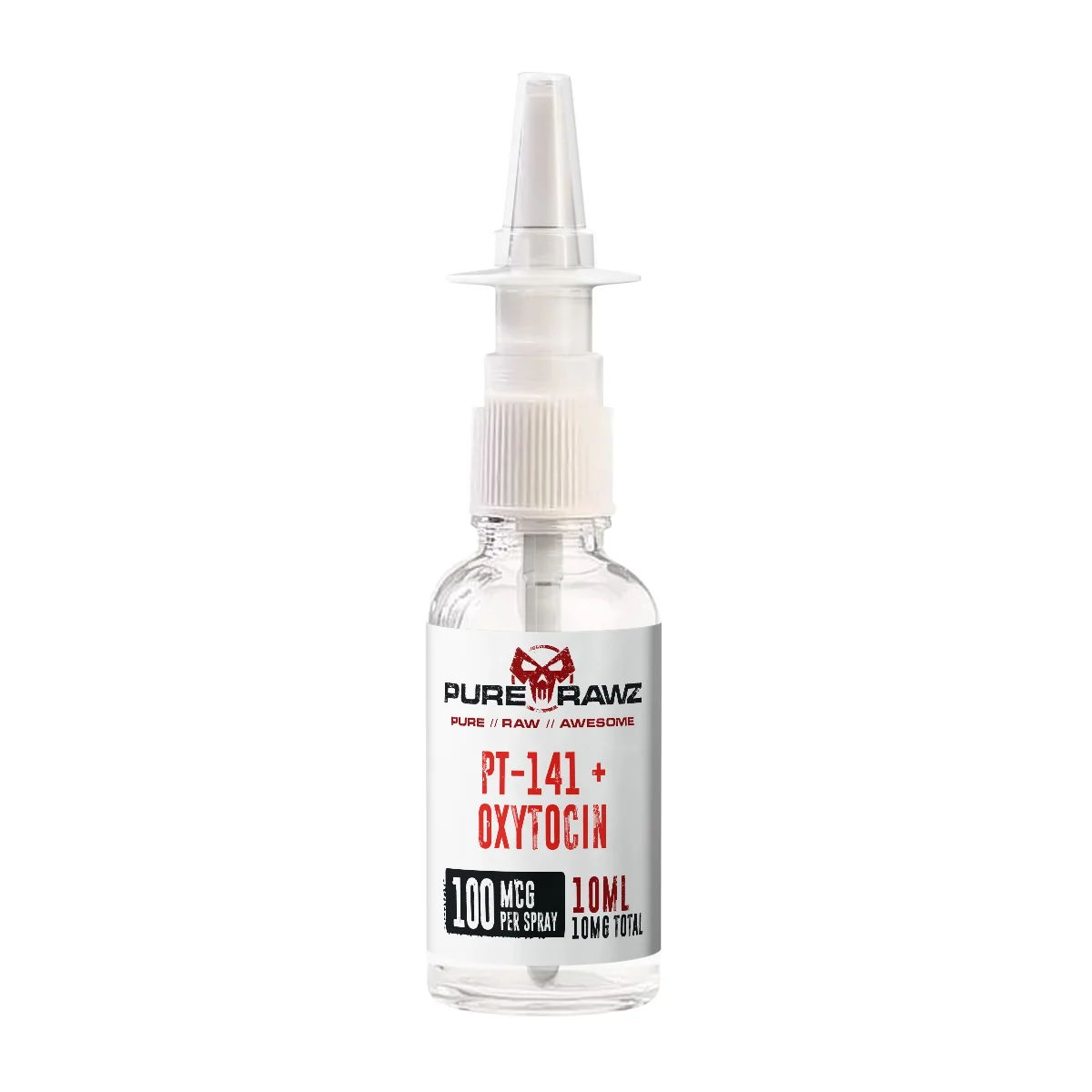
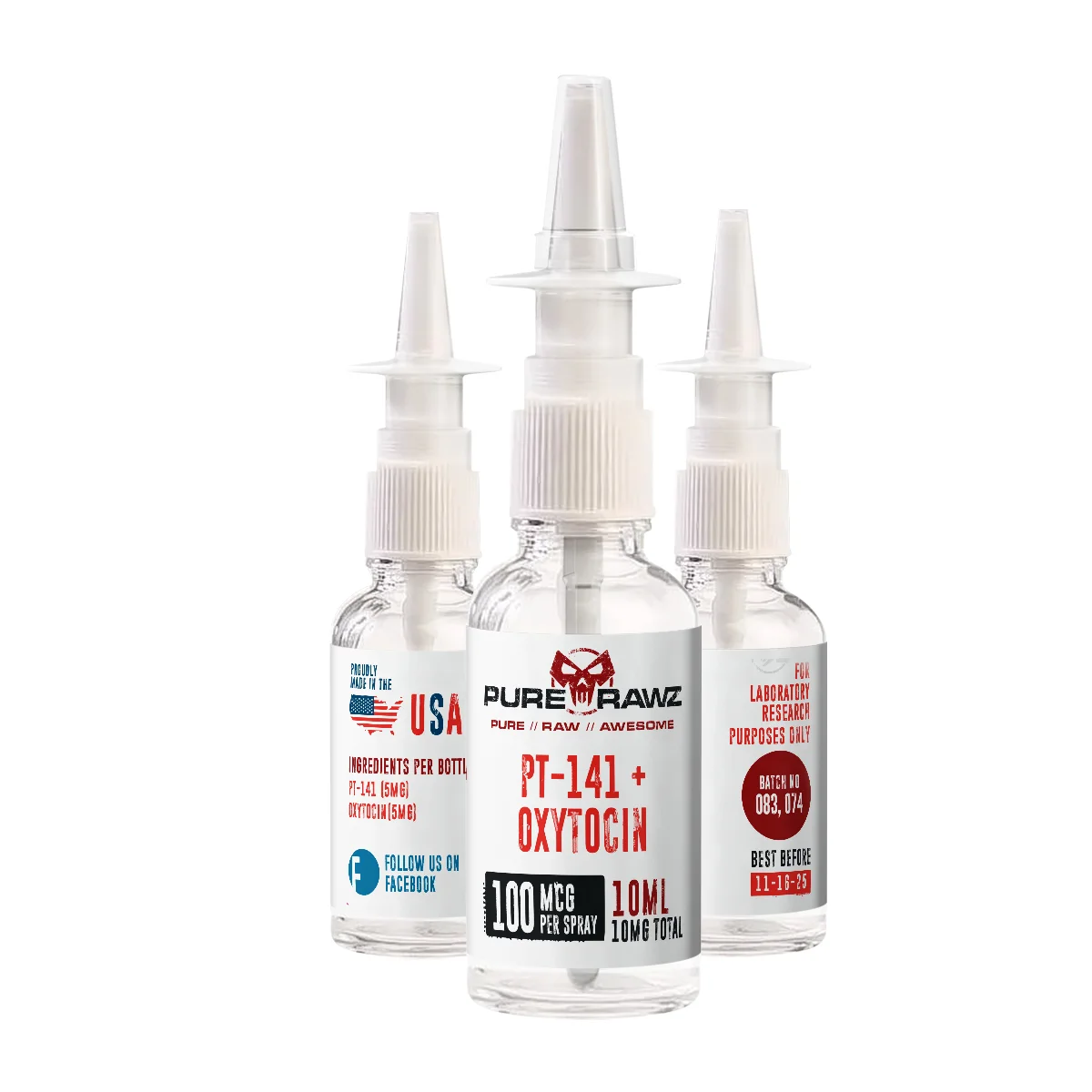

PT-141 + Oxytocin
$139.04
Earn 139 points upon purchasing this product.
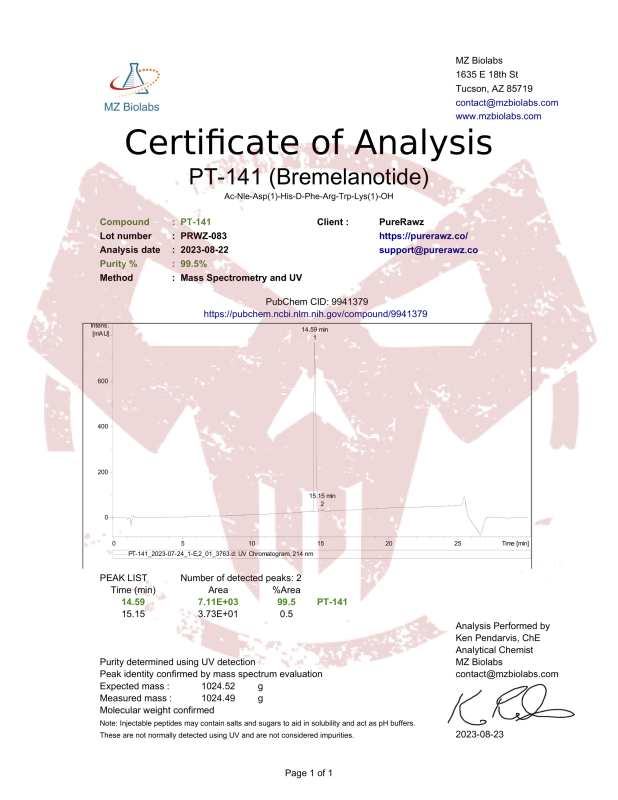
✅ 99% Purity – Third-Party Tested
🚚 Free U.S. Shipping on Orders $100+
 Proudly Made in the USA
⚡ Fast & Reliable Shipping
🔒 Secure Checkout Guaranteed
All products are strictly intended for laboratory and research purposes only and are not approved for veterinary or human use.
Description
Overview of Arouse Nasal Spray (PT-141 + Oxytocin)
Arouse Nasal Spray is a dual-compound investigational formulation combining PT-141 (Bremelanotide) and Oxytocin. These two peptides have been the subject of significant preclinical research.
PT-141 is a synthetic cyclic heptapeptide analog of alpha-melanocyte-stimulating hormone (α-MSH) and a selective melanocortin receptor agonist.
On the other hand, Oxytocin is a naturally occurring nonapeptide produced in the hypothalamus and released via the posterior pituitary. Researchers have well-documented its potential role in prosocial and neuromodulatory signaling pathways as observed across multiple preclinical models.
The nasal spray delivery format for this combination is studied for investigation based on the pharmacokinetic and anatomical characteristics of the transmucosal route. Researchers believe it may permit more direct central nervous system exposure in preclinical research models.
Disclaimer:
Important Regulatory Notice: PT-141 (bremelanotide) received FDA approval in June 2019 under the brand name Vyleesi (NDA 210557) as a prescription drug for one specific clinical indication in premenopausal adults. The pharmaceutical product Vyleesi is dispensed by prescription only through licensed channels.
The PT-141 supplied by PureRawz is a research-grade preparation intended exclusively for controlled laboratory and preclinical research purposes. It is distinct from the FDA-approved pharmaceutical product and must not be used for human consumption under any circumstances.
Oxytocin supplied by PureRawz is also a research-grade preparation for laboratory use only. It is not approved for unsupervised human administration.
The products sold by PureRawz are intended solely for laboratory and research purposes. They are not for human or animal consumption, and PureRawz does not sell these compounds for use in humans or animals. All compounds are strictly for use by qualified researchers in controlled, non-clinical laboratory environments in compliance with applicable regulations.
Chemical Properties of PT-141 Bremelanotide
| Property | Details |
| PubChem CID | 9941379 |
| CAS Number | 189691-06-3 |
| Molecular Formula | C₅₀H₆₈N₁₄O₁₀ |
| Molecular Weight | 1025.2 g/mol |
| Drug Class | Cyclic heptapeptide (synthetic) |
| Appearance | White to off-white lyophilized powder |
| Odor | Odorless |
| Physical State | Solid (lyophilized) |
| pH (Reconstituted) | ~4.0 (acidic aqueous solution) |
| Water Solubility | Soluble; ~1 mg/mL in sterile water or saline (with sonication) |
| Typical Purity | ≥98% |
| Lyophilized Powder Storage | −20 °C, desiccated, protect from light; stable ≥24 months |
| Reconstituted Solution Storage | 2–8 °C (refrigerated); use within 3 months |
| Freeze-Thaw Cycles | Avoid repeated cycling; aliquot before freezing |
| GHS Hazard Class | Not fully classified (peptide); handle with standard precautions |
| Research Use | For in vitro / preclinical use only (non-pharmaceutical grade) |
| WADA Status | Not currently listed on WADA 2026 Prohibited List (verify annually via | GlobalDRO.com) |
Chemical Properties of Oxytocin
| Property | Details |
| PubChem CID | 439302 |
| CAS Number | 50-56-6 |
| Molecular Formula | C₄₃H₆₆N₁₂O₁₂S₂ |
| Molecular Weight | 1007.19 g/mol |
| Physical State | Solid (lyophilized) or aqueous solution |
| Water Solubility | Freely soluble; >10 mg/mL at physiological pH |
| DMSO Solubility | Soluble; ≥5 mg/mL |
| Typical Purity | ≥97% |
| Lyophilized Powder Storage | −20 °C, desiccated; stable ≥36 months |
| Aqueous Solution Storage | 2–8 °C; stable up to 18 months (pH 3–5, with chlorobutanol) |
| Room Temperature Stability | Stable short-term (<25 °C) if protected from light |
| Research Use | For in vitro / preclinical use only |
| WADA Status | Not currently listed on WADA 2026 Prohibited List (verify annually via | GlobalDRO.com) |
Proposed Working Mechanism of Arouse Nasal Spray (PT-141 + Oxytocin)
PT-141 functions as a non-selective melanocortin receptor agonist with primary activity at MC3R and MC4R in preclinical binding studies. MC2R activity is negligible. Activity at MC1R is comparatively lower than Melanotan II, though not absent. These receptor subtypes are distributed across CNS regions involved in autonomic and neuroendocrine signaling. Pfaus et al., 2007; Molinoff et al., 2003
MC4R coupling to Gs/Gq signaling pathways initiates downstream cAMP production and phospholipase-C activity in neuronal research models. Research in preclinical models has demonstrated downstream effects on dopaminergic and noradrenergic signaling cascades following MC3R/MC4R activation. [Pfaus et al., 2007]
Oxytocin interacts with oxytocin receptors (OXTRs), G-protein- coupled receptors expressed in limbic, hypothalamic, and brainstem regions. Preclinical data indicate that OXTR activation is associated with modulation of prosocial behavior signaling and stress-axis regulation via the HPA pathway. Neuromodulatory influence over dopamine and serotonin system activity has also been observed in preclinical models. [Gimpl & Fahrenholz, 2001]
The combination of these two peptides allows researchers to investigate potential synergistic or complementary interactions between the melanocortin and oxytocinergic signaling systems, particularly within hypothalamic circuits where both receptor populations co-distribute.
Possible Research Applications of Arouse Nasal Spray (PT-141 + Oxytocin)
-
Melanocortin Receptor Signaling Research
Preclinical studies suggest PT-141 may serve as a useful compound for investigating MC3R and MC4R receptor binding kinetics and downstream pathway activation in research models.
-
Intranasal Peptide Delivery Studies
The dual-peptide nasal spray formulation is studied in preclinical research models as an opportunity to study transmucosal peptide bioavailability and CNS penetration dynamics.
-
Oxytocinergic Neuroscience
Preclinical findings suggest oxytocin receptor engagement in limbic and hypothalamic regions may influence prosocial signaling pathways in research models.
-
HPA Axis and Stress-Response Modeling
Research models indicate that OXTR agonism may exert downstream effects on corticotropin-releasing factor (CRF) activity and glucocorticoid release.
-
Dopaminergic Pathway Interaction Studies
Preclinical studies suggest both PT-141 and oxytocin interact with dopaminergic circuitry through distinct but potentially complementary mechanisms.
Risk and Handling
Arouse Nasal Spray (PT-141 + Oxytocin) is for research use only and should be handled exclusively by qualified researchers operating in controlled, non-clinical laboratory environments. Researchers are advised to consult the Safety Data Sheet (SDS) for both peptide constituents prior to handling.
- Standard laboratory personal protective equipment (PPE), including nitrile gloves, protective eyewear, and a lab coat is recommended during all handling procedures.
- The formulation should be stored in a refrigerated environment (2–8°C) and shielded from direct light to maintain peptide stability.
- Freeze-thaw cycling should be minimized, and researchers should aliquot as appropriate to prevent compound degradation.
- Any disposal of unused compound must comply with applicable institutional and regulatory guidelines for investigational peptide materials.
- Neither PT-141 nor Oxytocin is currently listed on the WADA Prohibited List (2026). Researchers working in sport science or athletic performance contexts should independently verify current WADA List status prior to use, as classifications are subject to annual review.
Buy Arouse Nasal Spray (PT-141 + Oxytocin) from PureRawz
Each batch of Arouse Nasal Spray (PT-141 + Oxytocin) undergoes rigorous third-party testing, with a Certificate of Analysis (COA) available for independent verification. PureRawz maintains a 99%+ purity standard across its research chemical inventory, confirmed through independent batch testing protocols designed to uphold compound integrity.
FAQs
What role does Oxytocin play in research studies?
Oxytocin is studied for its activity at oxytocin receptors (OXTRs) expressed in limbic, hypothalamic, and brainstem regions. In preclinical models, OXTR activation has been associated with modulation of prosocial behavior signaling, stress-axis regulation via the HPA pathway, and neuromodulatory influence over dopamine and serotonin system activity in controlled research settings.
Why combine PT-141 and Oxytocin in research?
This combination is explored to evaluate potential synergistic or complementary interactions between the melanocortin and oxytocinergic signaling systems in investigational models. Both peptides interact with overlapping hypothalamic circuits. MC3R/MC4R and OXTR populations co-distribute in regions relevant to autonomic and neuroendocrine research, making their combined study pharmacologically meaningful in preclinical systems.
What are melanocortin receptors?
Melanocortin receptors (MC1R–MC5R) are G-protein-coupled receptors with distinct anatomical distributions and functional roles across neuroendocrine, autonomic, and pigmentation signaling pathways. PT-141 demonstrates primary agonist activity at MC3R and MC4R in preclinical binding studies. MC3R and MC4R are expressed predominantly in hypothalamic and limbic CNS regions relevant to neuroendocrine research.
Why is intranasal delivery widely studied in peptide research?
Intranasal delivery is investigated for its transmucosal absorption characteristics and potential to permit more direct CNS exposure compared to peripheral administration routes in experimental models. The anatomical proximity of the nasal mucosa to olfactory and trigeminal pathways makes the intranasal route relevant to pharmacokinetic and CNS penetration research in preclinical systems.
Is PT-141 (bremelanotide) FDA-approved?
Yes, with important regulatory context. PT-141 (bremelanotide) received FDA approval in June 2019 under the brand name Vyleesi (NDA 210557) as a prescription drug for one specific clinical indication in premenopausal adults, dispensed by prescription only through licensed pharmacies. The PT-141 supplied by PureRawz is a research-grade preparation intended exclusively for controlled laboratory and preclinical research. It is not an FDA-approved pharmaceutical product and must not be used for human consumption.
Disclaimer
This information is for educational purposes only and not medical advice. Products are for research use only. Research must follow IRB or IACUC guidelines. Verify information independently before purchasing. By ordering, you agree to our Terms and Conditions. If you are not 100% satisfied with the product you received, please contact us at support@PureRawz.co
ATTENTION: All our products are for LABORATORY AND RESEARCH PURPOSES ONLY, not for veterinary or human use
Reference Links
- National Library of Medicine. Bremelanotide (PT-141) — Compound Summary. PubChem, National Center for Biotechnology Information (NCBI). https://pubchem.ncbi.nlm.nih.gov/compound/9941379
- National Institute of Diabetes and Digestive and Kidney Diseases. Bremelanotide — LiverTox: Clinical and Research Information on Drug-Induced Liver Injury. NCBI Bookshelf, National Institutes of Health; Updated August 2021. https://www.ncbi.nlm.nih.gov/books/NBK573221/
- National Library of Medicine. Oxytocin — Compound Summary. PubChem, National Center for Biotechnology Information (NCBI). https://pubchem.ncbi.nlm.nih.gov/compound/439302
- Gimpl G, Fahrenholz F. The oxytocin receptor system: structure, function, and regulation. Physiol Rev. 2001;81(2):629–683. PubMed PMID: 11274341. https://pubmed.ncbi.nlm.nih.gov/11274341/
- National Institute of Diabetes and Digestive and Kidney Diseases. Oxytocin — LiverTox: Clinical and Research Information on Drug-Induced Liver Injury. NCBI Bookshelf, National Institutes of Health. https://www.ncbi.nlm.nih.gov/books/NBK548049/
- U.S. National Library of Medicine. Clinical Trials Using Oxytocin. ClinicalTrials.gov. https://clinicaltrials.gov/search?term=oxytocin
- Pfaus JG, Giuliano F, Gelez H. Bremelanotide: an overview of preclinical CNS effects on female sexual function. J Sex Med. 2007;4 Suppl 4:269–279. PMID: 17727764. https://doi.org/10.1111/j.1743-6109.2007.00610.x
- Molinoff PB, Shadiack AM, Earle D, Diamond LE, Quon CY. PT-141: a melanocortin agonist for the treatment of sexual dysfunction. Ann N Y Acad Sci. 2003;994:96–102. PMID: 12851301. https://doi.org/10.1111/j.1749-6632.2003.tb03167.x

About Team PureRawz
Team PureRawz is dedicated to providing accurate, science-based information on research chemicals, including Peptides, Nootropics, and SARMs. Our team of expert writers, researchers, and editors is committed to delivering reliable, up-to-date content you can trust.
Our mission is to build an educated and informed community spanning researchers, laboratories, and general readers empowering them to make confident, well-informed decisions when selecting the right research chemical.
Related products
-

Hexarelin
Price range: $34.98 through $72.86 Select options This product has multiple variants. The options may be chosen on the product page -

Sermorelin + GHRP-2 Blend
$97.81 Select options This product has multiple variants. The options may be chosen on the product page -

CJC-1295 With DAC
Price range: $44.75 through $117.55 Select options This product has multiple variants. The options may be chosen on the product page -

GHRP-6
Price range: $37.28 through $122.22 Select options This product has multiple variants. The options may be chosen on the product page