

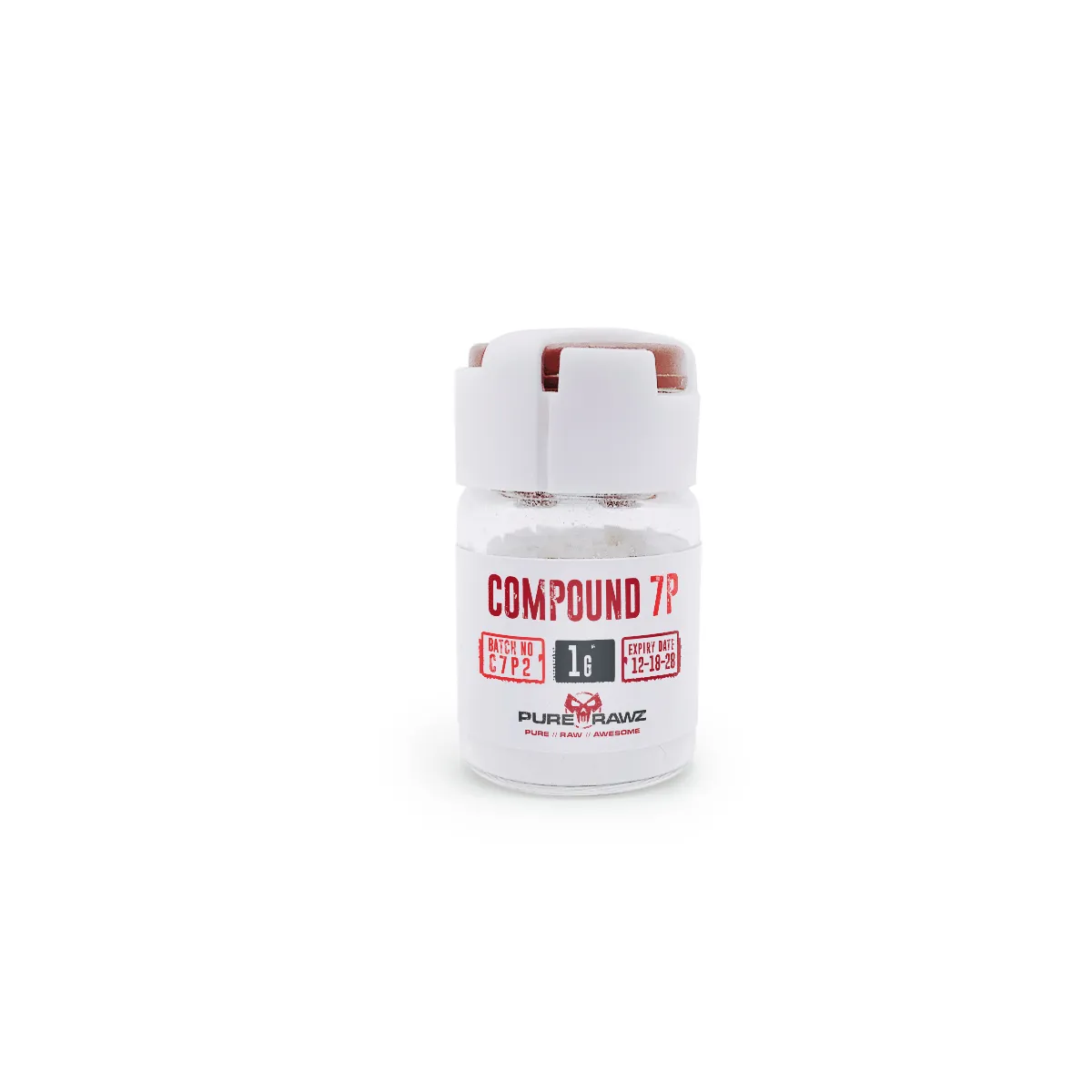


Compound 7P
$99.99
Earn 100 points upon purchasing this product.
✅ 99% Purity – Third-Party Tested
🚚 Free U.S. Shipping on Orders $100+
 Proudly Made in the USA
⚡ Fast & Reliable Shipping
🔒 Secure Checkout Guaranteed
All products are strictly intended for laboratory and research purposes only and are not approved for veterinary or human use.
Description
Overview of Compound 7P
Compound 7P is a synthetic small molecule used in laboratory research to investigate signaling pathways involved in tissue regeneration, cell migration, and cellular communication. It is primarily studied as an experimental research reagent in in vitro and preclinical models to better understand molecular mechanisms associated with cellular responses.
Researchers use Compound 7P to examine its interactions with specific signaling pathways under controlled laboratory conditions. Its applications include studies in cell biology, regenerative biology, molecular pharmacology, and related fields where pathway modulation is of research interest.
Compound 7P is intended for research use only and is not approved for human or veterinary use. Its inclusion in scientific studies is for experimental investigation and does not imply therapeutic efficacy or clinical application.
Proposed Mechanism of Action of Compound 7P
Compound 7P is studied for its potential role in promoting neurite outgrowth in cultured primary neurons derived from the hippocampus, cerebral cortex, and retina.
A few separate studies have also examined Compound 7P in a cervical cancer xenograft model. More in-depth research is required to fully understand Compound 7P’s mechanism.
Chemical & Molecular Properties
| Property | Description |
| Common Name | Compound 7P |
| Chemical Name | 2-[(2-Methoxyphenyl)[(4-methylphenyl)sulfonyl]amino]-N-(4-methoxy-3-pyridinyl)acetamide |
| IUPAC Name | 2-(2-Methoxy-N-(4-methylphenyl)sulfonylanilino)-N-(4-methoxypyridin-3-yl)acetamide |
| Chemical Classification | Sulfonamide-acetamide derivative |
| Molecular Formula | C₂₂H₂₃N₃O₅S |
| Molecular Weight | 441.5 g/mol |
| CAS Number | 1890208-58-8 |
| PubChem CID | 252827453 |
| Density | ~1.329 ± 0.06 g/cm³ (predicted) |
| pKa | ~11 ± 0.70 (predicted) |
| Appearance | White to off-white powder |
| Storage | Store in a dry environment, protected from light and moisture |
| Analytical Characterization | HPLC, LC-MS |
Potential Research Applications of Compound 7P
Researchers investigate Compound 7P under controlled laboratory conditions for the following research applications. Though more extensive study is required.
-
Axonal Regeneration Research
Used in experimental models to investigate molecular processes associated with GAP-43-positive axonal growth following optic nerve injury.
-
Cell-Cycle and Oncology Pathway Research
Studied in research models for effects on tumor cell-cycle distribution.
-
Structure-Activity Relationship (SAR) Research
Used as a scaffold compound in sulfonamide-acetamide SAR studies.
Why Buy Compound 7P from Purerawz for Research?
Each batch of Compound 7P supplied by Purerawz undergoes first- and third-party testing, with a Certificate of Analysis (CoA) available for identity and purity verification. Purerawz maintains a 99%+ purity standard confirmed through independent batch testing.
FAQs
Why is Compound 7P of interest in laboratory research?
Compound 7P is investigated as an experimental small molecule for studying signaling pathways involved in cellular communication under controlled laboratory conditions.
Which molecular target is associated with Compound 7P?
Published studies have examined Compound 7P in relation to the Wnt/β-catenin signaling pathway and its associated molecular mechanisms.
Which biomarkers are evaluated in Compound 7P studies?
Depending on the experimental design, researchers may evaluate biomarkers such as GAP-43 and other pathway-specific molecular indicators to characterize biological responses.
Which analytical techniques are used to characterize Compound 7P?
Identity and purity are commonly assessed using analytical methods including HPLC, LC-MS, NMR spectroscopy, and related laboratory techniques.
What experimental factors can influence Compound 7P studies?
Variables such as compound concentration, exposure duration, cell type, solvent selection, and assay conditions may influence experimental observations and should be optimized for each study.
Disclaimer
The products sold by Purerawz are intended solely for laboratory and research purposes. They are not FDA-approved for human or animal consumption, and Purerawz does not sell these compounds for use in humans or animals. All compounds are strictly for use by qualified researchers in controlled, non-clinical laboratory environments in compliance with applicable regulations.
Reference Links
National Library of Medicine. (n.d.). PubMed.
National Center for Biotechnology Information. https://pubmed.ncbi.nlm.nih.gov/
National Center for Biotechnology Information. (2017). Modulating the Wnt signaling pathway with small molecules. PubMed.
https://pubmed.ncbi.nlm.nih.gov/28120389/
National Center for Biotechnology Information. (2021). Small-molecule inhibitors targeting the canonical WNT signaling pathway for the treatment of cancer. PubMed.
https://pubmed.ncbi.nlm.nih.gov/33822624/

About Team PureRawz
Team PureRawz is dedicated to providing accurate, science-based information on research chemicals, including Peptides, Nootropics, and SARMs. Our team of expert writers, researchers, and editors is committed to delivering reliable, up-to-date content you can trust.
Our mission is to build an educated and informed community spanning researchers, laboratories, and general readers empowering them to make confident, well-informed decisions when selecting the right research chemical.
Related products
-

PRL-8-53
Price range: $57.37 through $92.36 Select options This product has multiple variants. The options may be chosen on the product page -

Picamilon Sodium (Nicotinoyl-GABA)
$24.57 Select options This product has multiple variants. The options may be chosen on the product page -

Oxiracetam
$25.97 Select options This product has multiple variants. The options may be chosen on the product page -

Emoxypine Succinate
$22.93 Select options This product has multiple variants. The options may be chosen on the product page