

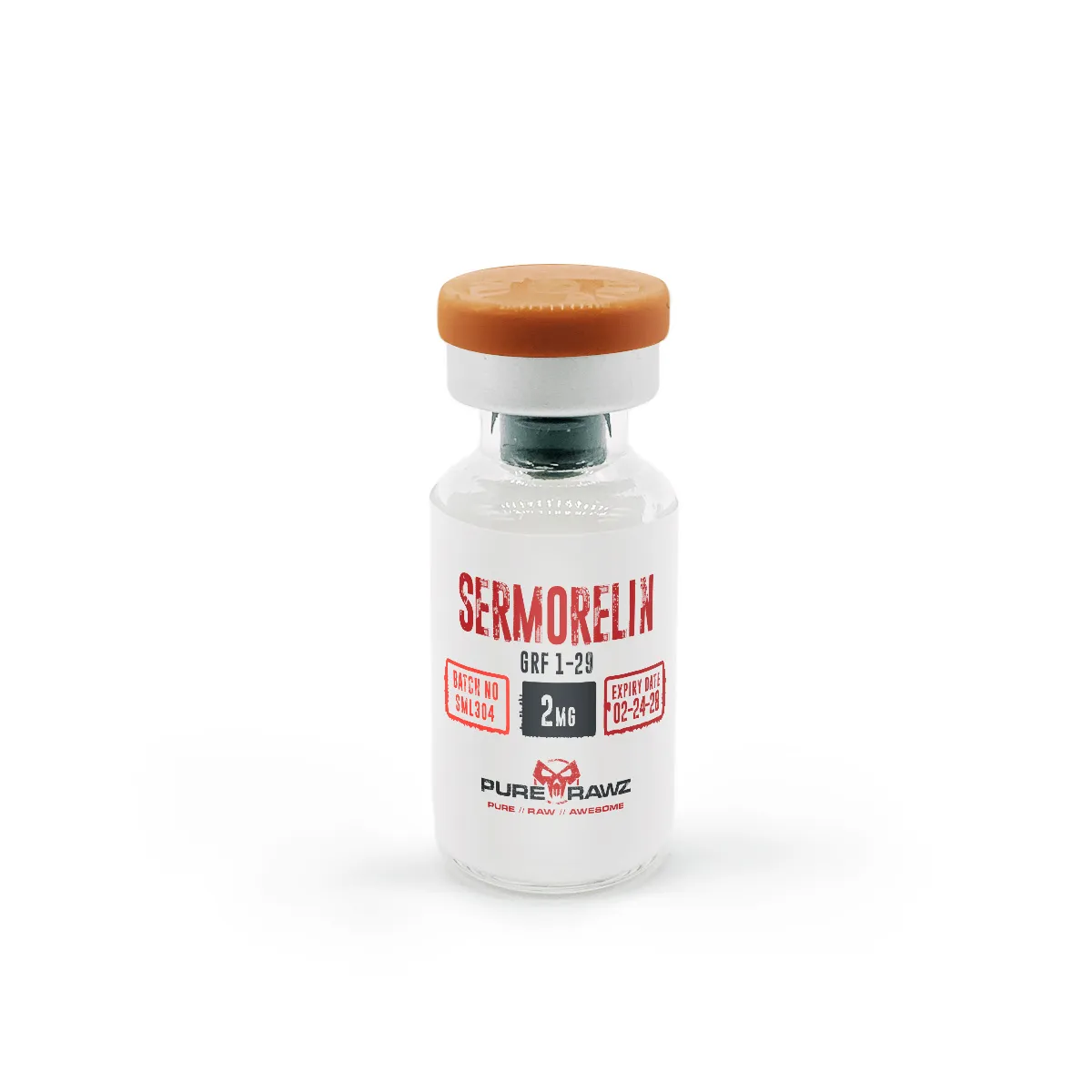


Sermorelin
Price range: $27.60 through $115.23
Earn 28 - 115 points upon purchasing this product.
Note: We recommend using sterile Bacteriostatic Water for reconstitution.
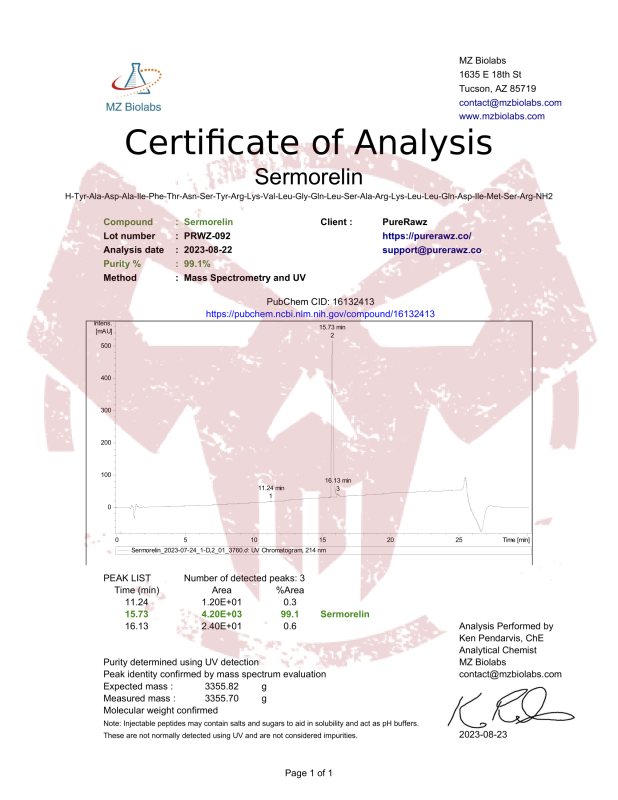
✅ 99% Purity – Third-Party Tested
🚚 Free U.S. Shipping on Orders $100+
 Proudly Made in the USA
⚡ Fast & Reliable Shipping
🔒 Secure Checkout Guaranteed
All products are strictly intended for laboratory and research purposes only and are not approved for veterinary or human use.
Description
Sermorelin (GHRH 1-29) Overview
GHRH 1-29 is a synthetic peptide widely used as a research tool in experimental endocrinology and molecular signaling studies. This fragment, commonly referred to as GHRH(1-29), represents the biologically active portion of the endogenous hormone responsible for initiating signaling at the growth hormone-releasing hormone receptor (GHRHR).
GHRH 1-29 is used in experimental endocrinology and molecular signaling studies to investigate receptor-mediated peptide signaling and endocrine regulatory pathways. Because it mimics the N-terminal active region of endogenous GHRH, the peptide serves as a research tool for studying G-protein-coupled receptor (GPCR) activation, intracellular signaling cascades, and peptide-receptor interactions.
Chemical and Molecular Properties
| Peptide Name | GHRH 1-29 |
| Peptide Class | Synthetic peptide hormone fragment |
| Amino Acid Length | 29 amino acids |
| Structural Type | Linear polypeptide |
| Parent Molecule | Growth Hormone-Releasing Hormone (GHRH) |
| CAS (free peptide) | 86168-78-7 |
Working Mechanism of GHRH 1-29
Interaction with Growth Hormone-Releasing Hormone Receptor in Research Models
In experimental models, GHRH 1-29 functions as an agonist of the growth hormone-releasing hormone receptor (GHRHR), a G-protein-coupled receptor (GPCR) expressed on pituitary somatotroph cells.
Binding of the peptide to GHRHR in in vitro receptor-binding studies initiates conformational changes within the receptor structure. These changes facilitate activation of Gs-type heterotrimeric G proteins, which subsequently stimulate intracellular signaling cascades.
Activation of the cAMP Signaling Pathway Studied in Research Models
Following receptor activation in experimental systems, intracellular signaling typically involves the adenylyl cyclase-cyclic AMP (cAMP) pathway. Activation of this pathway results in:
- Increased adenylyl cyclase activity
- Elevation of intracellular cAMP concentrations
- Activation of protein kinase A (PKA)
These molecular events are widely studied in cell culture research models to analyze peptide-mediated signal transduction processes.
Downstream Transcriptional Signaling Observed in Research Settings
In experimental cellular systems, activation of the PKA signaling pathway may influence transcriptional regulatory proteins such as cAMP response element-binding protein (CREB). Phosphorylation of CREB in laboratory models can modify transcriptional activity associated with endocrine signaling pathways.
Such mechanisms are commonly investigated using molecular biology techniques including reporter gene assays, transcription factor analysis, and intracellular signaling studies.
Receptor Desensitization and Signal Regulation
Like many GPCR agonists, GHRH 1-29 has been shown in experimental systems to undergo receptor regulatory processes, including:
- Receptor internalization
- Signal attenuation following sustained receptor activation
These regulatory mechanisms are often studied in cell-based receptor pharmacology experiments designed to evaluate peptide-receptor signaling dynamics.
Potential Research Applications of GHRH 1-29 in Laboratory Settings
-
Peptide-Receptor Interaction Studies
GHRH 1-29 is frequently used in biochemical and receptor-binding experiments investigating the structural and functional properties of growth hormone-releasing hormone receptors. Experimental applications may include:
- Ligand-receptor binding assays
- Receptor affinity and kinetics analysis
- Structural modeling of peptide-GPCR interactions
-
Intracellular Signaling Research
The peptide is also used in cell-based experimental models designed to analyze intracellular signaling mechanisms associated with GPCR activation. Such studies commonly investigate:
- cAMP signaling pathways
- Protein kinase activation cascades
- Transcription factor regulation in endocrine signaling networks
These experiments typically employ cultured endocrine cell lines and molecular signaling assays.
-
Endocrine System Research Models
In preclinical research settings, GHRH 1-29 serves as a tool compound for examining regulatory pathways associated with endocrine peptide signaling. Experimental frameworks may explore:
- Molecular regulation of endocrine signaling networks
- Signal transduction processes involving peptide hormones
- Receptor-mediated communication within endocrine cell systems
-
Structural and Peptide Chemistry Research
GHRH 1-29 is also utilized in peptide chemistry and structural biology studies. Researchers may investigate:
- Structure-activity relationships of GHRH peptide fragments
- Peptide stability and conformational dynamics
- Interaction of peptide ligands with GPCR extracellular domains
Laboratory methods frequently include mass spectrometry, peptide synthesis analysis, and molecular docking simulations.
Why Choose PureRawz for GHRH 1-29?
Buy GHRH 1-29 for laboratory research use from our online shop. At Purerawz, materials are handled according to standardized quality-control procedures to support batch consistency and analytical verification.
Each batch is assessed using established analytical methods to evaluate peptide identity, purity, and structural integrity. Batch-specific documentation, including Certificates of Analysis (COAs), is maintained for reference and product verification.
Disclaimer
This information is for educational purposes only and not medical advice. Products are for research use only. Verify information independently before purchasing. By ordering, you agree to our Terms and Conditions. If you are not 100% satisfied with the product you received, please contact us at support@purerawz.co
Reference Links
- DeAlmeida, V. I., & Mayo, K. E. (2001). The growth hormone-releasing hormone receptor. Vitamins and Hormones, 63, 233–276. https://doi.org/10.1016/S0083-6729(01)63008-5
- Gaylinn, B. D. (1999). Molecular and cell biology of the growth hormone-releasing hormone receptor. Growth Hormone & IGF Research, 9(Suppl A), 37–44. https://doi.org/10.1016/S1096-6374(99)80008-2
- Miller, T. L., Godfrey, P. A., DeAlmeida, V. I., & Mayo, K. E. (1999). The rat growth hormone-releasing hormone receptor gene: Structure, regulation, and generation of receptor isoforms with different signaling properties. Endocrinology, 140(9), 4152–4165. https://doi.org/10.1210/endo.140.9.6977

About Team PureRawz
Team PureRawz is dedicated to providing accurate, science-based information on research chemicals, including Peptides, Nootropics, and SARMs. Our team of expert writers, researchers, and editors is committed to delivering reliable, up-to-date content you can trust.
Our mission is to build an educated and informed community spanning researchers, laboratories, and general readers empowering them to make confident, well-informed decisions when selecting the right research chemical.
Related products
-

Viking 1 (GHRP-2 + GHRP-6 + Sermorelin)
$140.33 Select options This product has multiple variants. The options may be chosen on the product page -

PNC-27
$163.40 Select options This product has multiple variants. The options may be chosen on the product page -

Sermorelin + Ipamorelin Blend
Price range: $120.93 through $241.86 Select options This product has multiple variants. The options may be chosen on the product page -

Myostatin
$147.55 Select options This product has multiple variants. The options may be chosen on the product page