

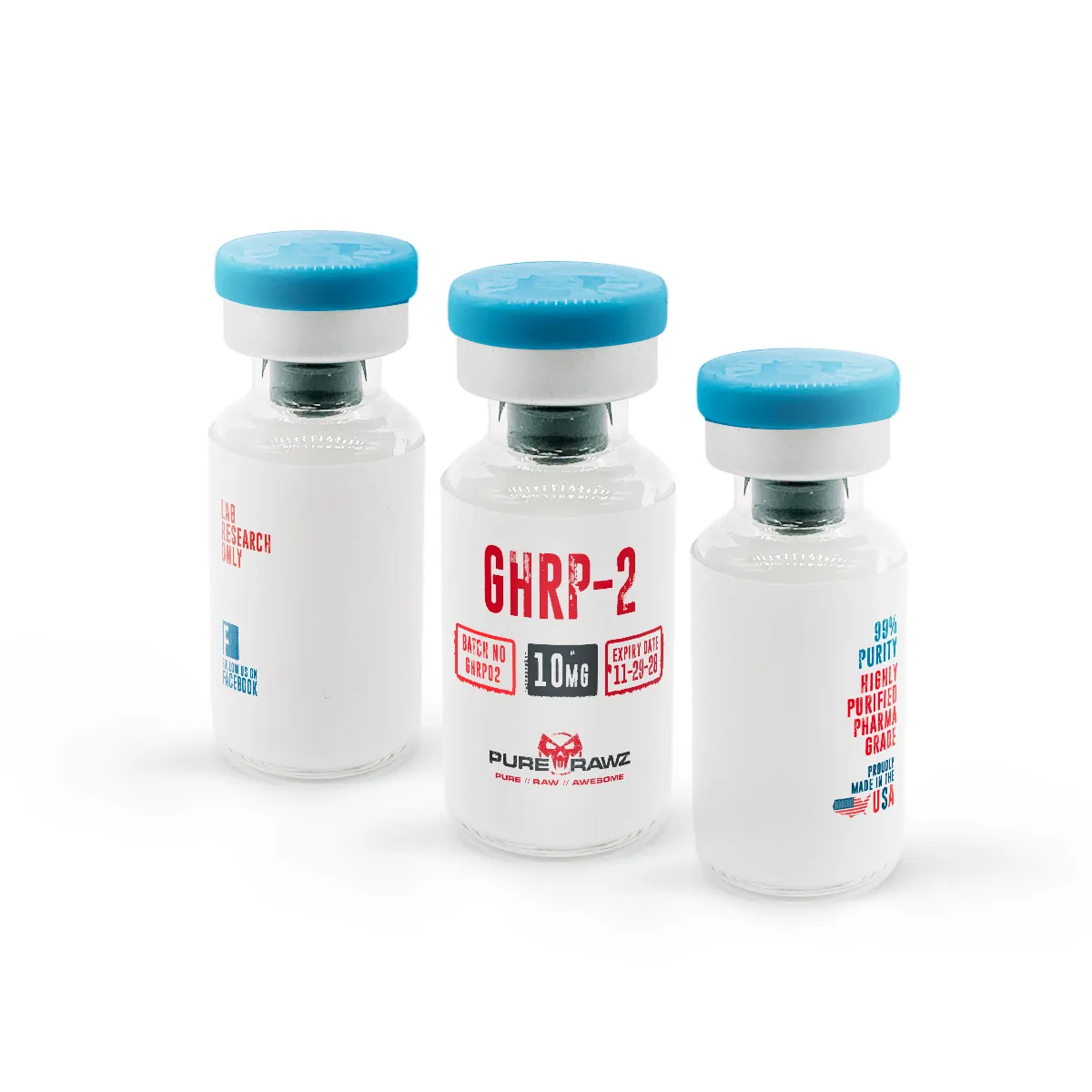


GHRP-2 (Pralmorelin) 10mg
$42.50
Earn 43 points upon purchasing this product.
✅ 99% Purity – Third-Party Tested
🚚 Free U.S. Shipping on Orders $100+
 Proudly Made in the USA
⚡ Fast & Reliable Shipping
🔒 Secure Checkout Guaranteed
All products are strictly intended for laboratory and research purposes only and are not approved for veterinary or human use.
Description
Overview
GHRP-2 (Growth Hormone Releasing Peptide-2, INN: pralmorelin) is a synthetic hexapeptide with the sequence D-Ala-D-β-Nal-Ala-Trp-D-Phe-Lys-NH₂, developed as a potent agonist of the growth hormone secretagogue receptor type 1a (GHS-R1a, ghrelin receptor). It was developed from structure-activity relationship studies on enkephalin-derived sequences and emerged as one of the most potent peptide GHS-R1a agonists, stimulating pulsatile GH release from anterior pituitary somatotrophs via Gq/11-coupled phospholipase C signalling and intracellular calcium mobilisation. Unlike ipamorelin (the first selective GHS-R1a agonist), GHRP-2 at GH-releasing concentrations co-stimulates ACTH and cortisol release in preclinical models. It is not FDA-approved for any use and is classified under WADA S2.2.4 (Growth Hormone-Releasing Peptides). Supplied for laboratory research only.
Chemical Properties
| Property | Details |
| CAS Number | 158861-67-7 |
| Molecular Formula | C45H55N9O6 |
| Molecular Weight | 825.99 g/mol |
| IUPAC Name | (3R)-3-[[(2R)-2-[[(2R)-2-[(2R)-2-amino-3-(4-methyl-2-oxo-1H-quinolin-3-yl)propanoyl]amino]-3-phenylpropanoyl]amino]propanoyl]-N-[(2R)-1-[(2-aminoethyl)amino]-1-oxo-3-phenylpropan-2-yl]pyrrolidine-1-carboxamide (simplified — see CAS 158861-67-7) |
| Synonyms | Pralmorelin, GHRP-2, GH-Releasing Peptide-2, KP-102, Growth Hormone-Releasing Peptide 2 |
| Amino Acid Sequence | D-Ala-D-β-Nal-Ala-Trp-D-Phe-Lys-NH₂ (hexapeptide; 3 unnatural D-amino acids) |
| Purity | ≥98% (HPLC verified) |
| Physical Form | Lyophilized white powder |
| Solubility | Soluble in water and 0.1% acetic acid at research concentrations |
| PubChem CID | 73657 |
| Storage | Store at −20°C, sealed, protected from light and moisture |
| WADA Classification | Prohibited — S2.2.4 Growth Hormone-Releasing Peptides (in- and out-of-competition) |
| Classification | Research Use Only (RUO) |
Mechanisms Investigated in Preclinical Research
GHS-R1a → Gq/11/PLCβ/IP3/Ca²⁺/GH Exocytosis: GHRP-2 has been investigated in anterior pituitary somatotroph models as a potent GHS-R1a agonist. Upon binding GHS-R1a, GHRP-2 activates the Gq/11 signalling pathway → phospholipase Cβ (PLCβ) activation → inositol-1,4,5-trisphosphate (IP3) generation → IP3-mediated Ca²⁺ release from endoplasmic reticulum stores in somatotrophs → GH secretory vesicle exocytosis. Published data (Muccioli et al. 2007, Front Neuroendocrinol, PMID 17622734) document GHS-R1a as a Gq-preferring GPCR whose activation by ghrelin and synthetic GHRPs, including GHRP-2, leads to this calcium-dependent GH release mechanism.
Hypothalamic GHS-R1a → GHRH Stimulation and Somatostatin Suppression: In addition to direct pituitary somatotroph activation, GHRP-2 has been investigated in hypothalamic model systems for its ability to stimulate GHRH-releasing neurons and suppress somatostatin release from the periventricular nucleus — creating a permissive environment for GH pulse generation synergistic with GHRH receptor agonism. This dual hypothalamic-pituitary mechanism distinguishes GHRP-2’s GH secretagogue activity from GHRH analogues, which act only at the pituitary GHRHR.
Non-Selective Pituitary Co-Stimulation (ACTH/Cortisol): In contrast to ipamorelin (first selective GHS secretagogue, Raun et al. 1998, PMID 9849822), GHRP-2 at GH-releasing concentrations is documented in published preclinical and clinical data to co-stimulate ACTH and cortisol release. This non-selective profile is mechanistically attributed to GHS-R1a expression on corticotroph cells and central CRH-stimulating effects. This distinction is critical for research design: GHRP-2 is not appropriate as a tool compound for studies requiring isolated GH axis activation without adrenal co-stimulation.
Research Applications
- GHS-R1a agonism potency and efficacy characterisation in competitive binding displacement assays and cell-based cAMP/calcium mobilisation assays using GHRP-2 as a high-affinity GHS-R1a reference ligand
- GHRP-2 vs ipamorelin selectivity comparison research: side-by-side ACTH/cortisol co-stimulation studies to quantify GHS-R1a vs CRH/corticotroph activation in primary pituitary cell cultures
- GHS-R1a Gq signalling pathway investigation: IP3 accumulation, intracellular Ca²⁺ flux measurements, and downstream PKC activation in GHS-R1a-transfected HEK-293 cell models
- Synergistic GH release kinetics: GHRP-2 + GHRH (or CJC-1295 DAC) combination research in pituitary somatotroph primary cultures to characterise receptor pathway convergence and GH pulse amplitude amplification
- GHS-R1a constitutive activity investigation: GHRP-2 as a reference full agonist for comparison with partial agonists and inverse agonists in receptor pharmacology panel research
Risk & Handling
Handling Precautions
- Trained laboratory personnel only. PPE: nitrile gloves, laboratory coat, eye protection
- Reconstitute under aseptic conditions with sterile water or 0.1% acetic acid. Handle as a CNS-active neuroendocrine research peptide
- As a GH secretagogue with potential CNS pathway activity, institutional biosafety review is recommended before initiating any research programme
Exposure Risks
- Risk Tier: HIGH — GHRP-2 is a potent GHS-R1a agonist with documented GH, ACTH, and cortisol stimulation in preclinical models. No human safety data has been established for research-grade GHRP-2 at injectable concentrations. No long-term toxicity data exist. Dependency or abuse potential via GH axis stimulation is mechanistically plausible but not characterised in the published literature. Researchers must account for GH, IGF-1, ACTH, and cortisol pathway activation as off-target variables in any biological research system.
Storage
- Store at −20°C in a sealed, dry, light-protected container. Reconstituted solution is stable for approximately 2–4 weeks at 2–8°C. Avoid freeze-thaw cycles. Stable ≥24 months lyophilized.
Quality Assurance
- Identity confirmation by nuclear magnetic resonance (NMR) spectroscopy and/or mass spectrometry (MS)
- Purity ≥98% by high-performance liquid chromatography (HPLC)
- Moisture content tested per USP standards where applicable
- Microbial testing for aerobic bacteria, yeast, and mould per USP <61> and <62>
- Heavy metals analysis (Pb, Cd, As, Hg) per USP <232>/<233> standards
- Full batch traceability with unique lot number documentation
- Certificate of Analysis (COA) available upon request for every batch
- Safety Data Sheet (SDS) available for all products
Why PureRawz
PureRawz supplies GHRP-2 as a rigorously tested research-grade compound. Each batch undergoes independent third-party identity confirmation by NMR and HPLC, with purity ≥98% verified. Where supplier specifications for complex blends or novel fusion compounds vary across vendors, PureRawz applies batch-specific molecular identity confirmation to verify component presence and ratio accuracy. A Certificate of Analysis (COA) documenting identity, purity, and lot traceability is available for every batch. A Safety Data Sheet (SDS) is provided for all products. Researchers requiring absolute certainty on batch composition for publication-quality study design should request COA documentation before initiating protocols.
References
- Muccioli G, Baragli A, Granata R, Papotti M, Ghigo E. Heterogeneity of ghrelin/growth hormone secretagogue receptors: toward the understanding of the molecular identity of novel ghrelin/GHS receptors. Frontiers in Neuroendocrinology. 2007;28(4):215–228. https://pubmed.ncbi.nlm.nih.gov/17622734/ [PMID 17622734]
- Raun K, Hansen BS, Johansen NL, et al. Ipamorelin, the first selective growth hormone secretagogue. European Journal of Endocrinology. 1998;139(5):552–561. https://pubmed.ncbi.nlm.nih.gov/9849822/ [PMID 9849822]
Enhanced Legal Notice — GH Secretagogue / WADA Prohibited S2.2.4: This product is a research chemical for laboratory use only. NOT approved by the FDA for human use and prohibited for human consumption or injection. Compounds that interact with the growth hormone axis or GLP-1 receptor systems carry significantly elevated regulatory exposure. Supplied strictly for in vitro bioassay and preclinical model research only. Unauthorized human use or distribution may violate federal law, including the Anti-Drug Abuse Act. Purchaser assumes all liability for federal and state law compliance.
Disclaimer: Preclinical and published scientific research indicates potential mechanisms of action for this compound in laboratory and animal models. Any references to published studies are for informational purposes only and do not constitute a claim that this product produces the same effects in humans. The safety and efficacy of this compound in humans have not been established.
ATTENTION: All products sold by PureRawz are intended for laboratory and research purposes only and are not approved for human consumption, veterinary use, or any other use. Products are not evaluated by the FDA and are not intended to diagnose, treat, cure, or prevent any disease. Customers assume full responsibility for the lawful use of these products in accordance with all applicable federal, state, and local regulations.

About Team PureRawz
Team PureRawz is dedicated to providing accurate, science-based information on research chemicals, including Peptides, Nootropics, and SARMs. Our team of expert writers, researchers, and editors is committed to delivering reliable, up-to-date content you can trust.
Our mission is to build an educated and informed community spanning researchers, laboratories, and general readers empowering them to make confident, well-informed decisions when selecting the right research chemical.
Related products
-

Hexarelin
Price range: $34.98 through $72.86 Select options This product has multiple variants. The options may be chosen on the product page -

Myostatin
$147.55 Select options This product has multiple variants. The options may be chosen on the product page -

Viking 1 (GHRP-2 + GHRP-6 + Sermorelin)
$140.33 Select options This product has multiple variants. The options may be chosen on the product page -

MOTS-c
Price range: $50.59 through $404.72 Select options This product has multiple variants. The options may be chosen on the product page