

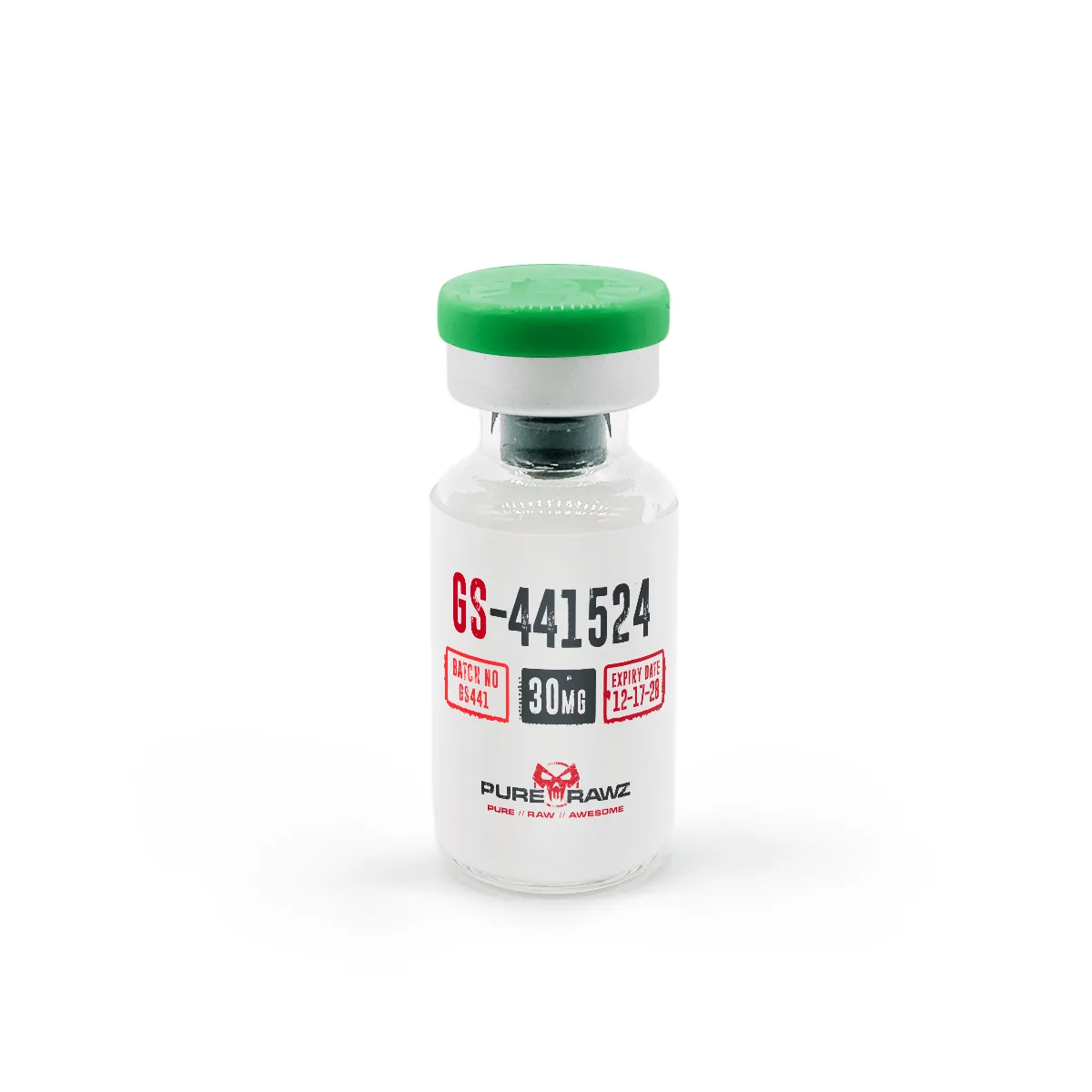


GS-441524
$93.99
Earn 94 points upon purchasing this product.
✅ 99% Purity – Third-Party Tested
🚚 Free U.S. Shipping on Orders $100+
 Proudly Made in the USA
⚡ Fast & Reliable Shipping
🔒 Secure Checkout Guaranteed
All products are strictly intended for laboratory and research purposes only and are not approved for veterinary or human use.
Description
GS-441524 Overview
GS-441524 is a synthetic adenosine nucleoside analog that has attracted significant scientific interest as an antiviral research compound investigated against multiple RNA viruses.
Researchers believe that Gilead Sciences originally developed GS-44 during antiviral drug discovery programs targeting RNA viruses.
GS-441524 is a synthetic adenosine nucleoside analog and serves as the parent nucleoside of the antiviral prodrug remdesivir.
The compound is primarily investigated for its potential interactions with viral RNA-dependent RNA polymerases (RdRp), intracellular nucleoside metabolism, and antiviral pharmacology.
Proposed Mechanism of Action of GS-441524
Experimental evidence demonstrates that GS-441524 is intracellularly phosphorylated by host kinases to yield its pharmacologically active nucleoside triphosphate metabolite.
Experimental studies investigate how this active metabolite competes with adenosine triphosphate (ATP) for incorporation into viral RNA by viral RNA-dependent RNA polymerase (RdRp).
The active triphosphate competes with adenosine triphosphate (ATP) for incorporation into nascent viral RNA. This results in delayed RNA chain termination and inhibition of viral RNA synthesis in susceptible viruses.
Researchers also investigate the compound for intracellular nucleotide metabolism and nucleoside transporter activity. It may also be studied for antiviral pharmacodynamics, viral replication kinetics, and resistance-associated mutations using molecular virology techniques.
These proposed mechanisms are based on experimental research and remain under continued investigation.
Chemical and Molecular Properties of GS-441524
| Property | Description |
| Common Name | GS-441524 |
| Chemical Name | 2R,3S,4R,5R)-2-(4-Amino-7H-pyrrolo[2,1-f][1,2,4]triazin-7-yl)-5-(hydroxymethyl)oxolane-3,4-diol |
| Chemical Classification | Adenosine nucleoside analog |
| PubChem CID | 44468216 |
| PubMed Search | https://pubmed.ncbi.nlm.nih.gov/?term=GS-441524 |
| PubChem Search | https://pubchem.ncbi.nlm.nih.gov/compound/44468216 |
| Molecular Formula | C12H13N5O4 |
| Molecular Weight | 291.26 g/mol |
| CAS Number | 1191237-69-0 |
| Appearance | White to off-white crystalline powder |
| Odor | Odorless |
| Solubility | Soluble in DMSO; moderately soluble in water; soluble in methanol |
| Chemical Nature | Synthetic nucleoside analog |
| Functional Groups | Aminopyrrolotriazine base, hydroxyl groups |
| Backbone Structure | Modified ribose nucleoside |
| Lipophilicity | Low |
| Water Solubility | Moderate |
| Stability | Stable under recommended laboratory storage conditions; protect from moisture and prolonged light exposure |
| Analytical Characterization | HPLC, UHPLC, LC-MS/MS, NMR spectroscopy, HRMS |
Potential Research Applications of GS-441524
Researchers investigate GS-441524 to better understand antiviral pharmacology, nucleoside metabolism, and viral RNA replication in experimental systems.
-
Studied for Antiviral Drug Discovery
Researchers explore GS-441524 as a nucleoside analog to study antiviral potency, viral replication kinetics, intracellular activation, and structure-activity relationships across RNA viruses.
-
Viral RNA Polymerase Research
A few research studies have investigated interactions between GS-441524-derived nucleoside triphosphates and viral RNA-dependent RNA polymerases (RdRp), including nucleotide incorporation and polymerase inhibition.
-
Medicinal Chemistry Investigations
Studies suggest that GS-441524 serves as a reference compound for structure-activity relationship (SAR).
-
Resistance Mechanism Research
Experimental investigations evaluate viral polymerase mutations and resistance-associated substitutions that may influence susceptibility to nucleoside analog antiviral compounds.
-
Analytical Chemistry
Researchers use HPLC, LC-MS/MS, UHPLC-MS/MS, and NMR spectroscopy to determine GS-441524’s purity, stability, metabolite formation, and analytical method validation.
Educational Use Only
These research applications are based on laboratory, analytical, and preclinical investigations and should not be interpreted as evidence of clinical efficacy or therapeutic benefit.
Why Buy GS-441524 from Purerawz?
Purerawz offers GS-441524 exclusively for laboratory and research applications, with an emphasis on product transparency and analytical quality documentation.
Product specifications, batch information, and available analytical data help researchers evaluate material suitability for experimental studies.
As with all research materials, investigators should review the accompanying documentation to determine whether the material meets the requirements of their intended research application.
FAQs
Why is GS-441524 considered a promising compound in antiviral research?
GS-441524 has attracted scientific interest because it targets viral RNA replication, a process shared by many RNA viruses. Researchers investigate the compound to better understand how nucleoside analogs inhibit viral RNA-dependent RNA polymerase (RdRp) and to support the development of next-generation antiviral therapies.
What is the relationship between GS-441524 and Remdesivir?
GS-441524 and Remdesivir are closely related but are not the same compound. Remdesivir is a phosphoramidate prodrug that is metabolized into GS-441524 and ultimately converted into the active nucleoside triphosphate inside cells. Studying both compounds helps researchers compare different antiviral delivery strategies and metabolic pathways.
Why does GS-441524 need to be converted inside cells before it becomes active?
Like many nucleoside analogs, GS-441524 is inactive when it first enters a cell. Host enzymes sequentially add phosphate groups to produce its active triphosphate form, which researchers investigate for its ability to interfere with viral RNA synthesis. This activation process is a key focus of antiviral pharmacology research.
Why is viral RNA-dependent RNA polymerase (RdRp) an important target for antiviral drug development?
RNA-dependent RNA polymerase is the enzyme responsible for copying the genetic material of many RNA viruses. Because human cells do not rely on this enzyme for normal cellular function, researchers consider RdRp an attractive target for studying selective antiviral compounds such as GS-441524.
What factors can influence the experimental performance of GS-441524?
Researchers evaluate several factors that may influence GS-441524 in experimental models, including cell type, intracellular kinase activity, nucleoside transporter expression, viral strain, dosing conditions, and study design. These variables can affect how efficiently the compound is activated and evaluated during laboratory investigations.
Disclaimer
All products sold by Purerawz are intended for laboratory and research purposes only and are not approved for human consumption, veterinary use, or any other use. Products are not evaluated by the FDA and are not intended to diagnose, treat, cure, or prevent any disease. Customers assume full responsibility for the lawful use of these products in accordance with all applicable federal, state, and local regulations.
Reference Links
Kim, T.-Y., & Oh, Y.-I. (2025). GS-441524 Treatment in a Cat With Feline Infectious Peritonitis Virus and Pyogranulomatous Transverse Colon Lesion. In Vivo (Athens, Greece), 39(5), 2760–2765. https://doi.org/10.21873/invivo.14074
Lee, S.-R., Song, B., Lee, S., Jin, M., Shin, J. S., Lee, S., Jo, Y., Hwang, S., Oh, B., Ahn, J.-H., Lee, H.-K., Na, Y.-G., & Cho, C.-W. (2025). A dual-strategy approach to improve GS-441524 therapy in feline infectious peritonitis: salt engineering and orally disintegrating tablet development. International Journal of Pharmaceutics, 683, 126066. https://doi.org/10.1016/j.ijpharm.2025.126066
Pedersen, N. C., Perron, M., Bannasch, M., Montgomery, E., Murakami, E., Liepnieks, M., & Liu, H. (2019). Efficacy and safety of the nucleoside analog GS-441524 for treatment of cats with naturally occurring feline infectious peritonitis. Journal of Feline Medicine and Surgery, 21(4), 271–281. https://doi.org/10.1177/1098612x19825701

About Team PureRawz
Team PureRawz is dedicated to providing accurate, science-based information on research chemicals, including Peptides, Nootropics, and SARMs. Our team of expert writers, researchers, and editors is committed to delivering reliable, up-to-date content you can trust.
Our mission is to build an educated and informed community spanning researchers, laboratories, and general readers empowering them to make confident, well-informed decisions when selecting the right research chemical.
Related products
-

Triptorelin (GnRH)
Price range: $45.90 through $67.21 Select options This product has multiple variants. The options may be chosen on the product page -
Ipamorelin
Price range: $29.23 through $111.58 Select options This product has multiple variants. The options may be chosen on the product page -

Hexarelin
Price range: $34.98 through $72.86 Select options This product has multiple variants. The options may be chosen on the product page -

BPC-157 ARG
Price range: $85.34 through $462.55 Select options This product has multiple variants. The options may be chosen on the product page