

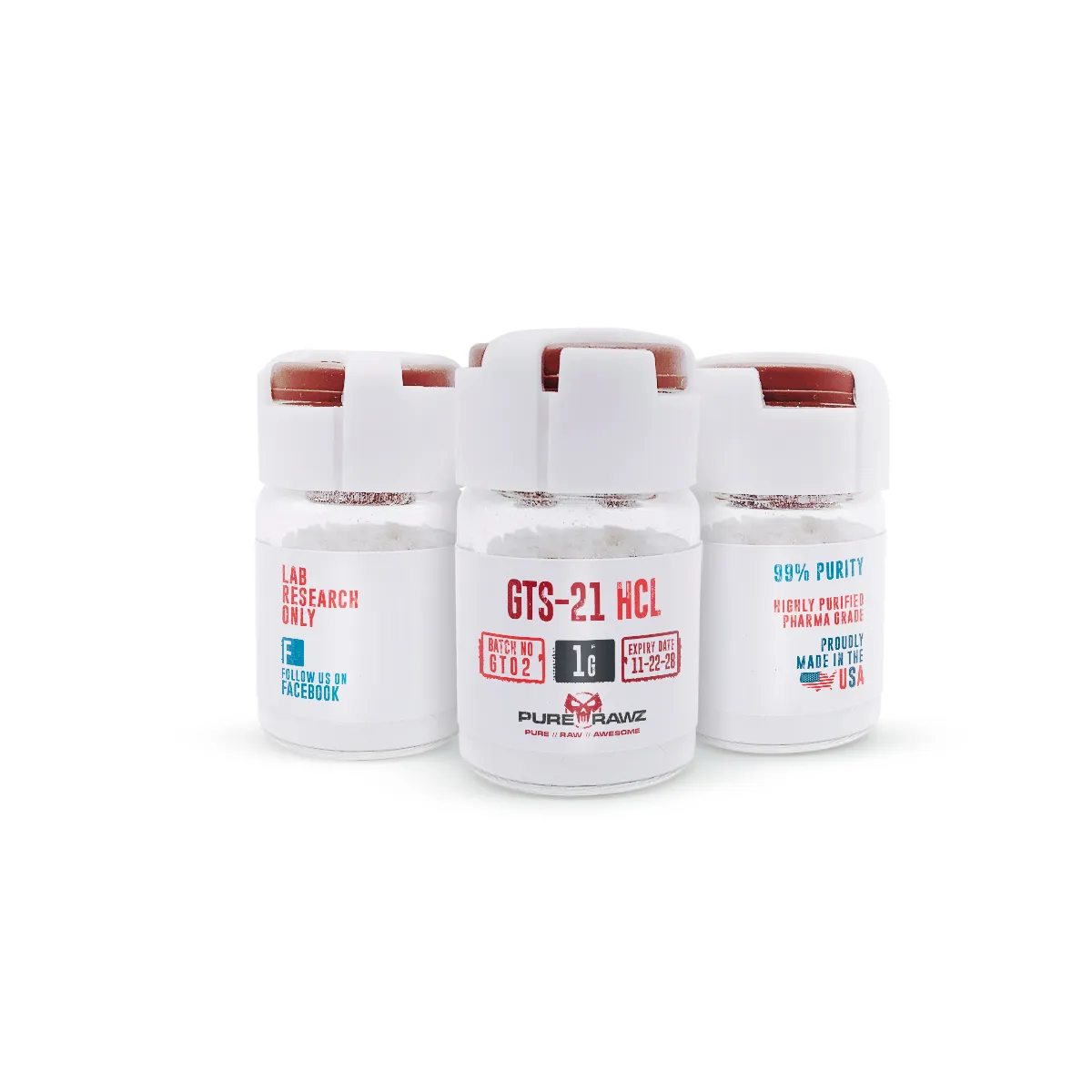


GTS-21 HCl
$29.60
Earn 30 points upon purchasing this product.
✅ 99% Purity – Third-Party Tested
🚚 Free U.S. Shipping on Orders $100+
 Proudly Made in the USA
⚡ Fast & Reliable Shipping
🔒 Secure Checkout Guaranteed
All products are strictly intended for laboratory and research purposes only and are not approved for veterinary or human use.
Description
Overview of GTS-21 HCl
GTS-21 HCl (also known as DMXBA, DMBX-A, or GTS-21 dihydrochloride) is a synthetic derivative of anabaseine, a natural product originally isolated from marine nemertine worms.
Researchers study GTS-21 primarily because it is characterized as a selective agonist at the α7 nicotinic acetylcholine receptor (α7-nAChR), a receptor subtype of particular interest due to its exceptionally high calcium ion selectivity.
Researchers believe that GTS-21 might be a useful compound to study α7 nicotinic receptor signaling, cholinergic anti-inflammatory pathways, and cognition-related neurotransmission in experimental models.
GTS-21 HCl is intended strictly for laboratory research purposes and is not approved for human or animal consumption.
Proposed Mechanism of Action of GTS-21 HCl
Research models have characterized GTS-21 as a selective partial agonist at α7 nicotinic acetylcholine receptors, while also functioning as a moderately potent antagonist at α4β2 receptors and at 5-HT3A receptors.
Investigations using research models have shown that GTS-21 displays neuroprotective activity against toxicity induced by beta-amyloid exposure or nerve growth factor (NGF) deprivation.
Chemical & Molecular Properties
| Property | Description |
| Common Name | GTS-21 HCl (GTS-21 dihydrochloride) |
| Synonyms | DMXBA; DMXB-A; DMBX-A; DMBX-anabaseine; 3-(2,4-Dimethoxybenzylidene)-anabaseine dihydrochloride |
| Chemical Classification | Anabaseine-derived synthetic alkaloid; α7 nicotinic receptor agonist |
| CAS Number | 156223-05-1 (dihydrochloride); 148372-04-7 (free base) |
| InChIKey | BXKYFUGAAFLYJL-BXGYHSFXSA-N |
| IUPAC Name | 3-[(3E)-3-[(2,4-dimethoxyphenyl)methylidene]-5,6-dihydro-4H-pyridin-2-yl]pyridine dihydrochloride |
| Appearance | Solid powder |
| Solubility | Water (~76 mg/mL), DMSO (~25 mg/mL), Ethanol (~3 mg/mL) |
| Storage Stability | Store sealed at +4°C under desiccating conditions |
| Analytical Characterization | HPLC, NMR spectroscopy |
Potential Research Applications of GTS-21 HCl
Researchers investigate GTS-21 HCl under controlled laboratory conditions for the following research applications. Though more extensive study is required.
-
α7 Nicotinic Receptor Signaling Research
Used as a selective reference agonist to study α7-nAChR-mediated calcium signaling and receptor pharmacology in research models.
-
Cholinergic Anti-Inflammatory Pathway Research
Investigated for effects on cytokine release in research models.
-
Neuroprotection Research
Examined in research models for protective effects against beta-amyloid toxicity and NGF-deprivation-induced damage.
Why Researchers Choose Purerawz for GTS-21 HCl Powder
Purerawz offers GTS-21 HCl Powder strictly for research and laboratory investigation purposes. Each batch may be accompanied by supporting documentation, including Certificates of Analysis (CoAs), batch identification details, and analytical testing data to help verify product identity, consistency, and quality.
Researchers are encouraged to examine all available technical documentation and product specifications before use. As with any research material, it is the responsibility of the investigator to determine whether the compound meets the requirements of their specific experimental design, analytical procedures, and laboratory applications.
Frequently Asked Questions
Why is the hydrochloride (HCl) form commonly used?
The hydrochloride salt generally offers improved water solubility and handling characteristics, making it more practical for many laboratory preparations and analytical procedures than the free-base form.
Why do researchers investigate GTS-21 in inflammation studies?
The α7 nicotinic receptor is involved in the cholinergic anti-inflammatory pathway, a signaling mechanism that helps regulate immune responses. GTS-21 is frequently used to explore this pathway in preclinical research.
What does receptor desensitization mean in GTS-21 research?
Like many receptor ligands, prolonged or repeated receptor activation may reduce receptor responsiveness over time. Researchers often examine this phenomenon to better understand receptor regulation and signaling dynamics.
Can GTS-21 be used to compare different α7 receptor modulators?
Yes. GTS-21 is frequently included in comparative studies alongside other α7 receptor agonists and modulators to evaluate differences in receptor activation, efficacy, and pharmacological profiles.
Why is GTS-21 of interest in translational research?
Because α7 nicotinic acetylcholine receptors influence multiple biological pathways, GTS-21 serves as a valuable experimental compound for investigating receptor-targeted strategies across several areas of biomedical research.
Reference Links
Kox, M., van Velzen, J. F., Pompe, J. C., Hoedemaekers, C. W., van der Hoeven, J. G., & Pickkers, P. (2009). GTS-21 inhibits pro-inflammatory cytokine release independent of the Toll-like receptor stimulated via a transcriptional mechanism involving JAK2 activation. Biochemical Pharmacology, 78(7), 863–872. https://doi.org/10.1016/j.bcp.2009.06.096
Rosas-Ballina, M., Goldstein, R. S., Gallowitsch-Puerta, M., Yang, L., Valdés-Ferrer, S. I., Patel, N. B., Chavan, S., Al-Abed, Y., Yang, H., & Tracey, K. J. (2009). The selective alpha7 agonist GTS-21 attenuates cytokine production in human whole blood and human monocytes activated by ligands for TLR2, TLR3, TLR4, TLR9, and RAGE. Molecular Medicine, 15(7–8), 195–202. https://doi.org/10.2119/molmed.2009.00039
Kem, W. R. (2000). The brain alpha7 nicotinic receptor may be an important therapeutic target for the treatment of Alzheimer's disease: Studies with DMXBA (GTS-21). Behavioural Brain Research, 113(1–2), 169–181. https://doi.org/10.1016/S0166-4328(00)00211-4
Stevens, K. E., Kem, W. R., & Freedman, R. (2010). Continuous administration of a selective alpha7 nicotinic partial agonist, DMXBA, improves sensory inhibition without causing tachyphylaxis or receptor upregulation in DBA/2 mice. Neuroscience Letters, 469(3), 349–353. https://doi.org/10.1016/j.neulet.2009.12.024
Disclaimer:
The products sold by Purerawz are intended solely for laboratory and research purposes. They are not FDA-approved for human or animal consumption, and Purerawz does not sell these compounds for use in humans or animals. All compounds are strictly for use by qualified researchers in controlled, non-clinical laboratory environments in compliance with applicable regulations.

About Team PureRawz
Team PureRawz is dedicated to providing accurate, science-based information on research chemicals, including Peptides, Nootropics, and SARMs. Our team of expert writers, researchers, and editors is committed to delivering reliable, up-to-date content you can trust.
Our mission is to build an educated and informed community spanning researchers, laboratories, and general readers empowering them to make confident, well-informed decisions when selecting the right research chemical.
Related products
-

MOTS-c
Price range: $76.96 through $412.40 Select options This product has multiple variants. The options may be chosen on the product page -

Sermorelin + GHRP-2 Blend
$97.81 Select options This product has multiple variants. The options may be chosen on the product page -

Thymosin Alpha 1
Price range: $79.45 through $424.10 Select options This product has multiple variants. The options may be chosen on the product page -

Sermorelin + GHRP-6 Blend
$97.81 Select options This product has multiple variants. The options may be chosen on the product page