

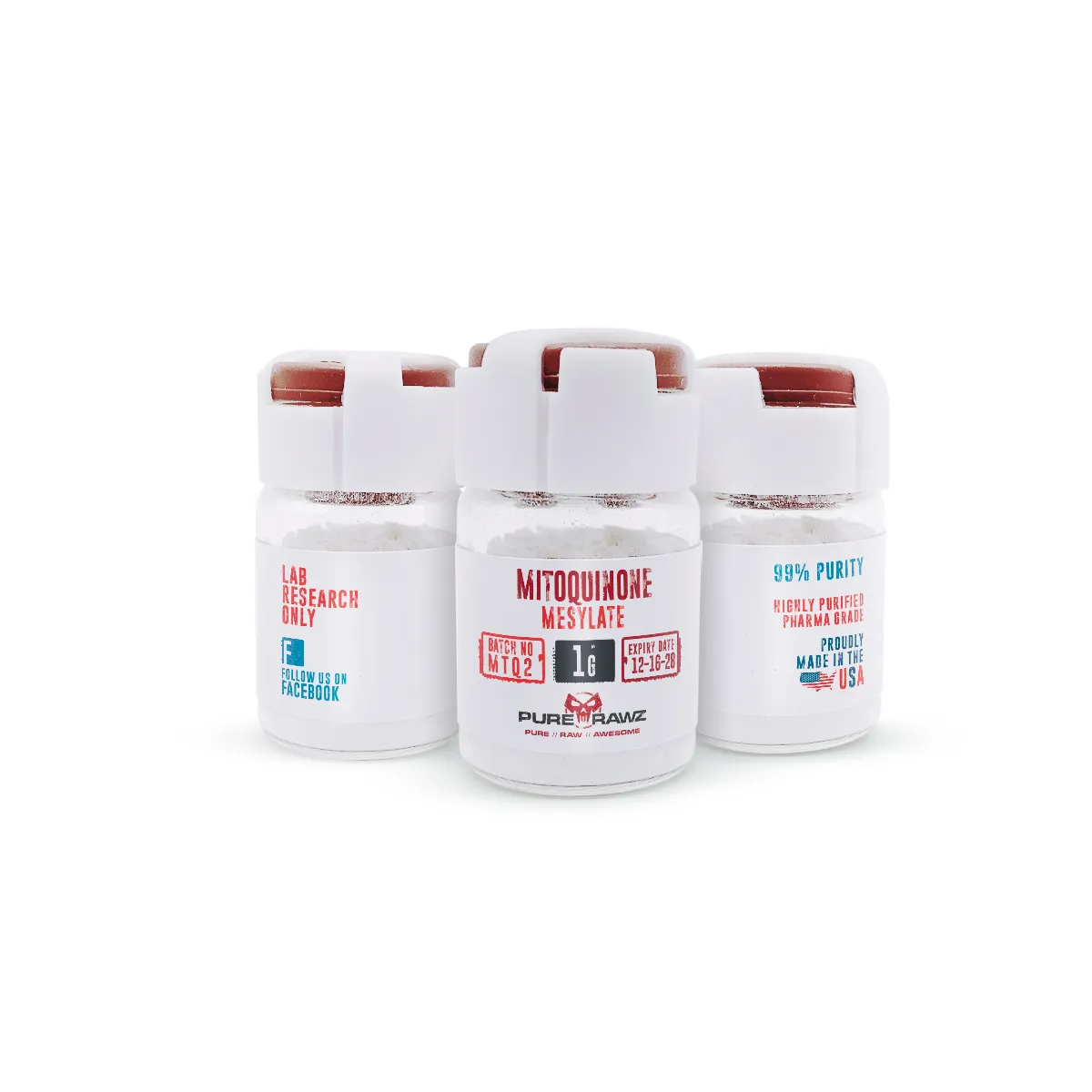


Mitoquinone Mesylate (MitoQ)
$98.99
Earn 99 points upon purchasing this product.
✅ 99% Purity – Third-Party Tested
🚚 Free U.S. Shipping on Orders $100+
 Proudly Made in the USA
⚡ Fast & Reliable Shipping
🔒 Secure Checkout Guaranteed
All products are strictly intended for laboratory and research purposes only and are not approved for veterinary or human use.
Description
Overview of Mitoquinone Mesylate (MitoQ)
Mitoquinone mesylate (MitoQ) is a synthetic analogue of ubiquinone (coenzyme Q10) conjugated to a lipophilic triphenylphosphonium (TPP⁺) cation.
Researchers believe that the structural modification was designed to drive selective accumulation of the antioxidant moiety within the mitochondrial matrix.
Researchers study MitoQ primarily because its TPP⁺-conjugated structure gives it significantly improved mitochondrial penetration compared to unmodified coenzyme Q10.
Researchers believe that MitoQ might be a useful compound to study mitochondrial reactive oxygen species (ROS) scavenging, redox cycling, and downstream inflammatory and apoptotic signaling in experimental models.
MitoQ is intended strictly for laboratory research purposes and is not approved for human or animal consumption.
Proposed Mechanism of Action of MitoQ
Research models have characterized MitoQ's mitochondrial targeting as dependent on its lipophilic TPP⁺ cation, which is well established in the literature to accumulate within the electronegative mitochondrial matrix.
Once inside the mitochondrial matrix, research indicates MitoQ is continually reduced by the respiratory chain to its active ubiquinol form. It then scavenges excess reactive oxygen species (ROS) before being reoxidized and recycled.
Chemical & Molecular Properties
| Property | Description |
| Common Name | Mitoquinone Mesylate (MitoQ) |
| Synonyms | MitoQ10 mesylate; Mitoquinone methanesulfonate; Mito Q10 |
| Chemical Classification | Triphenylphosphonium (TPP⁺)-conjugated ubiquinone derivative; mitochondria-targeted antioxidant |
| Molecular Formula | C₃₈H₄₇O₇PS |
| Molecular Weight | 678.81–678.83 g/mol |
| CAS Number | 845959-50-4 |
| PubChem CID | 11388331 |
| UNII | 6E01CG547T |
| InChIKey | GVZFUVXPTPGOQT-UHFFFAOYSA-M |
| IUPAC Name | [10-(4,5-Dimethoxy-2-methyl-3,6-dioxocyclohexa-1,4-dien-1-yl)decyl]triphenylphosphanium methanesulfonate |
| Solubility | Water: up to 100 mg/mL (ultrasonication required); DMSO and ethanol: up to 100 mg/mL |
| Storage Stability | Store sealed at -20°C, protected from moisture |
| Analytical Characterization | HPLC, NMR spectroscopy |
Potential Research Applications of MitoQ
Researchers investigate MitoQ under controlled laboratory conditions for the following research applications. Though more extensive study is required.
- Mitochondrial Oxidative Stress and ROS Scavenging Research
Used as a reference mitochondria-targeted antioxidant to study reactive oxygen species scavenging and lipid peroxidation inhibition in research models.
- Inflammasome and Inflammatory Signaling Research
Investigated for effects on NLRP3 inflammasome activation and downstream inflammatory cytokine production in preclinical models.
- Metabolic and Pancreatic Cell Research
Investigated in pancreatic β-cell models for effects on oxidative stress and insulin secretion under glucotoxicity and glucolipotoxicity conditions.
Why Order MitoQ Powder from Purerawz?
At Purerawz, MitoQ Powder is supplied exclusively for research and analytical purposes, with an emphasis on quality and consistency. Available supporting documentation may include batch records, Certificates of Analysis (CoAs), and analytical testing data to assist laboratories in confirming product identity and evaluating key quality attributes.
Since research methodologies and experimental goals vary, investigators should carefully review all available technical information before use. Assessing the provided specifications and analytical documentation helps ensure the material is suitable for the intended laboratory procedures and research applications.
Frequently Asked Questions
What makes MitoQ different from conventional antioxidants?
MitoQ is designed with a triphenylphosphonium (TPP+) moiety attached to a quinone structure, allowing researchers to investigate a mitochondria-targeted antioxidant rather than a non-targeted redox compound.
Why is the triphenylphosphonium (TPP+) group important in MitoQ?
The TPP+ group is a lipophilic cation that enables MitoQ to associate with mitochondrial membranes under experimental conditions, making it a valuable tool for studying mitochondrial redox processes.
Which analytical techniques are commonly used to characterize MitoQ?
Researchers commonly use high-performance liquid chromatography (HPLC), liquid chromatography-mass spectrometry (LC-MS), nuclear magnetic resonance (NMR), and ultraviolet-visible (UV-Vis) spectroscopy to verify identity, purity, and structural integrity.
Why is MitoQ widely studied in mitochondrial research?
MitoQ serves as a useful research compound for investigating mitochondrial function, oxidative processes, cellular bioenergetics, and redox signaling in controlled laboratory experiments.
What should researchers review before using MitoQ Powder?
Before beginning experimental work, investigators should examine the available Certificate of Analysis (CoA), batch-specific analytical data, storage recommendations, and product specifications to confirm the material aligns with their laboratory protocols and research objectiv
Reference Links
Kelso, G. F., Porteous, C. M., Coulter, C. V., Hughes, G., Porteous, W. K., Ledgerwood, E. C., Smith, R. A. J., & Murphy, M. P. (2001). Selective targeting of a redox-active ubiquinone to mitochondria within cells: Antioxidant and antiapoptotic properties. Journal of Biological Chemistry, 276(7), 4588–4596. https://doi.org/10.1074/jbc.M009093200
Mitchell, T., Rotaru, D., Saba, H., Smith, R. A. J., Murphy, M. P., & MacMillan-Crow, L. A. (2011). The mitochondria-targeted antioxidant mitoquinone protects against cold storage injury of renal tubular cells and rat kidneys. Journal of Pharmacology and Experimental Therapeutics, 336(3), 682–692. https://doi.org/10.1124/jpet.110.176743
Dashdorj, A., Jyothi, K. R., Lim, S., Jo, A., Nguyen, M. N., Ha, J., Yoon, K.-S., Kim, H. J., Park, J.-H., Murphy, M. P., & Kim, S. S. (2013). Mitochondria-targeted antioxidant MitoQ ameliorates experimental mouse colitis by suppressing NLRP3 inflammasome-mediated inflammatory cytokines. BMC Medicine, 11, 178. https://www.ncbi.nlm.nih.gov/pmc/articles/PMC3750576/
McManus, M. J., Murphy, M. P., & Franklin, J. L. (2011). The mitochondria-targeted antioxidant MitoQ prevents loss of spatial memory retention and early neuropathology in a transgenic mouse model of Alzheimer's disease. Journal of Neuroscience, 31(44), 15703–15715. https://doi.org/10.1523/JNEUROSCI.0552-11.2011
Ashraf, R., et al. (2022). Pharmacological significance of MitoQ in ameliorating mitochondria-related diseases. Advances in Redox Research. https://doi.org/10.1016/j.arres.2022.100034
Disclaimer:
The products sold by Purerawz are intended solely for laboratory and research purposes. They are not FDA-approved for human or animal consumption, and Purerawz does not sell these compounds for use in humans or animals. All compounds are strictly for use by qualified researchers in controlled, non-clinical laboratory environments in compliance with applicable regulations.

About Team PureRawz
Team PureRawz is dedicated to providing accurate, science-based information on research chemicals, including Peptides, Nootropics, and SARMs. Our team of expert writers, researchers, and editors is committed to delivering reliable, up-to-date content you can trust.
Our mission is to build an educated and informed community spanning researchers, laboratories, and general readers empowering them to make confident, well-informed decisions when selecting the right research chemical.
Related products
-

Kava Extract 70% Kavalactones
Price range: $19.66 through $47.52 Select options This product has multiple variants. The options may be chosen on the product page -

PRL-8-53
Price range: $57.37 through $92.36 Select options This product has multiple variants. The options may be chosen on the product page -

Agrocybe 30% Bisporiust
Price range: $26.77 through $56.28 Select options This product has multiple variants. The options may be chosen on the product page -

Piracetam
$24.08 Select options This product has multiple variants. The options may be chosen on the product page