

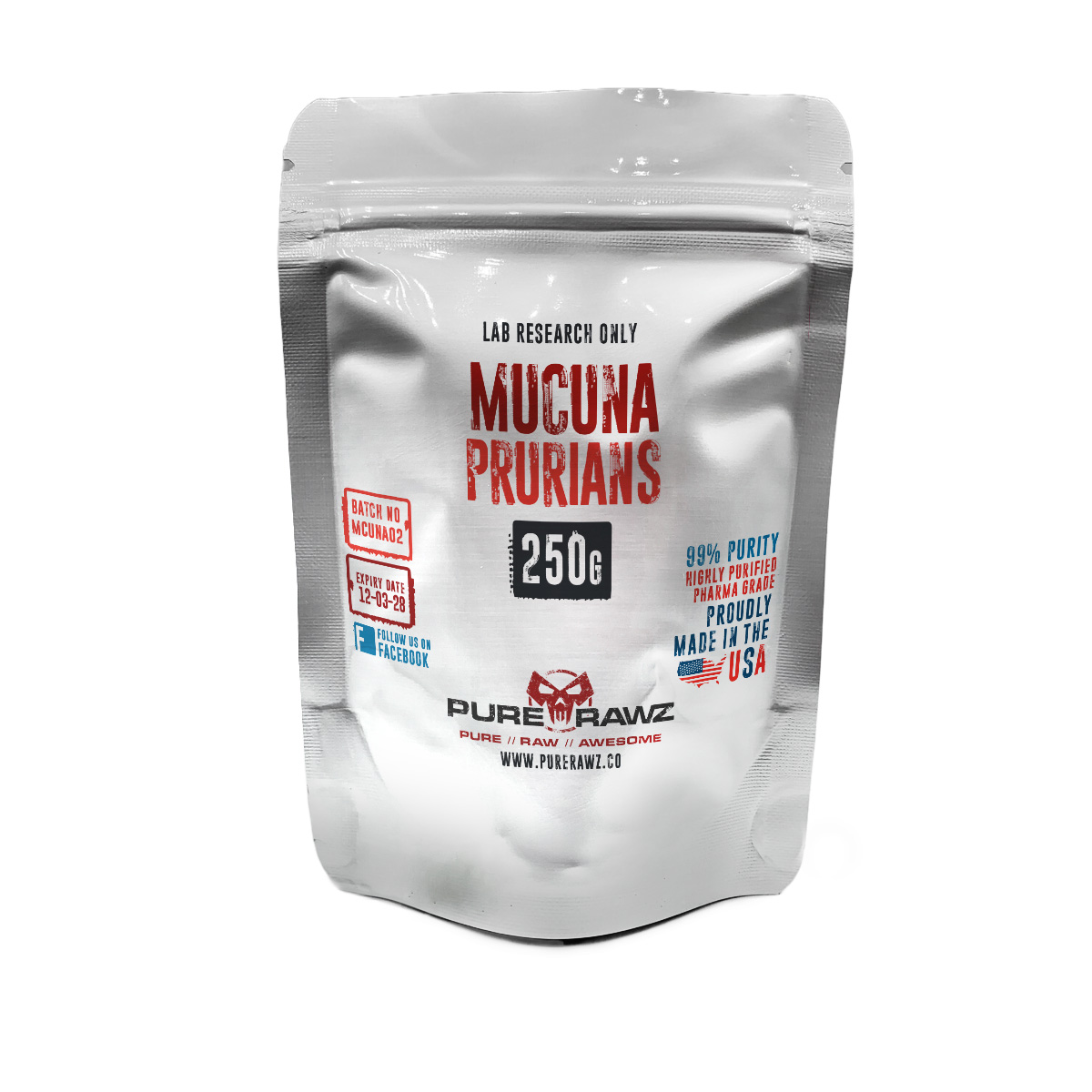


Mucuna Pruriens Extract (20% L-Dopa) Powder
Price range: $20.00 through $35.75
Earn 20 - 36 points upon purchasing this product.
✅ 99% Purity – Third-Party Tested
🚚 Free U.S. Shipping on Orders $100+
 Proudly Made in the USA
⚡ Fast & Reliable Shipping
🔒 Secure Checkout Guaranteed
All products are strictly intended for laboratory and research purposes only and are not approved for veterinary or human use.
Description
Mucuna Pruriens Extract (20% L-Dopa) Powder is a standardized botanical extract derived from the seeds of Mucuna pruriens, commonly known as Velvet Bean. The extract is standardized to contain 20% L-Dopa (Levodopa), a naturally occurring compound that serves as a precursor to dopamine. Due to its concentrated L-Dopa content, Mucuna pruriens has become a subject of interest in neurotransmitter, neurobiology, and phytochemical research.
This extract provides a consistent concentration of naturally occurring L-Dopa, making it suitable for laboratory investigations that require standardized botanical materials.
For Research Use Only. Not intended for human consumption.
What Is Mucuna Pruriens?
Mucuna pruriens is a tropical legume native to Africa and Asia and has been cultivated for centuries in traditional agricultural and herbal practices. The plant is recognized for its seeds, which naturally contain L-Dopa along with other phytochemicals, including alkaloids, phenolic compounds, and antioxidants.
The seeds of Mucuna pruriens are the primary source used to produce concentrated extracts standardized for L-Dopa content. Standardization helps provide a consistent composition compared to raw seed powders, making extracts more suitable for research applications.
What Is L-Dopa?
L-Dopa, also known as Levodopa, is a naturally occurring amino acid derivative involved in the biosynthesis of dopamine. In biological systems, L-Dopa acts as a direct precursor to dopamine, one of the body's primary neurotransmitters.
Because dopamine plays a role in numerous physiological processes, researchers continue to investigate L-Dopa-containing botanicals to better understand dopamine synthesis, neurotransmitter regulation, and related biochemical pathways.
Key Features of Mucuna Pruriens Extract (20% L-Dopa)
- Standardized to contain 20% naturally occurring L-Dopa.
- Derived from the seeds of Mucuna pruriens (Velvet Bean).
- Concentrated botanical extract with consistent composition.
- Fine powder suitable for laboratory handling.
- Batch-tested for identity and purity.
- Manufactured under controlled quality standards.
Why Researchers Study Mucuna Pruriens Extract
Dopamine Biosynthesis Research
L-Dopa is an important intermediate in dopamine production. Researchers frequently investigate L-Dopa-containing compounds to better understand dopamine synthesis pathways and neurotransmitter metabolism.
Neurobiology Research
Mucuna pruriens extract is studied in neurobiology because of its naturally occurring L-Dopa content and its relationship to dopaminergic signaling pathways. Research in this area focuses on neurotransmitter activity and neuronal communication mechanisms.
Oxidative Stress Research
The seeds of Mucuna pruriens contain several naturally occurring phytochemicals that have been evaluated for their antioxidant properties. Researchers continue to investigate these compounds and their interactions with cellular oxidative stress mechanisms.
Phytochemical Research
Mucuna pruriens contains multiple bioactive constituents beyond L-Dopa. Standardized extracts provide researchers with a reproducible material for studying the chemical composition and biological properties of the plant.
Why Choose a Standardized 20% L-Dopa Extract?
Higher Concentration
A standardized extract contains a significantly higher concentration of L-Dopa compared to raw seed powder, providing a more concentrated botanical material for analytical purposes.
Consistent Composition
Standardization ensures that each batch contains a defined amount of L-Dopa, reducing variability between samples.
Improved Reproducibility
Consistent composition is important for laboratory investigations that require repeatable and controlled experimental conditions.
Potential Research Applications
Mucuna Pruriens Extract (20% L-Dopa) Powder is commonly utilized in:
- Dopamine metabolism research.
- Neurotransmitter pathway investigations.
- Neurobiology studies.
- Phytochemical characterization.
- Botanical extract research.
- Antioxidant mechanism studies.
- Analytical and laboratory applications involving standardized plant extracts.
Product Specifications
| Common Names | Mucuna pruriens, Velvet Bean, Kapikacchu, Cowitch, Buffalo Bean |
| Botanical Family | Fabaceae (Leguminosae) |
| Active Constituent | L-3,4-dihydroxyphenylalanine (L-Dopa / Levodopa) |
| L-Dopa CAS Number | 59-92-7 |
| L-Dopa Molecular Formula | C₉H₁₁NO₄ |
| L-Dopa Molecular Weight | 197.19 g/mol |
| Standardization | Minimum 20% L-Dopa by HPLC |
| Extract Ratio | Concentrated standardized extract from Mucuna pruriens seeds |
| Active L-Dopa Per Gram | 200 mg |
| Package Size | 250 g |
| Total L-Dopa Per Package | 50,000 mg L-Dopa |
| Physical Form | Standardized powdered extract |
| Color | Light beige to off-white |
| Solubility | Partial in water; improved in mildly acidic aqueous solutions |
| Storage | 15–25°C, sealed, away from light and moisture; refrigeration for long-term archival |
| Intended Use | Laboratory and preclinical research only - not for human or animal consumption |
Quality and Testing
Batches of Mucuna Pruriens Extract (20% L-Dopa) Powder undergo quality verification procedures, including identity testing and purity assessment. Standardized manufacturing and analytical testing help ensure product consistency and reliability for laboratory use.
A Certificate of Analysis (COA) is available to verify product specifications and batch information.
Frequently Asked Questions
What is Mucuna Pruriens Extract?
Mucuna Pruriens Extract is a concentrated botanical extract derived from the seeds of Mucuna pruriens and standardized to contain a specified amount of naturally occurring L-Dopa.
What does 20% L-Dopa mean?
The standardization indicates that approximately 20% of the extract's composition consists of naturally occurring L-Dopa.
How is this different from raw Mucuna powder?
Raw Mucuna powder contains varying amounts of L-Dopa, whereas a standardized extract provides a more consistent and concentrated composition.
Why is Mucuna Pruriens studied?
Researchers study Mucuna pruriens because of its naturally occurring L-Dopa content and its phytochemical composition, particularly in investigations involving neurotransmitter pathways and botanical compounds.
Research Use Disclaimer
This product is intended for laboratory and research purposes only. It is not intended to diagnose, treat, cure, or prevent any disease and is not intended for human consumption.
References
- Kamkaen, N., Chittasupho, C., Vorarat, S., Tadtong, S., Phrompittayarat, W., Okonogi, S., et al. (2022). Mucuna pruriens Seed Aqueous Extract Improved Neuroprotective and Acetylcholinesterase Inhibitory Effects Compared with Synthetic L-Dopa. Molecules, 27(10), 3131. https://doi.org/10.3390/molecules27103131
- Bertoni, S., Bruni, R., Brighenti, V., Pellati, F., Benvenuti, S. (2018). Levodopa-Reduced Mucuna pruriens Seed Extract Shows Neuroprotective Effects against Parkinson's Disease in Murine Microglia and Human Neuroblastoma Cells, Caenorhabditis elegans, and Drosophila melanogaster. Oxidative Medicine and Cellular Longevity, 2018, 8413684. https://doi.org/10.1155/2018/8413684
- Singh, A., Sarkar, S., Tripathi, M., Rajender, S. (2013). Mucuna pruriens and Its Major Constituent L-DOPA Recover Spermatogenic Loss by Combating ROS, Loss of Mitochondrial Membrane Potential and Apoptosis. PLOS ONE, 8(1), e54655. https://doi.org/10.1371/journal.pone.0054655
- Soumyanath, A., Denne, T., Peterson, A., Shinto, L. (2012). Assessment of commercial formulations of Mucuna pruriens seeds for Levodopa (L-DOPA) content. BMC Complementary and Alternative Medicine, 12(Suppl 1), P36. https://doi.org/10.1186/1472-6882-12-S1-P36

About Team PureRawz
Team PureRawz is dedicated to providing accurate, science-based information on research chemicals, including Peptides, Nootropics, and SARMs. Our team of expert writers, researchers, and editors is committed to delivering reliable, up-to-date content you can trust.
Our mission is to build an educated and informed community spanning researchers, laboratories, and general readers empowering them to make confident, well-informed decisions when selecting the right research chemical.
Related products
-

S-23 SARM
Price range: $57.83 through $139.79 Select options This product has multiple variants. The options may be chosen on the product page -

Yohimbine HCL
Price range: $23.29 through $61.86 Select options This product has multiple variants. The options may be chosen on the product page -

RU-58841
Price range: $101.09 through $107.65 Select options This product has multiple variants. The options may be chosen on the product page -

AC-262
Price range: $38.44 through $152.06 Select options This product has multiple variants. The options may be chosen on the product page