

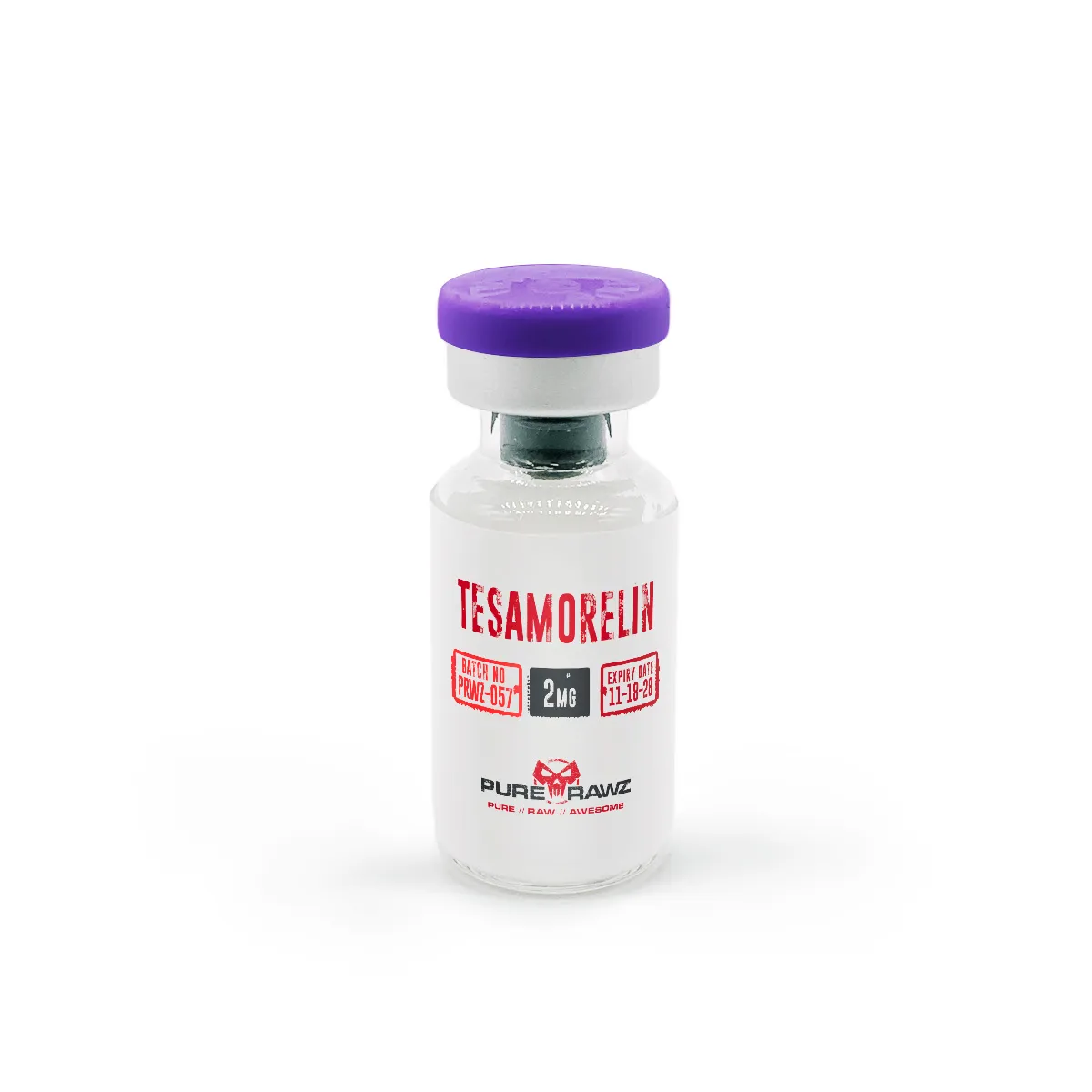


Tesamorelin
Price range: $6.04 through $1,228.30
Earn 6 - 1228 points upon purchasing this product.
Note: We recommend using sterile Bacteriostatic Water for reconstitution.
✅ 99% Purity – Third-Party Tested
🚚 Free U.S. Shipping on Orders $100+
 Proudly Made in the USA
⚡ Fast & Reliable Shipping
🔒 Secure Checkout Guaranteed
All products are strictly intended for laboratory and research purposes only and are not approved for veterinary or human use.
Description
TH9507 (Tesamorelin) Overview
TH9507 (Tesamorelin) is a synthetic 44-amino acid analog of endogenous human growth hormone-releasing hormone (GHRH). It was developed to improve metabolic stability while retaining affinity for the growth hormone-releasing hormone receptor (GHRHR). Compared with native GHRH, TH9507 incorporates a modified N-terminal trans-3-hexenoic acid residue intended to reduce enzymatic degradation.
Experimental studies suggest this N-terminal modification reduces susceptibility to cleavage by dipeptidyl peptidase-IV (DPP-IV), contributing to improved peptide stability under controlled laboratory conditions. Due to these structural characteristics, TH9507 is commonly investigated in laboratory research involving GHRHR signaling, peptide stability, and receptor–ligand interactions.
Proposed Mechanism of Action of TH9507 in Research Settings
In experimental models, TH9507 binds to the growth hormone-releasing hormone receptor (GHRHR), activating Gs protein-dependent intracellular signaling.
This receptor activation is commonly investigated to evaluate ligand-dependent signaling responses and downstream molecular activity.
Studies indicate one primary signaling mechanism may involve activation of adenylate cyclase. This may increase intracellular cyclic adenosine monophosphate (cAMP) levels. Elevated cAMP is frequently measured as a biomarker in peptide signaling assays.
Following GHRHR activation, intracellular signaling primarily involves the cAMP/PKA pathway and downstream CREB phosphorylation. MAPK/ERK signaling has also been investigated in experimental models.
Chemical Properties of TH9507
| PubChem CID | 16137828 |
| Molecular Formula | C221H366N72O67S |
| Molecular Weight | 5135.9 g/mol |
| CAS | 218949-48-5 |
| Synonyms | TH9507 MQG94M5EEO 218949-48-5 DTXSID00583207 |
| Solubility | Water: Freely soluble. Acetic Acid: Freely soluble. Methanol: Slightly soluble. |
| 2D Structure |  |
Possible Research Applications of TH9507
Further studies are needed to fully characterize TH9507 across experimental systems.
-
Receptor Binding Research
TH9507 is commonly studied in receptor-binding models to evaluate interaction with the growth hormone-releasing hormone receptor (GHRHR).
Researchers may assess binding affinity, receptor selectivity, and ligand-induced conformational changes using in vitro assays.
-
Signal Transduction Research
TH9507 is used to investigate intracellular signaling following receptor activation.
Research often focuses on pathway modulation involving cAMP, protein kinase A (PKA), CREB phosphorylation, and related signaling intermediates.
-
Peptide Stability Research
TH9507 is also studied for structural stability and degradation resistance.
Researchers analyze susceptibility to enzymatic cleavage, peptide integrity, and half-life using analytical assays such as HPLC and LC-MS/MS.
-
Structure–Activity Relationship Research
TH9507 may support studies examining how peptide modifications influence biological activity.
These investigations help evaluate sequence-dependent changes in receptor interaction, signaling efficiency, and molecular stability.
What makes TH9507 different from native GHRH?
Studies indicate TH9507 contains a modified N-terminal residue that distinguishes it from native GHRH. This structural change is commonly studied for its potential impact on peptide stability and degradation resistance in research settings.
Why is GHRHR important in TH9507 research?
The growth hormone-releasing hormone receptor (GHRHR) is the primary receptor associated with TH9507 activity. In preclinical studies, researchers examine this receptor to understand ligand binding, receptor activation, and downstream signaling behavior.
How should TH9507 be stored for research purposes?
TH9507 should be stored under conditions appropriate for peptide stability according to laboratory best practices. Lyophilized (freeze-dried) TH9507 is generally more stable when stored at low temperatures in a dry, light-protected environment. After reconstitution, researchers typically prepare aliquots to minimize repeated freeze–thaw cycles, as these may affect peptide integrity over time. Storage conditions should always follow the manufacturer's recommendations and be verified experimentally for the intended research application.
How is TH9507 analyzed for quality and identity?
TH9507 is commonly characterized using analytical techniques such as reverse-phase high-performance liquid chromatography (RP-HPLC) to assess peptide purity and liquid chromatography–mass spectrometry (LC-MS) to verify molecular identity. These methods are routinely used in research laboratories for peptide characterization.
What does TH9507 typically look like?
TH9507 is generally supplied as a white to off-white lyophilized (freeze-dried) powder for laboratory research. Its appearance may vary slightly depending on the manufacturing process and storage conditions but should be evaluated alongside the accompanying analytical documentation.
How is the purity of TH9507 verified?
The purity of TH9507 is typically determined using RP-HPLC, while LC-MS is used to confirm its molecular identity. Researchers often review Certificates of Analysis (COAs) and analytical reports to verify that the material meets the specifications required for their experimental applications.
Why Buy TH9507 from Purerawz?
Purerawz provides TH9507 for laboratory research with an emphasis on product transparency and analytical documentation. For research compounds such as TH9507, access to detailed specifications may help researchers better evaluate product quality before procurement.
Researchers often consider factors such as third-party testing, Certificates of Analysis (COAs), and analytical reports including HPLC and LC-MS data.
Disclaimer
This information is for educational purposes only and does not constitute medical advice. THE PRODUCTS DESCRIBED HEREIN ARE FOR LABORATORY AND RESEARCH USE ONLY. All clinical research must be conducted with oversight from the appropriate Institutional Review Board (IRB).
All preclinical research must be conducted with oversight from the appropriate Institutional Animal Care and Use Committee (IACUC) following the guidelines of the Animal Welfare Act (AWA).
Our content is intended to be used and must be used for informational purposes only. It is very important to do your own analysis and research from Trusted Sources before making any purchase, based on your personal circumstances. You should independently research and verify any information that you find on our Website and wish to rely upon.
By completing and paying for your order, you agree to our Terms and Conditions. Customer satisfaction is our number one priority. If you are not 100% satisfied with the product you received, please contact us at support@purerawz.co
ATTENTION: All our products are for LABORATORY AND RESEARCH PURPOSES ONLY, not for veterinary or human usage.
Reference Links
- DeAlmeida, V. I., & Mayo, K. E. (2001). The growth hormone-releasing hormone receptor. Vitamins and Hormones, 63, 233–276. https://doi.org/10.1016/S0083-6729(01)63008-5
- Gaylinn, B. D. (1999). Molecular and cell biology of the growth hormone-releasing hormone receptor. Growth Hormone & IGF Research, 9(Suppl A), 37–44. https://doi.org/10.1016/S1096-6374(99)80008-2
- Miller, T. L., Godfrey, P. A., DeAlmeida, V. I., & Mayo, K. E. (1999). The rat growth hormone-releasing hormone receptor gene: Structure, regulation, and generation of receptor isoforms with different signaling properties. Endocrinology, 140(9), 4152–4165. https://doi.org/10.1210/endo.140.9.6977
- Koutkia, P., Canavan, B., Breu, J., Torriani, M., Kissko, K., & Grinspoon, S. K. (2004). Growth hormone-releasing hormone in HIV-infected men with lipodystrophy: A randomized controlled trial. JAMA, 292(2), 210–218. https://doi.org/10.1001/jama.292.2.210
- Canadian Agency for Drugs and Technologies in Health. (2018). Clinical Review Report: Tesamorelin (Egrifta). National Center for Biotechnology Information. https://www.ncbi.nlm.nih.gov/books/NBK539131/

About Team PureRawz
Team PureRawz is dedicated to providing accurate, science-based information on research chemicals, including Peptides, Nootropics, and SARMs. Our team of expert writers, researchers, and editors is committed to delivering reliable, up-to-date content you can trust.
Our mission is to build an educated and informed community spanning researchers, laboratories, and general readers empowering them to make confident, well-informed decisions when selecting the right research chemical.
Related products
-

Thymosin Alpha 1
Price range: $79.45 through $424.10 Select options This product has multiple variants. The options may be chosen on the product page -

Sermorelin + GHRP-2 Blend
$97.81 Select options This product has multiple variants. The options may be chosen on the product page -

Spartan 3 (Mod GRF 1-29 + GHRP-6)
$97.81 Select options This product has multiple variants. The options may be chosen on the product page -

Myostatin
$147.55 Select options This product has multiple variants. The options may be chosen on the product page