

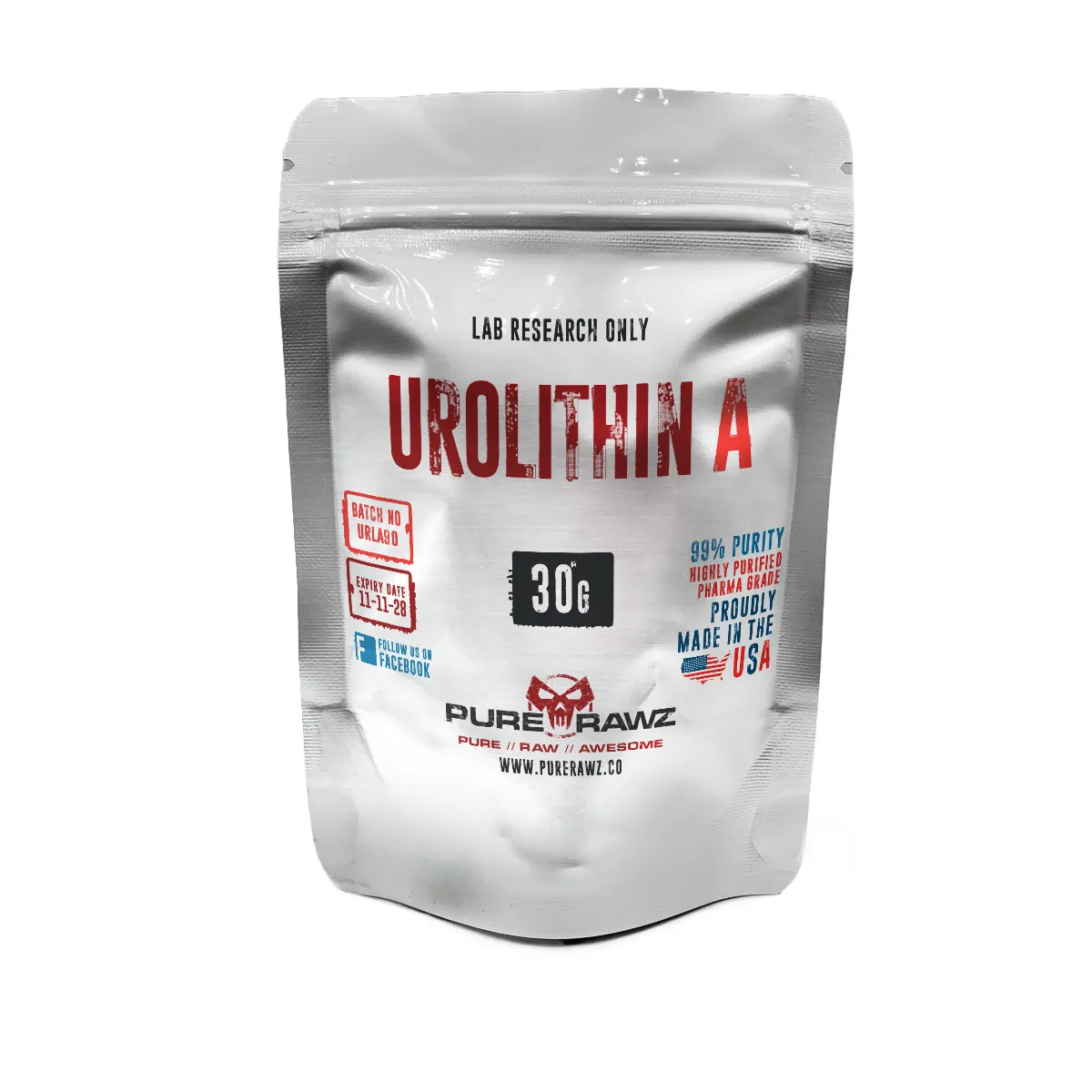

Urolithin A Powder
$88.75
Earn 89 points upon purchasing this product.
✅ 99% Purity – Third-Party Tested
🚚 Free U.S. Shipping on Orders $100+
 Proudly Made in the USA
⚡ Fast & Reliable Shipping
🔒 Secure Checkout Guaranteed
All products are strictly intended for laboratory and research purposes only and are not approved for veterinary or human use.
Description
Overview of Urolithin A Powder
Urolithin A is a gut microbiota-derived metabolite of dietary ellagitannins and ellagic acid, compounds found in high concentration in pomegranates, walnuts, and certain berries.
Since it is produced through bacterial transformation of dietary tannins rather than being present in the food itself, Urolithin A is classified in the research literature as a postbiotic metabolite.
Urolithin A is intended strictly for laboratory research purposes and is not approved for human or animal consumption.
Proposed Mechanism of Action of Urolithin A Powder
Preclinical research has characterized Urolithin A as a first-in-class inducer of mitophagy — the selective degradation of defective mitochondria.
Mechanistic research further indicates that Urolithin A shifts mitochondrial respiration from Complex I-driven to Complex II-driven pathways, a shift studied in relation to its mitophagy-inducing activity.
Beyond mitochondrial quality control, Urolithin A has been studied for anti-inflammatory and antioxidant effects.
Chemical & Molecular Properties
| Property | Description |
| Common Name | Urolithin A |
| Synonyms | 3,8-Dihydroxy Urolithin; 2',7-Dihydroxy-3,4-benzocoumarin |
| Chemical Classification | Ellagitannin-derived postbiotic metabolite (benzocoumarin/dibenzopyranone class) |
| Molecular Formula | C₁₃H₈O₄ |
| Molecular Weight | 228.20 g/mol |
| CAS Number | 1143-70-0 |
| Purity (Reference Grade) | >98% (HPLC, NMR-confirmed) |
| Storage Stability | Store dry, dark, and refrigerated (0–4°C) short-term; -20°C long-term |
| Analytical Characterization | HPLC, NMR spectroscopy |
Note: Molecular weight can vary slightly batch-to-batch depending on the degree of hydration; the batch-specific value on the CoA should be used when preparing stock solutions.
Potential Research Applications of Urolithin A Powder
Researchers investigate Urolithin A powder under controlled laboratory conditions for the following research applications. Though more extensive study is required.
-
Mitophagy and Mitochondrial Quality Control Research
Studied as a reference inducer of selective mitochondrial degradation in research models.
-
Neuroinflammation and Neurodegeneration Research
Studied in research models for effects on microglial inflammasome activation and amyloid-beta-induced toxicity.
-
Immunology and T-Cell Signaling Research
Investigated effects on calcium signaling and anti-tumor T-cell function in investigational models.
-
Comparative Postbiotic Metabolite Research
Used alongside related urolithins (B, C, D) and iso-urolithin A in comparative structure-activity studies.
Frequently Asked Questions
What cellular pathway is Urolithin A best known for?
Urolithin A is primarily studied for its ability to promote mitophagy, a selective form of autophagy that removes dysfunctional mitochondria. Mitophagy helps maintain mitochondrial quality and cellular energy homeostasis, making it an important area of aging and metabolic research.
What makes Urolithin A different from other mitochondrial research compounds?
Unlike compounds that are studied to increase cellular energy production, Urolithin A is being studied for its role in mitochondrial quality control. Its research focuses on helping cells recycle damaged mitochondria through mitophagy rather than simply increasing mitochondrial activity.
Which biomarkers are commonly evaluated in Urolithin A studies?
Research commonly examines biomarkers related to mitochondrial function, ATP production, reactive oxygen species (ROS), mitochondrial membrane potential, autophagy-related proteins, and mitophagy-associated signaling pathways.
Why is Urolithin A classified as a postbiotic metabolite?
Urolithin A is formed through microbial metabolism of dietary ellagitannins and ellagic acid, making it a microbial-derived metabolite that is commonly classified as a postbiotic in scientific literature.
What analytical techniques are used to characterize Urolithin A?
Researchers commonly use high-performance liquid chromatography (HPLC), liquid chromatography-mass spectrometry (LC-MS), nuclear magnetic resonance (NMR), and other analytical methods to evaluate the identity and purity of Urolithin A.
Why Researchers Source Urolithin A from Purerawz?
Purerawz supplies Urolithin A exclusively for laboratory research and analytical applications. Available product documentation may include batch-specific information, certificates of analysis (CoAs), and analytical characterization data to assist researchers in evaluating material identity and quality for experimental use.
As with all research materials, investigators should independently review the available specifications and supporting documentation to determine whether the material is appropriate for their intended laboratory protocols and research objectives.
Disclaimer:
The products sold by Purerawz are intended solely for laboratory and research purposes. They are not FDA-approved for human or animal consumption, and Purerawz does not sell these compounds for use in humans or animals. All compounds are strictly for use by qualified researchers in controlled, non-clinical laboratory environments in compliance with applicable regulations.
Reference Links
Ryu, D., Mouchiroud, L., Andreux, P. A., Katsyuba, E., Moullan, N., Nicolet-Dit-Félix, A. A., Williams, E. G., Jha, P., Lo Sasso, G., Huzard, D., Aebischer, P., Sandi, C., Rinsch, C., & Auwerx, J. (2016). Urolithin A induces mitophagy and prolongs lifespan in C. elegans and increases muscle function in rodents. Nature Medicine, 22(8), 879–888. https://doi.org/10.1038/nm.4132
Qiu, J., Chen, Y., Zhuo, J., Zhang, L., Liu, J., Wang, B., Sun, D., Yu, S., & Lou, H. (2022). Urolithin A promotes mitophagy and suppresses NLRP3 inflammasome activation in lipopolysaccharide-induced BV2 microglial cells and MPTP-induced Parkinson's disease model. Neuropharmacology, 207, Article 108963. https://doi.org/10.1016/j.neuropharm.2022.108963
Jayatunga, D. P. W., Hone, E., Khaira, H., Lunelli, T., Singh, H., Guillemin, G. J., Fernando, B., Verdile, G., & Martins, R. N. (2021). Therapeutic potential of mitophagy-inducing microflora metabolite, Urolithin A for Alzheimer's disease. Nutrients, 13(11), Article 3744. https://doi.org/10.3390/nu13113744
Lin, J., Cheng, A., Cheng, K., Deng, Q., Zhang, S., Lan, Z., Wang, W., & Chu, J. (2020). Urolithin A-induced mitophagy suppresses apoptosis and attenuates intervertebral disc degeneration via the AMPK signaling pathway. Free Radical Biology and Medicine, 150, 109–119. https://doi.org/10.1016/j.freeradbiomed.2020.02.024

About Team PureRawz
Team PureRawz is dedicated to providing accurate, science-based information on research chemicals, including Peptides, Nootropics, and SARMs. Our team of expert writers, researchers, and editors is committed to delivering reliable, up-to-date content you can trust.
Our mission is to build an educated and informed community spanning researchers, laboratories, and general readers empowering them to make confident, well-informed decisions when selecting the right research chemical.
Related products
-

Agrocybe 30% Bisporiust
Price range: $26.77 through $56.28 Select options This product has multiple variants. The options may be chosen on the product page -

Compound 7P
$62.85 Select options This product has multiple variants. The options may be chosen on the product page -

Galantamine Hydrobromide
$57.37 Select options This product has multiple variants. The options may be chosen on the product page -

Pramiracetam
Price range: $8.59 through $18.91 Select options This product has multiple variants. The options may be chosen on the product page