

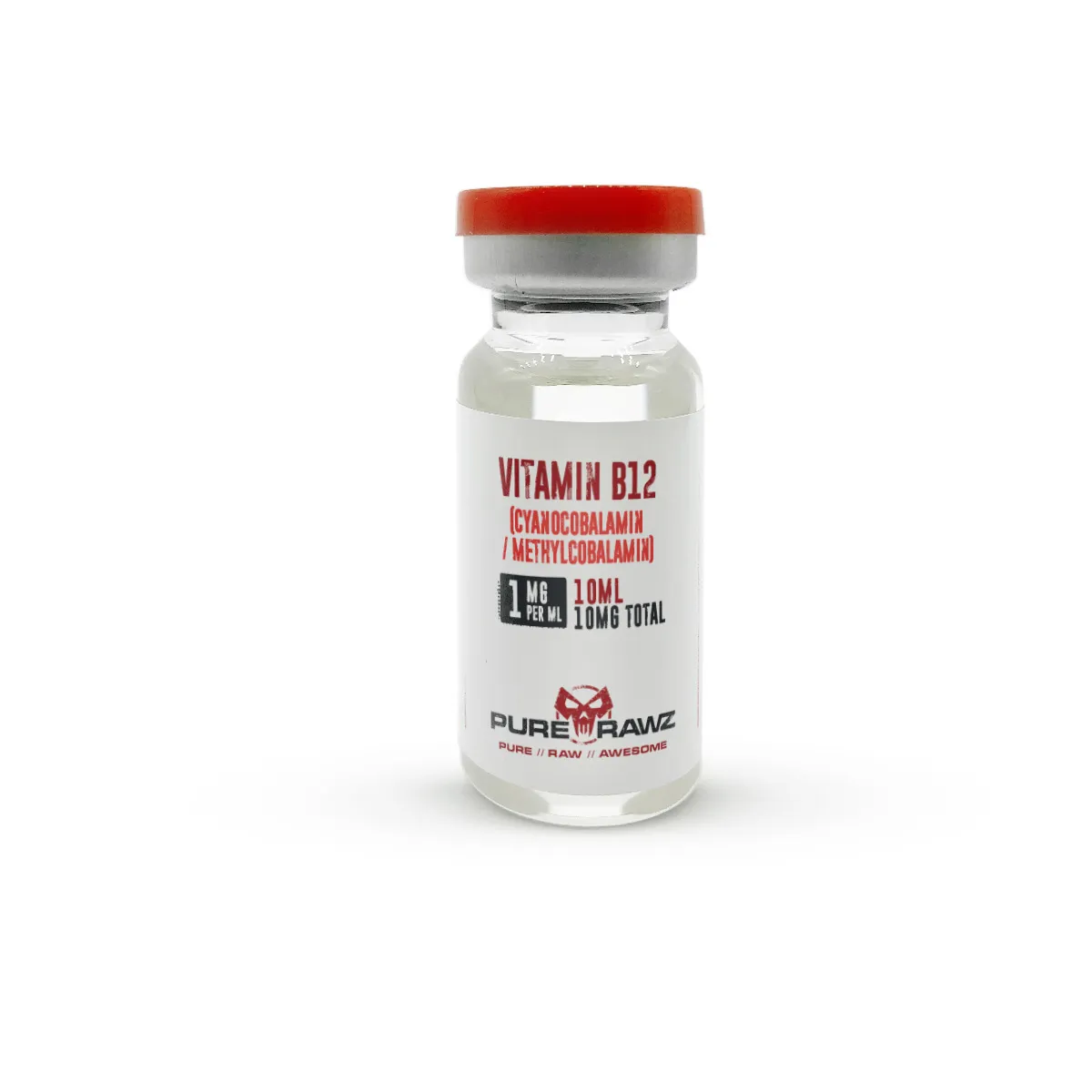


Vitamin B12 (Cyanocobalamin / Methylcobalamin)
$22.00
Earn 22 points upon purchasing this product.
Note: We recommend using sterile Bacteriostatic Water for reconstitution.
✅ 99% Purity – Third-Party Tested
🚚 Free U.S. Shipping on Orders $100+
 Proudly Made in the USA
⚡ Fast & Reliable Shipping
🔒 Secure Checkout Guaranteed
All products are strictly intended for laboratory and research purposes only and are not approved for veterinary or human use.
Description
Vitamin B12 is a cobalt containing corrinoid compound available in two research-grade forms: cyanocobalamin, the cyano ligated form widely used as a stable reference and research standard, and methylcobalamin, the methyl ligated form studied for its role as a direct coenzyme in the methylation cycle. Both are supplied as a 10ml solution at 1mg/ml.
This compound is studied in preclinical research settings for molecular interactions spanning methionine synthase and methylmalonyl CoA mutase coenzyme pathways, as well as methylation cycle and nerve-regeneration research specific to the methylcobalamin form.
RESEARCH USE ONLY: This product is intended for laboratory research purposes only. We do not sell this product for human or animal consumption.
Available Forms
| Form | CAS | Best Suited For |
| Cyanocobalamin | 68-19-9 | General cobalamin reference standard, stability focused research |
| Methylcobalamin | 13422-55-4 | Methylation cycle and nerve regeneration research requiring the direct coenzyme form |
Chemical and Molecular Properties
Cyanocobalamin
| Property | Value |
| PubChem CID | 166596686 |
| Synonyms | Vitamin B12, CN-Cbl, Cyanocob(III)alamin |
| Molecular Formula | C63H88CoN14O14P |
| Molecular Weight | 1,355.37 g/mol |
| CAS | 68-19-9 |
| Purity | Verify per batch COA (HPLC verified) |
| Physical Form | Dark red solution (1mg/ml) |
| Solubility | Soluble in water |
| Shelf Life | Verify per Certificate of Analysis |
| Classification | Research Use Only (RUO) |
Methylcobalamin
| Property | Value |
| PubChem CID | 16686083 |
| Synonyms | Mecobalamin, MeCbl, Methyl Vitamin B12 |
| Molecular Formula | C63H91CoN13O14P |
| Molecular Weight | 1,344.38 g/mol |
| CAS | 13422-55-4 |
| Purity | Verify per batch COA (HPLC verified) |
| Physical Form | Red to dark red solution (1mg/ml) |
| Solubility | Soluble in water |
| Shelf Life | Verify per Certificate of Analysis |
| Classification | Research Use Only (RUO) |
Both forms share the same corrin-ring, cobalt-centered core structure; they differ only in the chemical group attached to the upper axial position of the cobalt atom (cyano vs. methyl), which affects stability and direct coenzyme activity.
Proposed Working Mechanism of Vitamin B12
Investigational findings indicate that cyanocobalamin is converted intracellularly to its active coenzyme forms after administration, functioning as a precursor in the methionine synthase reaction relevant to DNA synthesis and methylation, and the methylmalonyl CoA mutase reaction relevant to fatty acid and amino acid metabolism.
Research data suggests methylcobalamin's potential to act directly as a coenzyme for methionine synthase without requiring intracellular conversion, a mechanism associated in preclinical models with increased Erk1/2 and Akt signaling activity through the methylation cycle.
Studies conducted in controlled laboratory environments have observed that methylcobalamin administration is associated with nerve regeneration and functional recovery parameters in rodent peripheral nerve injury models. This interaction is of particular investigational interest in the context of neuroregeneration and methylation pathway research.
Note: Vitamin B12 in both forms is an investigational research compound. It is not approved for clinical use as sold; all mechanistic data are derived from studies of these compounds administered in independent research and clinical settings, not from testing of this specific vendor-supplied research formulation.
Possible Research Applications of Vitamin B12
Cyanocobalamin and methylcobalamin have gained attention in nutrition and neuroscience research for their potential research applications, which include:
Coenzyme Pathway Research Preclinical investigations have recorded measurable shifts in methionine synthase and methylmalonyl CoA mutase activity markers linked to cobalamin coenzyme function.
Methylation Cycle Research Investigational studies have yielded quantifiable data on methylation-cycle activity and homocysteine-to-methionine conversion parameters, specific to the methylcobalamin form.
Nerve Regeneration Research Investigational findings have documented modulation of Erk1/2 and Akt signaling and functional recovery metrics in rodent peripheral nerve injury research models.
Cobalamin Deficiency Modeling Preclinical studies have recorded notable shifts in deficiency-state biomarkers relevant to malabsorption and cobalamin status research frameworks.
Research Stability & Handling Profile
Vitamin B12 exhibits notable stability characteristics that distinguish it within the vitamin-compound research space.
Storage Recommendations for Research Use:
- Store the solution at 2–8°C, protected from light
- Avoid repeated temperature fluctuations to preserve compound integrity for research purposes
- Methylcobalamin is more light- and temperature-sensitive than cyanocobalamin; minimize exposure time outside refrigeration
- For dilution, use sterile water appropriate to the intended research protocol
Risk & Handling
- Vitamin B12 research solutions are intended for research purposes only and should be handled by trained professionals using appropriate laboratory procedures and safety protocols.
- Researchers should avoid direct exposure through inhalation, ingestion, or skin contact and use suitable protective equipment during handling.
- Materials should be stored in a cool, dark, and controlled environment away from heat, moisture, and direct sunlight to maintain stability and integrity.
- All preparation and handling equipment should be sterile and properly maintained to reduce the risk of contamination or compromised results.
- This product should not be marketed or represented as an approved treatment, cure, or preventive solution for any condition without regulatory authorization.
- Proper documentation, labeling, and disposal procedures should be followed in accordance with institutional, local, and national regulations.
PureRawz Quality & Purity Standards
PureRawz is committed to supplying the USA research community with the highest integrity investigational compounds available. Every batch of Vitamin B12 (Cyanocobalamin or Methylcobalamin) is confirmed by independent third-party HPLC analysis, with a Certificate of Analysis (COA) available per lot.
Note: This product is an investigational research compound and has not been established as safe or effective for any therapeutic use in this specific research-grade formulation.
Frequently Asked Questions
Can I legally order this in the US?
In the US, this product is supplied for laboratory research purposes only. Note that cyanocobalamin injection is also an FDA-approved prescription pharmaceutical for treating B12 deficiency; this research grade solution is not that product and is not sold for therapeutic use. Methylcobalamin has no FDA approved injectable form. Researchers should verify compliance with applicable regulations before ordering.
Do I need a license to buy it?
No license is needed to purchase it, but it should only be used by trained people in a real lab setting, not at home.
What's the difference between cyanocobalamin and methylcobalamin?
Cyanocobalamin is the more stable, common reference form; methylcobalamin is the form that acts directly as a coenzyme without needing conversion first. Same core B12 structure, different attached chemical group.
Is this backed by real research?
Yes. Both forms are extensively studied cyanocobalamin as the standard cobalamin reference, methylcobalamin specifically in methylation-cycle and nerve-regeneration research.
What do researchers actually study this for?
Mostly cobalamin coenzyme pathways, methylation-cycle activity, and for methylcobalamin specifically nerve regeneration in animal models.
How do I store it once it arrives?
Refrigerate at 2–8°C, away from light. Methylcobalamin is more sensitive to light and heat than cyanocobalamin, so minimize time outside the fridge.
Can I use this as an actual B12 supplement or injection?
No. It's not approved for that. It's sold strictly for research purposes, not as a finished product to take or inject.
Disclaimer
This information is for educational purposes only and not medical advice. Products are for research use only. Research must follow IRB or IACUC guidelines. Verify information independently before purchasing. By ordering, you agree to our Terms and Conditions. If you are not 100% satisfied with the product you received, please contact us at support@purerawz.co.
ATTENTION: All our products are for LABORATORY AND RESEARCH PURPOSES ONLY, not for veterinary or human use.
Reference Links
- Green, R., Allen, L. H., Bjørke-Monsen, A. L., et al. (2017). Vitamin B12 deficiency. Nature Reviews Disease Primers, 3, 17040. https://doi.org/10.1038/nrdp.2017.40
- Okada, K., Tanaka, H., Temporin, K., et al. (2010). Methylcobalamin increases Erk1/2 and Akt activities through the methylation cycle and promotes nerve regeneration in a rat sciatic nerve injury model. Experimental Neurology, 222(2), 191–203. https://doi.org/10.1016/j.expneurol.2009.12.017
- U.S. Food and Drug Administration / DailyMed. Cyanocobalamin Injection, USP — Drug Label. https://dailymed.nlm.nih.gov/dailymed/fda/fdaDrugXsl.cfm?setid=a66eb3c4-3e1d-4d49-b963-4fa2334cc9b6
- National Institutes of Health, Office of Dietary Supplements. Vitamin B12 – Health Professional Fact Sheet. https://ods.od.nih.gov/factsheets/VitaminB12-HealthProfessional/

About Team PureRawz
Team PureRawz is dedicated to providing accurate, science-based information on research chemicals, including Peptides, Nootropics, and SARMs. Our team of expert writers, researchers, and editors is committed to delivering reliable, up-to-date content you can trust.
Our mission is to build an educated and informed community spanning researchers, laboratories, and general readers empowering them to make confident, well-informed decisions when selecting the right research chemical.
Related products
-

Thymalin
Price range: $76.92 through $321.92 Select options This product has multiple variants. The options may be chosen on the product page -

CJC-1295 With DAC
Price range: $23.77 through $117.55 Select options This product has multiple variants. The options may be chosen on the product page -

PNC-27
$163.40 Select options This product has multiple variants. The options may be chosen on the product page -

Spartan 3 (Mod GRF 1-29 + GHRP-6)
$97.81 Select options This product has multiple variants. The options may be chosen on the product page