

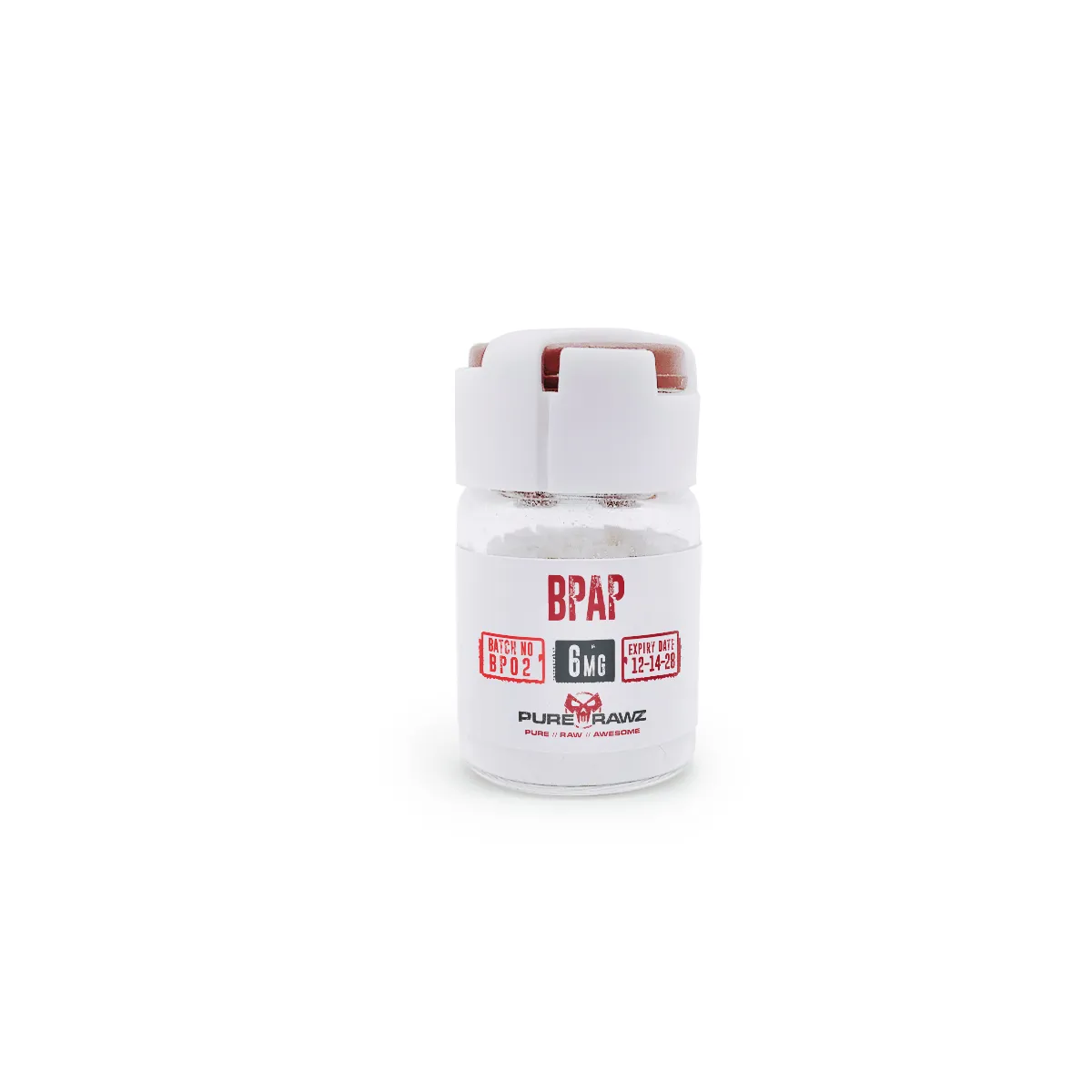


BPAP
$97.99
Earn 98 points upon purchasing this product.
✅ 99% Purity – Third-Party Tested
🚚 Free U.S. Shipping on Orders $100+
 Proudly Made in the USA
⚡ Fast & Reliable Shipping
🔒 Secure Checkout Guaranteed
All products are strictly intended for laboratory and research purposes only and are not approved for veterinary or human use.
Description
Overview of BPAP
BPAP (Benzofuranylpropylaminopentane; developmental code name FPFS-1169) is a synthetic 1-aryl-2-alkylaminoalkane developed through structure-activity relationship (SAR).
BPAP was selected from a series of 65 newly synthesized compounds during structure-activity relationship research aimed at developing catecholaminergic/serotoninergic activity enhancer (CAE/SAE) substances structurally unrelated to phenylethylamine (PEA) and the amphetamines.
Researchers study BPAP primarily because it is classified as a monoaminergic activity enhancer (MAE), a mechanistic category distinct from classic monoamine-releasing agents.
Researchers believe that BPAP might be a useful compound to study impulse-propagation-mediated monoamine release. The compound may also be researched for TAAR1-mediated dopaminergic signaling and neuroprotective mechanisms in experimental models.
BPAP is intended strictly for laboratory research purposes and is not approved for human or animal consumption.
Proposed Mechanism of Action of BPAP
Research studies have shown the impulse propagation-mediated release of catecholamines and serotonin in research models.
Investigations have found that (-)BPAP potentiated stimulation-evoked dopamine release with vesicular origin via TAAR1 (trace amine-associated receptor 1) mediation, without inducing non-vesicular dopamine release.
Subsequent analyses in the same research indicated that BPAP's dopamine-release stimulatory effect was associated with increased PKC-mediated phosphorylation.
Chemical & Molecular Properties
| Property | Description |
| Common Name | BPAP; R-(-)-BPAP |
| Synonyms | Benzofuranylpropylaminopentane; FPFS-1169; DOV-220,075 |
| Chemical Classification | Benzofuran-substituted phenethylamine derivative; monoaminergic activity enhancer (MAE) |
| Molecular Formula | C₁₆H₂₃NO |
| Molecular Weight | 245.36 g/mol |
| CAS Number | 260550-89-8 (R-(-)-enantiomer, free base) |
| PubChem CID | 9859674 |
| InChIKey | LJHIBIVAYHQPBT-UHFFFAOYSA-N |
| IUPAC Name | (2R)-1-(1-Benzofuran-2-yl)-N-propylpentan-2-amine |
| Structural Relationship | Benzofuran-ring analog of phenylpropylaminopentane (PPAP); structurally related to selegiline |
| Purity (Reference Grade) | ≥97% |
| Analytical Characterization | HPLC, NMR spectroscopy |
Potential Research Applications of BPAP
Researchers investigate BPAP under controlled laboratory conditions for the following research applications. Though more extensive study is required.
Monoaminergic Activity Enhancer (MAE) Mechanism Research
Used as a reference compound to study impulse propagation-mediated release of catecholamines and serotonin, distinct from classic monoamine-releasing agent mechanisms.
TAAR1-Mediated Dopaminergic Signaling Research
Investigated in research models for effects on vesicular dopamine release via TAAR1-dependent pathways.
Neuroprotection and Apoptosis Pathway Research
Studied in preclinical research models for effects against neurotoxin-induced apoptosis.
Comparative Structure-Activity Relationship (SAR) Research
Used alongside related compounds such as PPAP and IPAP to study how ring substitutions (benzofuran vs. indole vs. benzene) affect selectivity between catecholaminergic and serotonergic activity enhancement.
Why Buy BPAP Powder from Purerawz?
Purerawz supplies BPAP exclusively for laboratory research and analytical applications. Available product documentation may include batch-specific information, certificates of analysis (CoAs), and analytical characterization data to assist researchers in evaluating material identity and quality for experimental use.
As with all research materials, investigators should independently review the available specifications and supporting documentation to determine whether the material is appropriate for their intended laboratory protocols and research objectives.
Frequently Asked Questions
What does BPAP stand for?
BPAP stands for Benzofuran-2-yl-2-propylaminopentane, a synthetic research compound investigated for its interactions with monoaminergic signaling pathways in experimental neuroscience and pharmacology studies.
How is BPAP different from conventional monoamine-releasing compounds?
Unlike compounds that primarily trigger neurotransmitter release, BPAP has been investigated for its ability to modulate neuronal activity at very low concentrations, making it a valuable tool for studying neurotransmission and regulatory mechanisms in laboratory settings.
Which analytical methods are commonly used to characterize BPAP?
Researchers typically employ high-performance liquid chromatography (HPLC), liquid chromatography-mass spectrometry (LC-MS), nuclear magnetic resonance (NMR), and infrared (IR) spectroscopy to verify BPAP's identity, purity, and structural characteristics.
Why is BPAP of interest in neuroscience research?
BPAP is used to investigate monoaminergic signaling, neuronal communication, receptor regulation, and cellular mechanisms associated with neurotransmitter systems, contributing to experimental studies in neuropharmacology.
What should researchers evaluate before working with BPAP?
Before incorporating BPAP into laboratory protocols, researchers should review the available Certificate of Analysis (CoA), batch-specific analytical data, storage recommendations, and technical specifications to ensure the material meets the requirements of their intended research applications.
Reference Links
Knoll, J., Yoneda, F., Knoll, B., Ohde, H., & Miklya, I. (1999). (–)1-(Benzofuran-2-yl)-2-propylaminopentane, [(–)BPAP], a selective enhancer of the impulse propagation mediated release of catecholamines and serotonin in the brain. British Journal of Pharmacology, 128(8), 1723–1732. https://pmc.ncbi.nlm.nih.gov/articles/PMC1571822/
Maruyama, W., Yi, H., Takahashi, T., Shimazu, S., Ohde, H., Yoneda, F., Iwasa, K., & Naoi, M. (2004). Neuroprotective function of R-(-)-1-(benzofuran-2-yl)-2-propylaminopentane, [R-(-)-BPAP], against apoptosis induced by N-methyl(R)salsolinol, an endogenous dopaminergic neurotoxin, in human dopaminergic neuroblastoma SH-SY5Y cells. Life Sciences, 75(1), 107–117. https://doi.org/10.1016/j.lfs.2003.12.001
Yoshitake, T., Yoshitake, S., Yoneda, F., Ogren, S. O., & Kehr, J. (2008). Effects of (R)-(-)-1-(benzofuran-2-yl)-2-propylaminopentane hydrochloride [(-)-BPAP] in animal models of mood disorders. Naunyn-Schmiedeberg's Archives of Pharmacology, 377(4-6), 469–475. https://pubmed.ncbi.nlm.nih.gov/18243357/
Miklya, I., Pencz, N., & Kiss, B. (2022). Enhancer regulation of dopaminergic neurochemical transmission in the striatum. International Journal of Molecular Sciences, 23(15), 8543. https://www.ncbi.nlm.nih.gov/pmc/articles/PMC9369307/
Knoll, J. (2001). Antiaging compounds: (-)deprenyl (selegiline) and (-)1-(benzofuran-2-yl)-2-propylaminopentane, [(-)BPAP], a selective highly potent enhancer of the impulse propagation mediated release of catecholamine and serotonin in the brain. CNS Drug Reviews, 7(3), 317–345. https://doi.org/10.1111/j.1527-3458.2001.tb00202.x
Disclaimer:
The products sold by Purerawz are intended solely for laboratory and research purposes. They are not FDA-approved for human or animal consumption, and Purerawz does not sell these compounds for use in humans or animals. All compounds are strictly for use by qualified researchers in controlled, non-clinical laboratory environments in compliance with applicable regulations.

About Team PureRawz
Team PureRawz is dedicated to providing accurate, science-based information on research chemicals, including Peptides, Nootropics, and SARMs. Our team of expert writers, researchers, and editors is committed to delivering reliable, up-to-date content you can trust.
Our mission is to build an educated and informed community spanning researchers, laboratories, and general readers empowering them to make confident, well-informed decisions when selecting the right research chemical.
Related products
-

Centrophenoxine
$17.47 Select options This product has multiple variants. The options may be chosen on the product page -

Methylene Blue
Price range: $14.91 through $178.19 Select options This product has multiple variants. The options may be chosen on the product page -

Vincamine
Price range: $15.83 through $49.18 Select options This product has multiple variants. The options may be chosen on the product page -

Picamilon Sodium (Nicotinoyl-GABA)
$24.57 Select options This product has multiple variants. The options may be chosen on the product page