

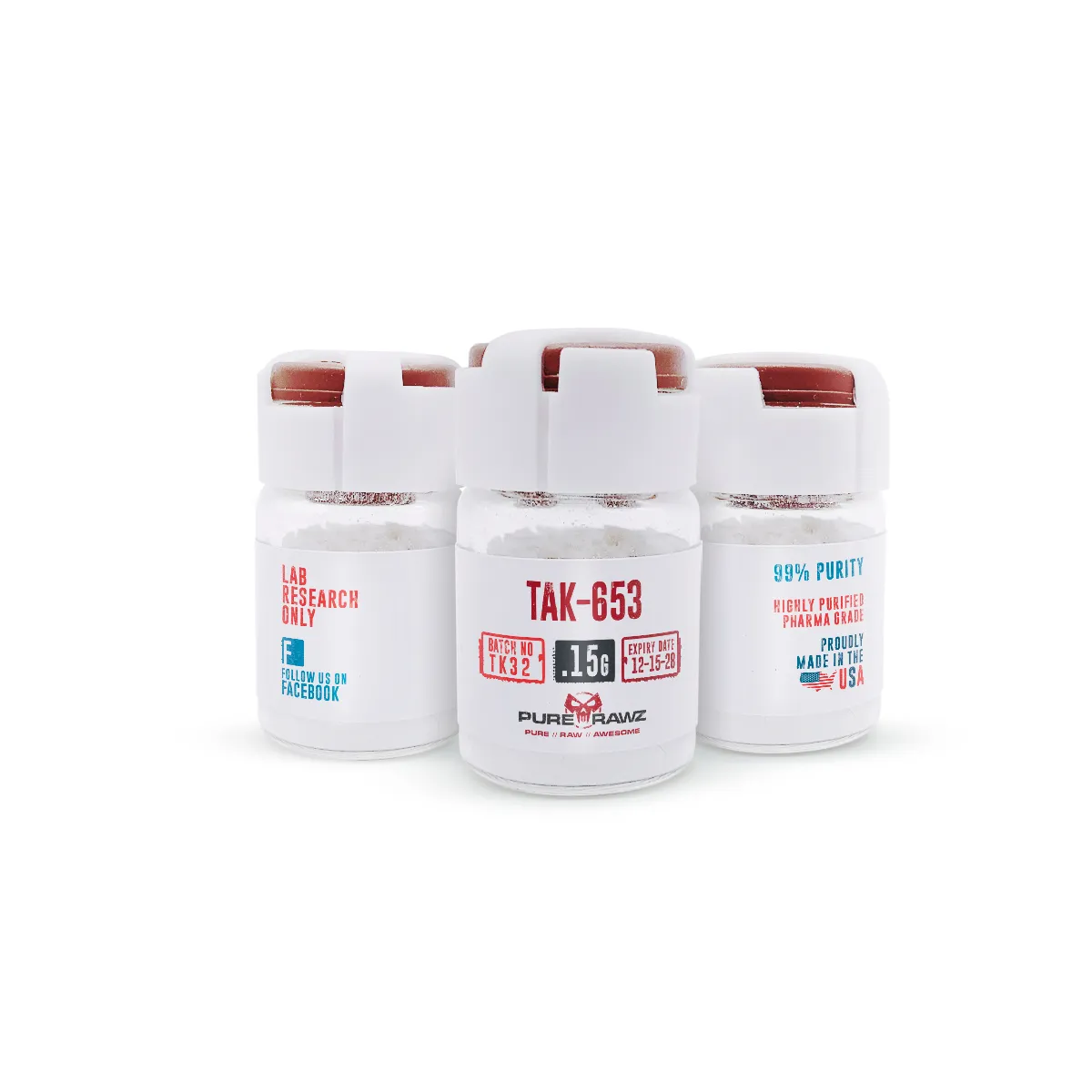


TAK-653 Powder
$58.10
Earn 58 points upon purchasing this product.
✅ 99% Purity – Third-Party Tested
🚚 Free U.S. Shipping on Orders $100+
 Proudly Made in the USA
⚡ Fast & Reliable Shipping
🔒 Secure Checkout Guaranteed
All products are strictly intended for laboratory and research purposes only and are not approved for veterinary or human use.
Description
Overview of TAK-653 Powder
TAK-653 (also known as Osavampator or NBI-1065845) is a synthetic dihydropyridothiadiazine 2,2-dioxide derivative developed as a selective positive allosteric modulator (potentiator) of AMPA-type glutamate receptors (AMPA-R).
Researchers study TAK-653 primarily because it exhibits minimal intrinsic agonistic activity at AMPA receptors compared to other potentiators in its structural class.
Researchers believe that TAK-653 might be a useful compound to study AMPA receptor allosteric modulation, glutamatergic synaptic transmission, and receptor-mediated calcium signaling in experimental models.
TAK-653 is intended strictly for laboratory research purposes and is not approved for human or animal consumption.
Proposed Mechanism of Action of TAK-653
Research models have characterized TAK-653 as a compound that binds to the ligand-binding domain of recombinant AMPA-R in a glutamate-dependent manner, distinguishing it from direct receptor agonists.
In hGluA1i-expressing CHO cell models, TAK-653 has been shown to potentiate glutamate-induced calcium influx through structural interference at the Ser743 residue in the GluA1 receptor subunit, with reported EC50 values in the range of 2.2–3.3 μM across independent studies.
Investigations in research models have demonstrated that TAK-653 augments AMPA-induced calcium influx and AMPA-elicited currents at physiological AMPA receptors while exhibiting minimal agonistic effects on its own.
Separate structure-function research has examined a related structural interference mechanism at the corresponding Ser750 residue in the GluA2o receptor subunit.
Chemical & Molecular Properties
| Property | Description |
| Common Name | TAK-653 |
| Synonyms | Osavampator; NBI-1065845; NBI 1065845 |
| Chemical Classification | Dihydropyridothiadiazine 2,2-dioxide derivative; AMPA receptor positive allosteric modulator |
| Molecular Formula | C₁₉H₂₃N₃O₃S |
| Molecular Weight | 373.47 g/mol |
| CAS Number | 1358751-06-0 |
| Appearance | Solid powder |
| Purity (Reference Grade) | ≥98% |
| Storage Stability | Store dry and dark at 0–4°C for short-term use, or -20°C for long-term storage |
| Analytical Characterization | HPLC, NMR spectroscopy |
Potential Research Applications of TAK-653
Researchers investigate TAK-653 under controlled laboratory conditions for the following research applications. Though more extensive study is required.
- AMPA Receptor Allosteric Modulation Research
Used as a reference compound to study glutamate-dependent positive allosteric modulation at AMPA receptors in research models. - Glutamatergic Synaptic Transmission Research
Investigated for effects on AMPA receptor-mediated excitatory postsynaptic potentials in preclinical models. - Cognitive and Memory Pathway Research
Studied in investigational models for potential effects on working memory and recognition memory performance. - Comparative AMPA Potentiator Structure-Activity Research
Used alongside other AMPA-R potentiators, such as LY451646, in comparative studies examining agonistic versus purely modulatory receptor activity.
Why Purchase TAK-653 Powder from Purerawz?
Purerawz is committed to supplying high-quality research compounds that support scientific investigation and laboratory innovation. TAK-653 Powder is offered for research use only and is accompanied, where applicable, by technical documentation to help researchers evaluate its analytical profile and batch consistency.
Every research project has unique requirements, which is why investigators are encouraged to assess the available product specifications, analytical data, and handling information before beginning experimental work. This approach helps ensure the selected material aligns with the objectives and standards of their specific laboratory studies.
Frequently Asked Questions
What distinguishes TAK-653 from traditional glutamate receptor agonists?
Rather than directly activating AMPA receptors, TAK-653 functions as a positive allosteric modulator (PAM), meaning it enhances the receptor's response to naturally released glutamate without acting as the primary activator.
Why are AMPA receptor modulators like TAK-653 of scientific interest?
AMPA receptors are central to fast excitatory neurotransmission in the brain. Modulating their activity allows researchers to investigate mechanisms involved in synaptic plasticity, learning, memory, and neural circuit function.
Does TAK-653 activate AMPA receptors on its own?
No. TAK-653 is designed to enhance receptor activity only in the presence of glutamate, making it dependent on endogenous neurotransmitter signaling rather than directly triggering receptor activation.
Why is allosteric modulation considered different from direct receptor activation?
Allosteric modulators bind to a site separate from the receptor's active (orthosteric) binding site. This approach can fine-tune receptor activity while preserving normal physiological signaling patterns.
What makes TAK-653 valuable for neuroscience research?
Its selective modulation of AMPA receptors enables researchers to explore how enhanced excitatory signaling influences cognition, synaptic communication, and neuronal network dynamics under controlled laboratory conditions.
Reference Links
Hara, H., Suzuki, A., Kunugi, A., Tajima, Y., Suzuki, N., Kimura, H., & Mihara, T. (2021). TAK-653, an AMPA receptor potentiator with minimal agonistic activity, produces an antidepressant-like effect with a favorable safety profile in rats. Pharmacology Biochemistry and Behavior, 211, Article 173289. https://doi.org/10.1016/j.pbb.2021.173289
Suzuki, A., Hara, H., Kimura, H., Ito, H., Yasoshima, K., Fukuoka, M., Kondo, M., Kawakita, K., Yoritaka, H., Mihara, T., & Mizutani, T. (2021). Strictly regulated agonist-dependent activation of AMPA-R is the key characteristic of TAK-653 for robust synaptic responses and cognitive improvement. Scientific Reports, 11(1), 14532. https://doi.org/10.1038/s41598-021-93888-0
Dijkstra, F., O'Donnell, P., Klaassen, E., Buhl, D., Asgharnejad, M., Rosen, L., Zuiker, R., van Gerven, J., & Jacobs, G. (2022). Central nervous system effects of TAK-653, an investigational alpha-amino-3-hydroxy-5-methyl-4-isoxazole receptor (AMPAR) positive allosteric modulator in healthy volunteers. Translational Psychiatry, 12(1), 408. https://doi.org/10.1038/s41398-022-02148-w
Witkin, J. M., Martin, A. E., Golani, L. K., Xu, N. Z., & Smith, J. L. (2021). AMPA receptor-based novel treatments for mood and cognitive disorders. Pharmacology Biochemistry and Behavior, 211, Article 173289.
Suzuki, A., Hara, H., & Kimura, H. (2023). Role of the AMPA receptor in antidepressant effects of ketamine and potential of AMPA receptor potentiators as a novel antidepressant. Neuropharmacology, 222, Article 109308. https://doi.org/10.1016/j.neuropharm.2022.109308
Disclaimer:
The products sold by Purerawz are intended solely for laboratory and research purposes. They are not FDA-approved for human or animal consumption, and Purerawz does not sell these compounds for use in humans or animals. All compounds are strictly for use by qualified researchers in controlled, non-clinical laboratory environments in compliance with applicable regulations.

About Team PureRawz
Team PureRawz is dedicated to providing accurate, science-based information on research chemicals, including Peptides, Nootropics, and SARMs. Our team of expert writers, researchers, and editors is committed to delivering reliable, up-to-date content you can trust.
Our mission is to build an educated and informed community spanning researchers, laboratories, and general readers empowering them to make confident, well-informed decisions when selecting the right research chemical.
Related products
-

Agomelatine
$61.76 Select options This product has multiple variants. The options may be chosen on the product page -

HBT1
$92.36 Select options This product has multiple variants. The options may be chosen on the product page -

Vincamine
Price range: $15.83 through $49.18 Select options This product has multiple variants. The options may be chosen on the product page -

Sulbutiamine
Price range: $17.47 through $61.76 Select options This product has multiple variants. The options may be chosen on the product page