

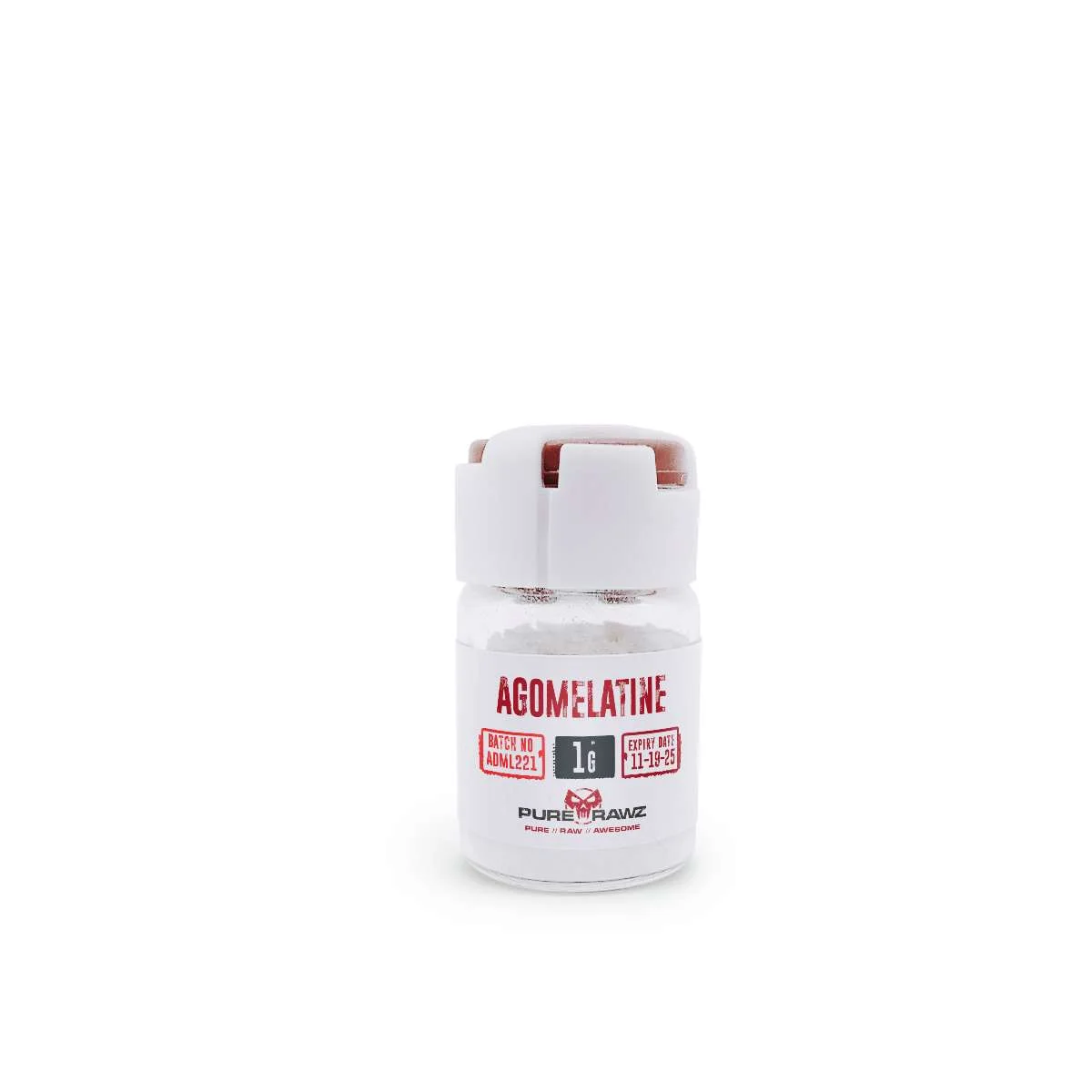
Agomelatine
$61.76
Earn 62 points upon purchasing this product.
✅ 99% Purity – Third-Party Tested
🚚 Free U.S. Shipping on Orders $100+
 Proudly Made in the USA
⚡ Fast & Reliable Shipping
🔒 Secure Checkout Guaranteed
All products are strictly intended for laboratory and research purposes only and are not approved for veterinary or human use.
Description
Overview of Agomelatine
Agomelatine is an agonist of the melatonin receptors (MT1 and MT2) and an antagonist of the serotonin receptors (5HTC). Agomelatine was initially developed in 1997 and was granted authorization for medical use in the European Union in 2009 and in Australia in 2010.
Multiple trials have shown that Agomelatine may have effects on depressive symptoms. Agomelatine has also shown its potential efficacy in preventing the relapse of depression. Plus, it has demonstrated potential good tolerability compared with widely used antidepressants.
On the basis of favorable results in multiple clinical trials, Agomelatine was approved for medical use in Europe in 2009. A year later, this prescription compound was granted marketing authorization in Australia. However, the Food and Drug Administration (FDA) has yet to approve it.
Note: PureRawz sells Agomelatine for laboratory research use only.
Chemical Properties of Agomelatine
| Property | Information |
| CAS Number | 138112-76-2 |
| Molecular Formula | C15H17NO2 |
| Molecular Mass | 243.30 g/mol |
| Synonyms | Agomelatine, Thymanax, Valdoxan, Agomelatina |
| IUPAC Name | N-[2-(7-methoxynaphthalen-1-yl)ethyl]acetamide |
| Storage | 2°C-8°C (36°F-46°F) |
Working Mechanism of Agomelatine
Agomelatine binds with melatonin receptors (MT1 and MT2) to potentially stimulate the release of melatonin. It may also stop the action of serotonin receptors (5HTC), which could stimulate the release of norepinephrine and dopamine (it would not affect serotonin levels).
Its mechanisms of action are different from those of existing antidepressants. While Agomelatine could primarily act via the melatonergic and serotonergic pathways, most antidepressants you see on the market act via monoaminergic (monoamine) mechanisms.
This difference in their working mechanisms is noteworthy. A report prepared by the European Medicines Agency (EMA), as well as a meta-analysis of 20 trials, indicates that Agomelatine poses a relatively small risk of potentially severe side effects, as opposed to standard antidepressants.[R]
Research Findings on Agomelatine
Multiple large-scale, randomized clinical trials have been conducted on Agomelatine. This research chemical has also attracted numerous animal and cell-based studies. All these trials and studies have demonstrated that Agomelatine possesses enormous potential as an antidepressant.
Agomelatine and Major Depressive Disorder
Ten placebo-controlled trials were conducted to investigate the short-term efficacy of Agomelatine in major depressive disorder in adult subjects. At the end of the trials (over 6 or 8 weeks), Agomelatine demonstrated potential significant efficacy in 6 out of the ten trials.
A meta-analysis of 20 trials with more than 7,400 participants concluded that Agomelatine is a potentially effective antidepressant with similar efficacy to standard antidepressants. The trials' results also show that Agomelatine may pose a relatively small risk of sexual side effects.[R]
Another placebo-controlled trial demonstrated that Agomelatine could potentially successfully prevent relapse in more than two-thirds (78%) of the patients. The incidence of relapse during the 6-month follow-up period was potentially 22% and 47% for Agomelatine and placebo, respectively.
Agomelatine and Anxiety
A 2005 study found that Agomelatine may potentially elicit anxiety-relieving properties in rats. The anxiolytic effects produced by Agomelatine were comparable to those induced by clorazepate, a clinically approved compound to treat anxiety, even though Agomelatine had a different mechanism of action.[R]
A relatively recent study has demonstrated how Agomelatine can potentially relieve anxiety. It has been shown that Agomelatine blocks a receptor in nerve cells (5HT2C), which could potentially play a role in causing anxiety. In addition, Agomelatine may activate the MT receptor, which is known for keeping anxiety in check.[R]
The researchers also concluded that Agomelatine's potential anxiolytic effects are caused by mechanisms that are distinct from those of other non-controlled prescription drugs currently used to treat General Anxiety Disorder (GAD).
Agomelatine and Cognition
In a 2017 animal study, Agomelatine was effective in alleviating stress-induced cognitive impairments in mice. This research chemical was also shown to reverse gene-related effects of stress. Plus, Agomelatine significantly reversed the memory impairments caused by stress in mice.[R]
Another study was conducted to investigate the chronic effects of Agomelatine administration on the cognitive performance of rats. It was noted that the memory performance of rats during one of the study's trials was significantly better than that of the controls.
In addition, Agomelatine-treated animals achieved a better learning index. These data provide evidence that Agomelatine has beneficial effects on the cognitive parameters of animals.
Agomelatine and Sleep
An analysis of the effects of Agomelatine on sleep indicates that this antidepressant produces subjective and objective potential improvements in sleep. Agomelatine may potentially increase slow-wave sleep and improve sleep wave quality, with little to no effect whatsoever on REM sleep.[R]
It has also been shown that when taken at night, Agomelatine could potentially improve sleep patterns by mimicking the natural rhythm of melatonin release in test models. Furthermore, it can have the potential ability to restore non-rapid-eye movement (NREM-REM) sleep stage cycles within nighttime sleep.
Agomelatine has also been shown to have the potential to improve all aspects of the sleep-wake cycle in depressed models. This antidepressant has demonstrated a potential improvement in sleep patterns and focus.[R]
Agomelatine and Autism
Agomelatine has shown an ameliorative effect on behavioral, neurochemical, and blood-brain barrier alterations in animals with an induced autism spectrum disorder. Thus, it may provide a potentially beneficial therapeutic strategy for managing autism spectrum disorder. Agomelatine may also potentially help reduce sleep disturbances in ASD models.
Agomelatine and Neurogenesis
Neurogenesis is the process by which new nerve cells are formed in the brain. Research has shown that neurogenesis preserves cognitive functioning. It also plays a vital role in neural plasticity and the repair of damaged brain cells affected by aging and brain disorders.
Data from an animal study provides evidence that Agomelatine may promote adult hippocampal neurogenesis in chronically stressed rats. This is encouraging given that hippocampal neurogenesis has been established in different species.[R]
Where to Buy Agomelatine?
PureRawz is the best place to buy Agomelatine online.
In order to be the best Nootropic supplier of research chemicals, we provide reference materials with every product we sell. All of our products come with an independent, third-party-issued Certificate of Analysis for identification, purity, and concentration.
We offer free international shipping on all orders above $100. You can pay for your purchase through various methods, including PayPal and Bitcoin. Click on the 'Reviews' tab to check out what existing customers say about our products and great customer service.
Note: In the Nootropics Powder category, PureRawz offers lab-tested formulations including Bemethyl (Bemetil), IDRA-21, and many other products.
Disclaimer
This information is for educational purposes only and not medical advice. Products are for research use only. Research must follow IRB or IACUC guidelines. Verify information independently before purchasing. By ordering, you agree to our Terms and Conditions. If you are not 100% satisfied with the product you received, please contact us at support@purerawz.co
ATTENTION: All our products are for LABORATORY AND RESEARCH PURPOSES ONLY, not for veterinary or human usage.
Reference Links:
de Bodinat, C., Guardiola-Lemaitre, B., Mocaer, E., Renard, P., Munoz, C., & Millan, M. J. (2010). Agomelatine, the first melatonergic antidepressant: discovery, characterization and development. Nature Reviews Drug Discovery, 9(8), 628-642. https://doi.org/10.1038/nrd3140
Taylor, D., Sparshatt, A., Varma, S., & Olofinjana, O. (2014). Antidepressant efficacy of agomelatine: meta-analysis of published and unpublished studies. BMJ, 348(mar19 5), g1888-g1888. https://doi.org/10.1136/bmj.g1888
Millan, M. J., Brocco, M., Gobert, A., & Dekeyne, A. (2004). Anxiolytic properties of agomelatine, an antidepressant with melatoninergic and serotonergic properties: role of 5-HT2C receptor blockade. Psychopharmacology, 177(4), 448-458. https://doi.org/10.1007/s00213-004-1962-z
Millan, M. J. (2022). Agomelatine for the treatment of generalized anxiety disorder: focus on its distinctive mechanism of action. Therapeutic Advances in Psychopharmacology, 12, 204512532211051. https://doi.org/10.1177/20451253221105128
Martin,V., Allaili, N., Euvrard, M., Marday, T., Riffaud, A., Franc, B., Mocaer, E., Gabriel, C., Fossati, P., Lehericy, S., & Lanfumey, L. (2017). Effect of agomelatine on memory deficits and hippocampal gene expression induced by chronic social defeat stress in mice. Scientific Reports, 7(1). https://doi.org/10.1038/srep45907
Agomelatine - an overview | ScienceDirect Topics. (n.d.). www.sciencedirect.com. https://www.sciencedirect.com/topics/neuroscience/agomelatine
Quera-Salva, M.-A., Lemoine, P., & Guilleminault, C. (2010). Impact of the novel antidepressant agomelatine on disturbed sleep-wake cycles in depressed patients. Human Psychopharmacology: Clinical and
Experimental, 25(3), 222-229. https://doi.org/10.1002/hup.1112
Posey, D. J., Stigler, K. A., Erickson, C. A., & McDougle, C. J. (2008). Antipsychotics in the treatment of autism. Journal of Clinical Investigation, 118(1), 6-14. https://doi.org/10.1172/jci32483
Girstaute Dagyte, Trentani, A., Postema, F., Luiten, P. G., Johan, Gabriel, C., Mocaer, E., Meerlo, P., & Van, E. A. (2010). The Novel Antidepressant Agomelatine Normalizes Hippocampal Neuronal Activity and Promotes Neurogenesis in Chronically Stressed Rats. CNS Neuroscience & Therapeutics, 16(4), 195-207. https://doi.org/10.1111/j.1755-5949.2009.00125.x

About Team PureRawz
Team PureRawz is dedicated to providing accurate, science-based information on research chemicals, including Peptides, Nootropics, and SARMs. Our team of expert writers, researchers, and editors is committed to delivering reliable, up-to-date content you can trust.
Our mission is to build an educated and informed community spanning researchers, laboratories, and general readers empowering them to make confident, well-informed decisions when selecting the right research chemical.
Related products
-

Oxiracetam
$22.94 Select options This product has multiple variants. The options may be chosen on the product page -

L-Theanine
Price range: $11.45 through $24.57 Select options This product has multiple variants. The options may be chosen on the product page -

Galantamine Hydrobromide
$57.37 Select options This product has multiple variants. The options may be chosen on the product page -

PRL-8-53
Price range: $57.37 through $92.36 Select options This product has multiple variants. The options may be chosen on the product page