

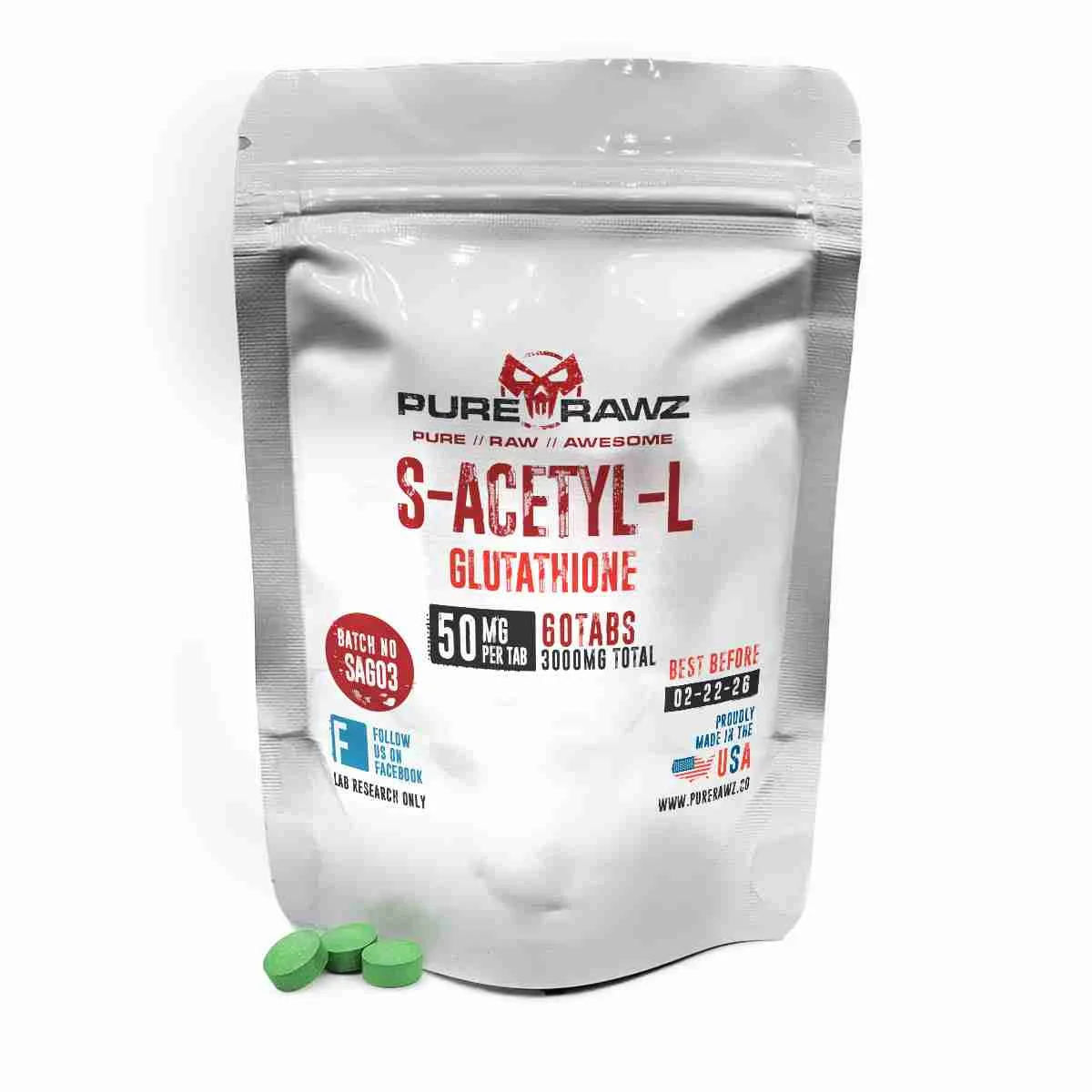
S-Acetyl L-Glutathione
Price range: $20.20 through $40.98
Earn 20 - 41 points upon purchasing this product.
✅ 99% Purity – Third-Party Tested
🚚 Free U.S. Shipping on Orders $100+
 Proudly Made in the USA
⚡ Fast & Reliable Shipping
🔒 Secure Checkout Guaranteed
All products are strictly intended for laboratory and research purposes only and are not approved for veterinary or human use.
Description
S-Acetyl L-Glutathione Overview
S-Acetyl L-Glutathione (SAG), sometimes referred to as S-Acetyl Glutathione or S-A-GSH, is an acetylated derivative of glutathione. Glutathione is a naturally occurring tripeptide composed of glutamate, cysteine, and glycine and is widely studied for its role in intracellular redox regulation.
In biochemical research, glutathione is recognized as one of the primary intracellular antioxidants involved in maintaining cellular redox balance and protecting cells from oxidative stress.
S-Acetyl L-Glutathione is structurally modified by the addition of an acetyl group to the sulfur atom of the cysteine residue. This modification has been investigated in laboratory settings for its potential influence on molecular stability and intracellular delivery of glutathione.
Chemical and Molecular Properties
| PubChem CID | 9894372 |
| Molecular Formula | C12H19N3O7S |
| Molecular Weight | 349.36 g/mol |
| Synonyms | S-Acetylglutathione L- -glutamyl-S-acetyl-L-cysteinylglycine Glutathione, S-acetate Glutathione, acetate (ester) |
| IUPAC | 5-[[3-acetylsulfanyl-1-(carboxymethylamino)-1-oxopropan-2-yl]amino]-2-amino-5-oxopentanoic acid |
| CAS | 3054-47-5 |
| Labeling | Research Use Only (RUO), not for human or animal consumption |
| Chemical Structure Depiction | |
| Purity | 99% Purity |
| Classification | Research Use Only (RUO) |
| Storage Temperature | Store at -20°C (-4°F) for long-term stability |
| Solubility | Water, DMSO (research-grade solvents) |
| Safety | Handle with gloves, a lab coat, eye protection; use a fume hood if dust/aerosol is possible |
Mechanisms of Action
S-Acetyl L-Glutathione contains an acetyl functional group attached to the sulfur atom of the cysteine residue within the glutathione molecule.
This structural modification is of interest in biochemical research for several reasons:
- The acetyl group may protect the molecule from oxidation during handling or experimental exposure.
- It may influence the molecule's stability and transport characteristics in laboratory models.
- Once inside cells in experimental systems, enzymatic processes may remove the acetyl group, allowing the molecule to participate in intracellular glutathione-related biochemical pathways.
Potential Research Applications
S-Acetyl L-Glutathione is studied in laboratory environments due to its relationship with glutathione metabolism and intracellular antioxidant systems. Researchers may utilize this compound to investigate several biochemical and cellular processes.
Oxidative Stress Research
S-Acetyl L-Glutathione may be examined in experimental models investigating cellular responses to oxidative stress and reactive oxygen species (ROS), which are commonly studied in redox biology.
Glutathione Metabolism Studies
Researchers may use S-Acetyl L-Glutathione to explore pathways related to glutathione regulation, intracellular antioxidant balance, and enzymatic processes associated with glutathione metabolism.
Cellular Detoxification Pathways
Glutathione is involved in cellular detoxification mechanisms. Laboratory studies may investigate how glutathione derivatives interact with biochemical pathways related to oxidative and chemical stress responses.
Neurochemical Research Models
In controlled research settings, S-Acetyl L-Glutathione may be used to examine glutathione-related processes in neuronal cell models and redox-regulated cellular signaling pathways.
Disclaimer
This information is for educational purposes only and not medical advice. Products are for research use only. Research must follow IRB or IACUC guidelines. Verify information independently before purchasing. By ordering, you agree to our Terms and Conditions. If you are not 100% satisfied with the product you received, please contact us at support@purerawz.co
ATTENTION: All our products are for LABORATORY AND RESEARCH PURPOSES ONLY, not for veterinary or human use
References:
- Di Paola, R., Modafferi, S., Siracusa, R., Cordaro, M., D'Amico, R., Ontario, M. L., Interdonato, L., Salinaro, A. T., Fusco, R., Impellizzeri, D., Calabrese, V., & Cuzzocrea, S. (2022). S-Acetyl-Glutathione attenuates carbon Tetrachloride-Induced liver injury by modulating oxidative imbalance and inflammation. International Journal of Molecular Sciences, 23(8), 4429. https://doi.org/10.3390/ijms23084429
- Pizzorno, J. (2014, February 1). Glutathione! https://www.ncbi.nlm.nih.gov/pmc/articles/PMC4684116
- Wollin, S. D., Wang, Y., Kubow, S., & Jones, P. J. (2004). Effects of a medium chain triglyceride oil mixture and α-lipoic acid diet on body composition, antioxidant status, and plasma lipid levels in the Golden Syrian hamster. The Journal of Nutritional Biochemistry, 15(7), 402-410. https://doi.org/10.1016/j.jnutbio.2003.12.001

About Team PureRawz
Team PureRawz is dedicated to providing accurate, science-based information on research chemicals, including Peptides, Nootropics, and SARMs. Our team of expert writers, researchers, and editors is committed to delivering reliable, up-to-date content you can trust.
Our mission is to build an educated and informed community spanning researchers, laboratories, and general readers empowering them to make confident, well-informed decisions when selecting the right research chemical.
Related products
-

SR 9011
Price range: $99.83 through $174.46 Select options This product has multiple variants. The options may be chosen on the product page -
DHEA (Dehydroepiandrosterone)
Price range: $15.49 through $38.44 Select options This product has multiple variants. The options may be chosen on the product page -

Coleus Forskohlii 20%
$21.85 Select options This product has multiple variants. The options may be chosen on the product page -

LGD-3303
Price range: $84.93 through $296.69 Select options This product has multiple variants. The options may be chosen on the product page