

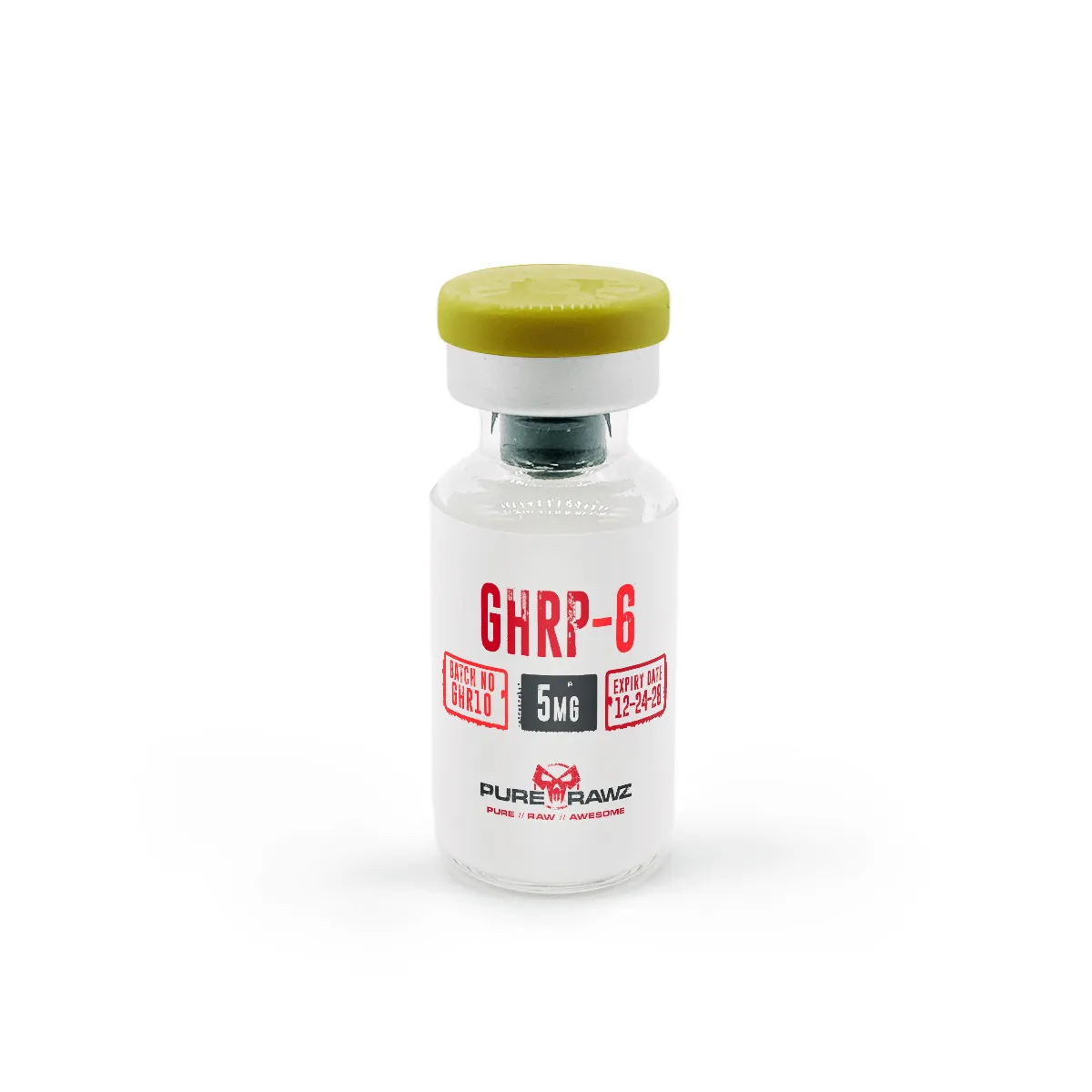


GHRP-6
Price range: $37.28 through $122.22
Earn 37 - 122 points upon purchasing this product.
Note: We recommend using sterile Bacteriostatic Water for reconstitution.
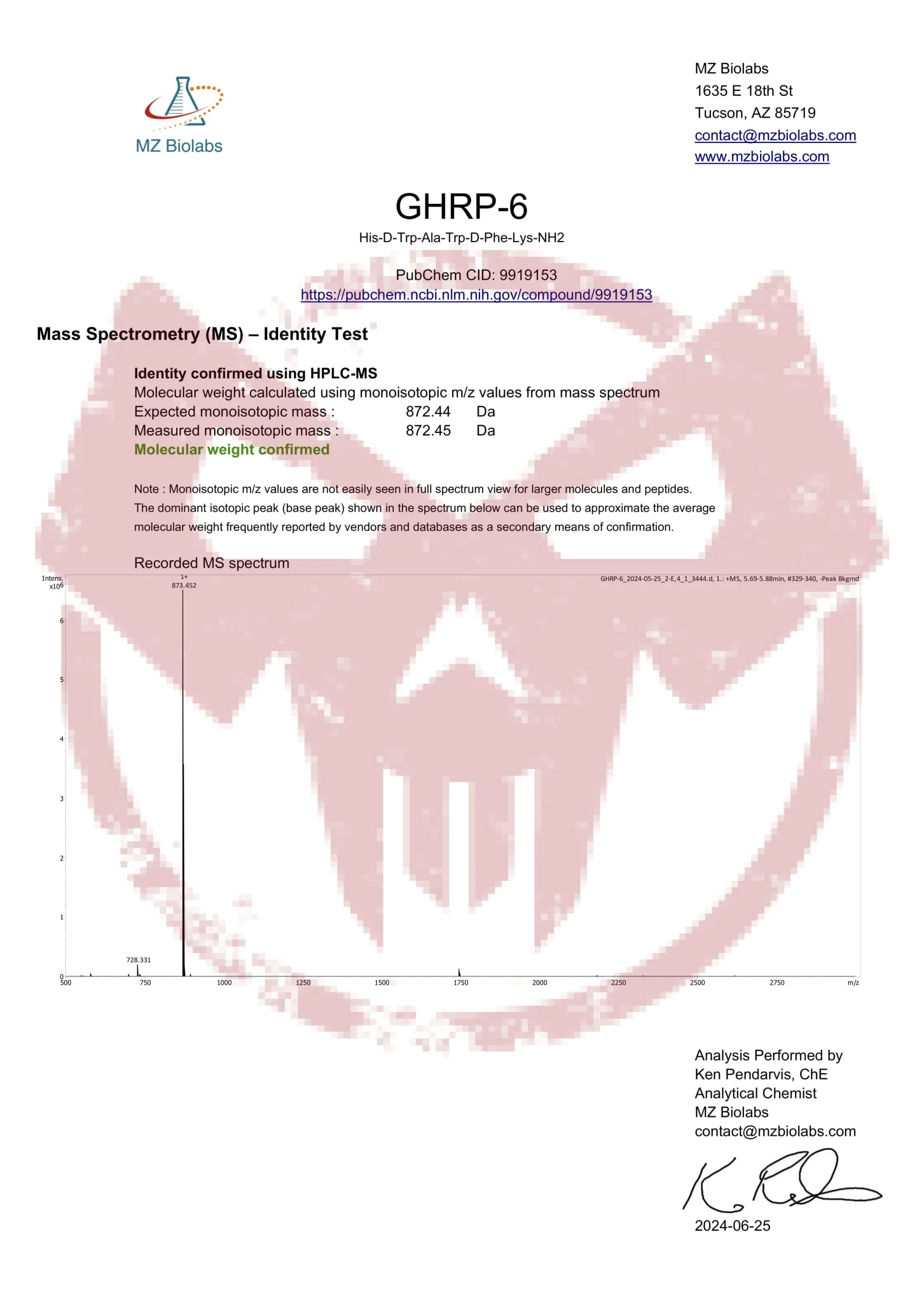
✅ 99% Purity – Third-Party Tested
🚚 Free U.S. Shipping on Orders $100+
 Proudly Made in the USA
⚡ Fast & Reliable Shipping
🔒 Secure Checkout Guaranteed
All products are strictly intended for laboratory and research purposes only and are not approved for veterinary or human use.
Description
Overview of SKF-110679
SKF-110679, also known as Growth Hormone Releasing Peptide-6 (GHRP-6), is an investigational synthetic hexapeptide used in preclinical research to study peptide signaling pathways and receptor-mediated interactions.
Researchers have investigated SKF-110679 for its potential role in molecular signaling, ligand-binding behavior, and pathway modulation in controlled research settings.
Current findings remain limited to preclinical research studies and laboratory research.
Proposed Mechanism of Action of SKF-110679
SKF-110679 (GHRP-6) acts as an agonist of the Growth Hormone Secretagogue Receptor 1a (GHSR1a), a G protein-coupled receptor involved in peptide-mediated signal transduction.
Upon receptor binding, the compound is thought to promote conformational changes that activate intracellular G-protein signaling. This receptor activation leads to downstream second-messenger cascades such as phospholipase C activation, intracellular calcium mobilization, and MAPK/ERK signaling.
These pathways are associated with stimulation of growth hormone secretion in pituitary models and may influence downstream cellular signaling in experimental systems.
Chemical Properties of SKF-110679
| Pubchem CID | 9919153 |
| Molecular Formula | C46H56N12O6 |
| Molecular Weight | 873.0 g/mol |
| 2D Structural Depiction |  |
| Synonyms | 87616-84-0 Hexapeptide-2 Melanostatine 2 GH-Releasing hexapeptide 6 His-D-Trp-Ala-Trp-D-Phe-Lys-NH2 Ghrp, his(1)-lys(6)- L-Lysinamide, SK&F-110679 4H7N4I6X6A Skf 110679 |
| CAS | 87616-84-0 |
Possible Research Applications of SKF-110679
Though more advanced research is required, some research applications of SKF-110679 focus on:
1. Peptide Signaling Research
SKF-110679 may be used in preclinical research to investigate peptide-mediated signaling and intracellular signaling pathway activation.
2. Receptor Binding Studies
Research analysts may use the compound to evaluate ligand-receptor affinity, receptor selectivity, and signaling kinetics in investigational models.
3. Cellular Signaling Studies
SKF-110679 might assist research studies focused on signal transduction pathways and associated cellular signaling responses.
4. Compound Screening Research
In preclinical research, SKF-110679 may serve as a reference compound for evaluating novel peptide analogs and related investigational molecules.
FAQs
What makes SKF-110679 relevant in modern research?
SKF-110679 remains relevant because it may serve as a useful investigational reference compound for studying peptide-based signaling behavior, ligand interactions, and receptor pharmacology in preclinical research.
Why do research analysts study synthetic peptides like SKF-110679?
Synthetic peptides such as SKF-110679 allow research analysts to investigate structure–activity relationships, helping identify how small sequence changes might influence binding affinity and signaling efficiency in research studies.
Can SKF-110679 be used to compare emerging peptide analogs?
Yes. In preclinical research, SKF-110679 may be used as a benchmark compound when comparing newly developed peptide analogs for receptor selectivity, stability, and signaling characteristics.
What challenges exist when analyzing SKF-110679?
One challenge is that SKF-110679 may exhibit activation of multiple downstream signaling pathways, making it difficult for research analysts to isolate which signaling events are primary versus secondary during research analysis.
What future research directions may involve SKF-110679?
Future investigations may further evaluate receptor pharmacology and peptide structure–activity relationships using computational and experimental approaches.
Disclaimer
This information is for educational purposes only and not medical advice. Products are for research use only. Research must follow IRB or IACUC guidelines. Verify information independently before purchasing. By ordering, you agree to our Terms and Conditions. If you are not 100% satisfied with the product you received, please contact us at support@purerawz.co
ATTENTION: All our products are for LABORATORY AND RESEARCH PURPOSES ONLY, not for veterinary or human use
Reference Links
Micic, D., Mallo, F., Peino, R., Cordido, F., Leal-Cerro, A., Garcia-Mayor, R. V., & Casanueva, F. F. (1993). Regulation of growth hormone secretion by the growth hormone releasing hexapeptide (GHRP-6). Journal of Pediatric Endocrinology, 6(3–4), 283–289. https://doi.org/10.1515/JPEM.1993.6.3-4.283
Smith, R. G., Leonard, R., Bailey, A. R., Palyha, O., Feighner, S., Tan, C., McKee, K. K., Pong, S. S., Griffin, P., & Howard, A. (2001). Growth hormone secretagogue receptor family members and ligands. Endocrine, 14(1), 9–14. https://doi.org/10.1385/ENDO:14:1:009
Peñalva, A., Pombo, M., Carballo, A., Barreiro, J., Casanueva, F. F., & Dieguez, C. (1993). Influence of sex, age and adrenergic pathways on the growth hormone response to GHRP-6. Clinical Endocrinology, 38(1), 87–91. https://doi.org/10.1111/j.1365-2265.1993.tb00977.x
Boutard, N., Jamieson, A. G., Ong, H., & Lubell, W. D. (2010). Structure-activity analysis of the growth hormone secretagogue GHRP-6 by alpha- and beta-amino gamma-lactam positional scanning. Chemical Biology & Drug Design, 75(1), 40–50. https://doi.org/10.1111/j.1747-0285.2009.00913.x
National Center for Biotechnology Information. (n.d.). GHSR gene. National Institutes of Health. Retrieved July 3, 2026, from https://www.ncbi.nlm.nih.gov/gene/2693

About Team PureRawz
Team PureRawz is dedicated to providing accurate, science-based information on research chemicals, including Peptides, Nootropics, and SARMs. Our team of expert writers, researchers, and editors is committed to delivering reliable, up-to-date content you can trust.
Our mission is to build an educated and informed community spanning researchers, laboratories, and general readers empowering them to make confident, well-informed decisions when selecting the right research chemical.

Related products
-

PNC-27
$163.40 Select options This product has multiple variants. The options may be chosen on the product page -

IGF-1 DES
Price range: $109.93 through $138.42 Select options This product has multiple variants. The options may be chosen on the product page -

Adipotide
Price range: $50.62 through $119.07 Select options This product has multiple variants. The options may be chosen on the product page -

IGF-1 LR3
Price range: $17.32 through $86.61 Select options This product has multiple variants. The options may be chosen on the product page