

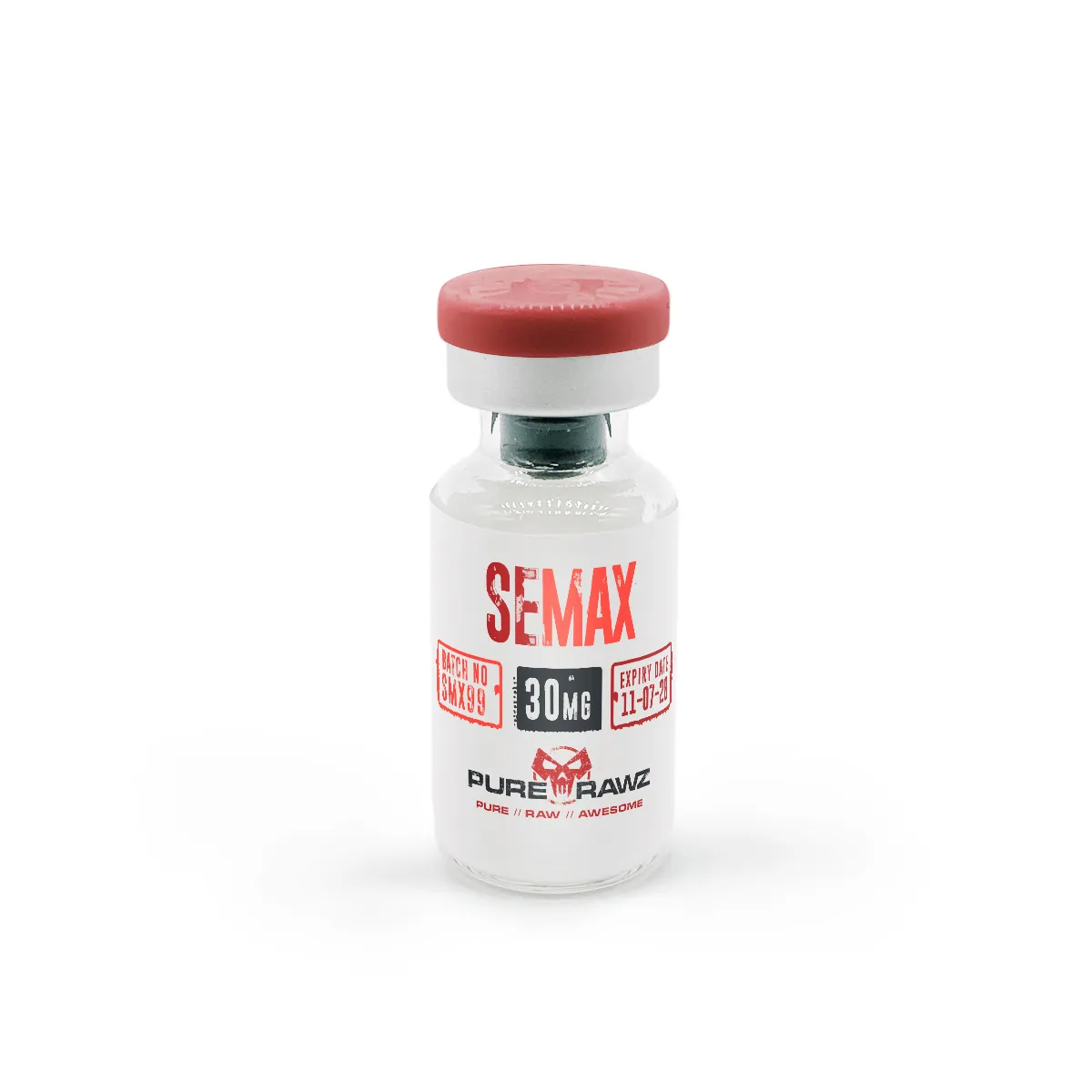


Semax(ACTH (4-7) Pro-Gly-Pro)
Price range: $34.98 through $128.54
Earn 35 - 129 points upon purchasing this product.
✅ 99% Purity – Third-Party Tested
🚚 Free U.S. Shipping on Orders $100+
 Proudly Made in the USA
⚡ Fast & Reliable Shipping
🔒 Secure Checkout Guaranteed
All products are strictly intended for laboratory and research purposes only and are not approved for veterinary or human use.
Description
ACTH (4-7) Pro-Gly-Pro (Semax) Overview
ACTH (4–7) Pro-Gly-Pro (Semax) is a synthetic heptapeptide consisting of the ACTH(4–7) fragment linked to the C-terminal tripeptide Pro-Gly-Pro. Owing to this structure, it is widely investigated in neuroscience and molecular biology research.
ACTH (4-7) Pro-Gly-Pro is intended strictly for laboratory research purposes and is not approved for human or animal consumption.
What Is ACTH(4–7)?
ACTH(4–7) is a synthetic peptide fragment derived from the adrenocorticotropic hormone (ACTH). Researchers investigate this peptide because it retains certain biological properties while exhibiting substantially reduced corticotropic activity compared with full-length ACTH, making it useful for studying peptide signaling and neurobiology in experimental models.
Why Was the Pro-Gly-Pro Sequence Added?
The Pro-Gly-Pro (PGP) tripeptide was incorporated into ACTH(4–7) during peptide design and is investigated for its potential influence on peptide stability, resistance to enzymatic degradation, and molecular behavior. Researchers continue to study how this modification affects the peptide's properties in experimental systems.
How Is ACTH (4–7) Pro-Gly-Pro Characterized?
Research-grade ACTH (4–7) Pro-Gly-Pro is typically characterized using complementary analytical techniques. RP-HPLC is commonly used to estimate chromatographic purity, while LC-MS supports molecular weight verification and peptide identity confirmation. Researchers evaluate these results together with batch-specific analytical documentation to assess research-grade quality.
Proposed Working Mechanism of ACTH (4-7) Pro-Gly-Pro
ACTH (4–7) Pro-Gly-Pro is a synthetic heptapeptide investigated in preclinical research for its molecular effects on neuronal signaling pathways. Although derived from an ACTH fragment, its primary mechanism of action has not been fully established and appears to differ from classical melanocortin receptor activation.
Proposed mechanisms include modulation of neurotrophin-related signaling pathways, though definitive primary mechanisms remain unconfirmed.
The C-terminal Pro-Gly-Pro (PGP) sequence has been proposed to enhance peptide stability in certain experimental systems, although its precise contribution to Semax pharmacology remains under investigation.
Chemical Properties of ACTH (4-7) Pro-Gly-Pro
| Pubchem CID | 9811102 |
| Structure |  |
| Molecular Formula | C37H51N9O10S |
| Synonyms | Semax 80714-61-0 ACTH (4-7), Pro-Gly-Pro- I5FAL2585H ACTH (4-7), prolyl-glycyl-proline- |
| Molecular Weight | 813.9 g/mol |
Research Applications
-
Cellular signaling pathway research
Preclinical studies have reported changes in the expression of neurotrophin-related genes, including BDNF and TrkB, in specific experimental models.
-
Gene and protein expression research
Preclinical studies have evaluated peptide-associated changes in gene and protein expression involving cellular signaling pathways, including molecules such as MMP-9, c-Fos, and JNK-associated signaling proteins.
-
Transcriptomic expression studies
Experimental transcriptomic studies have reported differential expression of genes involved in inflammatory signaling, neuroplasticity, and intracellular signaling pathways under controlled laboratory conditions. However, the biological significance of these findings remains under investigation.
-
Monoamine pathway research
Preclinical studies have investigated peptide-associated changes in monoamine metabolism, including alterations in metabolites such as 5-hydroxyindoleacetic acid (5-HIAA).
-
Growth factor signaling research
Laboratory studies have examined the effects of ACTH (4–7) Pro-Gly-Pro and its Pro-Gly-Pro (PGP) fragment on neurotrophin- and growth factor-associated gene expression, contributing to ongoing investigations of peptide-mediated molecular signaling in experimental models.
Buy ACTH (4-7) Pro-Gly-Pro from Purerawz
Each batch of ACTH (4-7) Pro-Gly-Pro undergoes rigorous first- and third-party testing, with a Certificate of Analysis available for verification. Researchers can access batch-specific COA documentation to validate compound integrity prior to use.
What does the “Pro-Gly-Pro” sequence contribute to this peptide?
The Pro-Gly-Pro (PGP) tripeptide is commonly studied for its structural role in peptide design. Researchers investigate whether this sequence may influence peptide stability, resistance to enzymatic degradation, and overall behavior in experimental systems.
What laboratory techniques are commonly used to study peptides like ACTH (4–7) Pro-Gly-Pro?
Scientists commonly use RNA sequencing, RT-qPCR, Western blotting, immunohistochemistry, chromatography, and cell-based assays to investigate the molecular and cellular effects of ACTH (4–7) Pro-Gly-Pro in experimental systems.
Why Does Peptide Purity Matter?
Peptide purity helps researchers estimate the proportion of the target peptide relative to detectable impurities. Higher chromatographic purity may reduce experimental variability, although purity should be interpreted alongside peptide identity confirmation and other analytical quality data.
Why Is a Batch-Specific Certificate of Analysis (COA) Important?
A batch-specific Certificate of Analysis (COA) provides analytical data for the exact production lot, including information such as RP-HPLC purity, LC-MS identity confirmation, molecular weight verification, and batch identification. Researchers commonly review the COA to verify research-grade quality before laboratory use.
What factors can affect peptide integrity during storage?
Temperature fluctuations, moisture exposure, repeated freeze-thaw cycles, and improper solvent selection can all reduce peptide integrity. Proper storage conditions help preserve sample quality.
Why does ACTH (4–7) Pro-Gly-Pro contain the Pro-Gly-Pro sequence?
The Pro-Gly-Pro (PGP) sequence was added to the ACTH(4–7) fragment during peptide design and has been investigated for its potential influence on peptide stability and molecular properties. This modification is also associated with substantially reduced corticotropic activity compared with full-length ACTH, making ACTH (4–7) Pro-Gly-Pro a useful subject for preclinical studies of peptide signaling and neurobiology.
Disclaimer
This information is for educational purposes only and not medical advice. Products are for research use only. Research must follow IRB or IACUC guidelines. Verify information independently before purchasing. By ordering, you agree to our Terms and Conditions. If you are not 100% satisfied with the product you received, please contact us at support@purerawz.co
ATTENTION: All our products are for LABORATORY AND RESEARCH PURPOSES ONLY, not for veterinary or human usage.
Reference Links
- Agapova TY, Agniullin YV, Shadrina MI, Slominsky PA, Limborska SA, Myasoedov NF. Neurotrophin gene expression in rat brain under the action of Semax, an analogue of ACTH(4-10). Neuroscience Letters. 2007;417(2):201-205. https://pubmed.ncbi.nlm.nih.gov/17353092/
- Shadrina MI, Dolotov OV, Grivennikov IA, Slominsky PA, Andreeva LA, Inozemtseva LS, Limborska SA, Myasoedov NF. Rapid induction of neurotrophin mRNAs in rat glial cell cultures by Semax, an adrenocorticotropic hormone analog. Neuroscience Letters. 2001;308(2):115-118. https://www.sciencedirect.com/science/article/abs/pii/S0304394001019942
- Dmitrieva VG, Povarova OV, Skvortsova VI, Limborska SA, Myasoedov NF, Dergunova LV. Semax and Pro-Gly-Pro activate the transcription of neurotrophins and their receptor genes after cerebral ischemia. Cellular and Molecular Neurobiology. 2010;30(1):71-79. https://pubmed.ncbi.nlm.nih.gov/19633950/
- Medvedeva EV, Dmitrieva VG, Limborska SA, Myasoedov NF, Dergunova LV. Semax, an analog of ACTH(4-7), regulates expression of immune response genes during ischemic brain injury in rats. Molecular Genetics and Genomics. 2017;292(3):635-653. https://pubmed.ncbi.nlm.nih.gov/28255762/
- Filippenkov IB, Stavchansky VV, Denisova AE, Yuzhakov VV, Myasoedov NF, Limborska SA, Dergunova LV. Novel Insights into the Protective Properties of ACTH(4-7)PGP (Semax) Peptide at the Transcriptome Level Following Cerebral Ischaemia-Reperfusion in Rats. Genes (Basel). 2020;11(6):681. https://pubmed.ncbi.nlm.nih.gov/32580520/
- Stavchansky VV, Filippenkov IB, Denisova AE, Yuzhakov VV, Myasoedov NF, Limborska SA, Dergunova LV. Brain Protein Expression Profile Confirms the Protective Effect of the ACTH(4-7)PGP Peptide (Semax). International Journal of Molecular Sciences. 2021;22(12):6179. https://www.ncbi.nlm.nih.gov/pmc/articles/PMC8226508/
- Dolotov OV, Andreeva LA, Myasoedov NF. Insight into Glyproline Peptides' Activity through Modulation of Inflammatory and Neurosignaling Genetic Response Following Cerebral Ischemia-Reperfusion. International Journal of Molecular Sciences. 2022;23(22):14193. https://www.ncbi.nlm.nih.gov/pmc/articles/PMC9697538/

About Team PureRawz
Team PureRawz is dedicated to providing accurate, science-based information on research chemicals, including Peptides, Nootropics, and SARMs. Our team of expert writers, researchers, and editors is committed to delivering reliable, up-to-date content you can trust.
Our mission is to build an educated and informed community spanning researchers, laboratories, and general readers empowering them to make confident, well-informed decisions when selecting the right research chemical.
Related products
-
Ipamorelin
Price range: $29.23 through $111.58 Select options This product has multiple variants. The options may be chosen on the product page -

KP-102
Price range: $35.50 through $127.32 Select options This product has multiple variants. The options may be chosen on the product page -

Adipotide
Price range: $50.62 through $119.07 Select options This product has multiple variants. The options may be chosen on the product page -

BPC-157 ARG
Price range: $85.34 through $462.55 Select options This product has multiple variants. The options may be chosen on the product page