

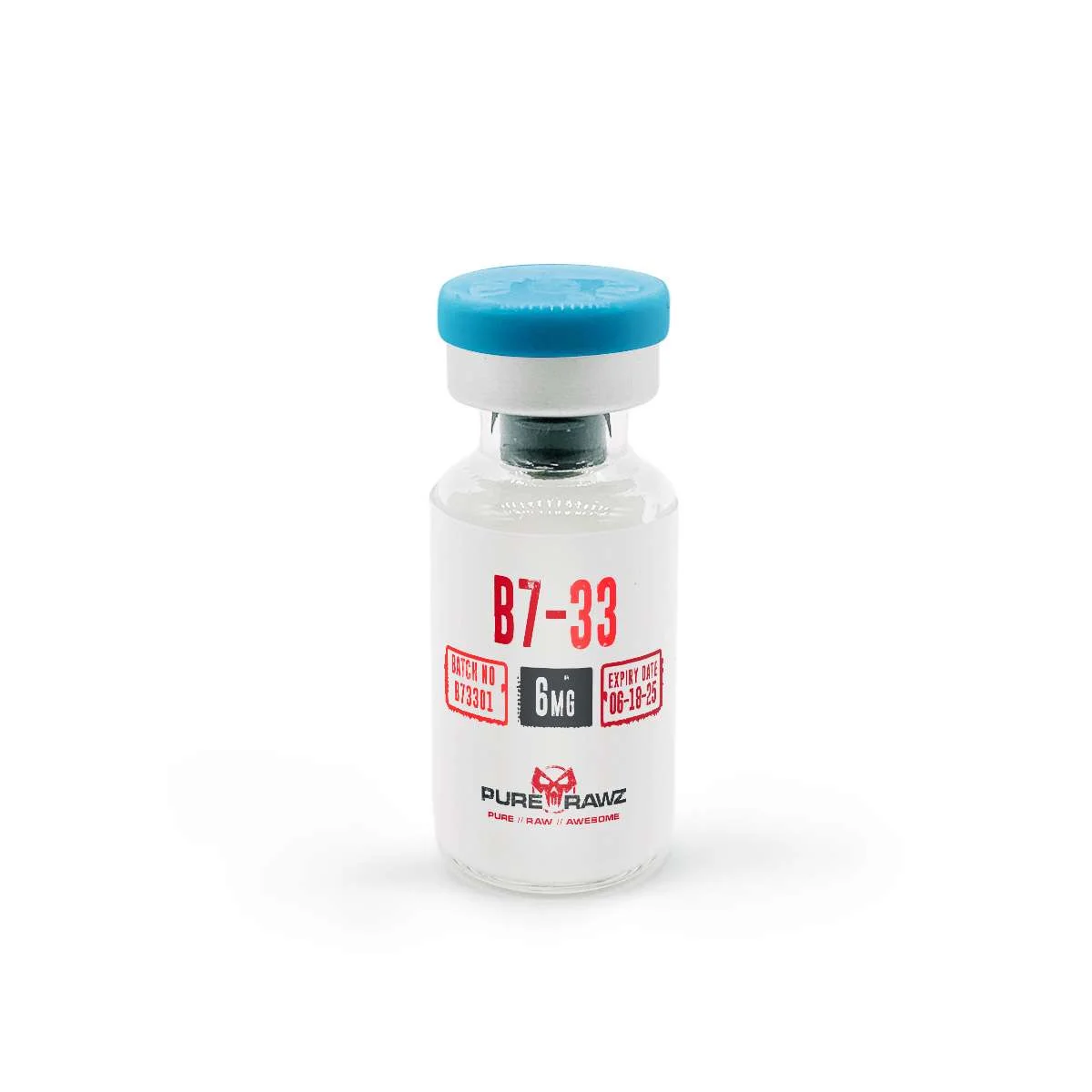
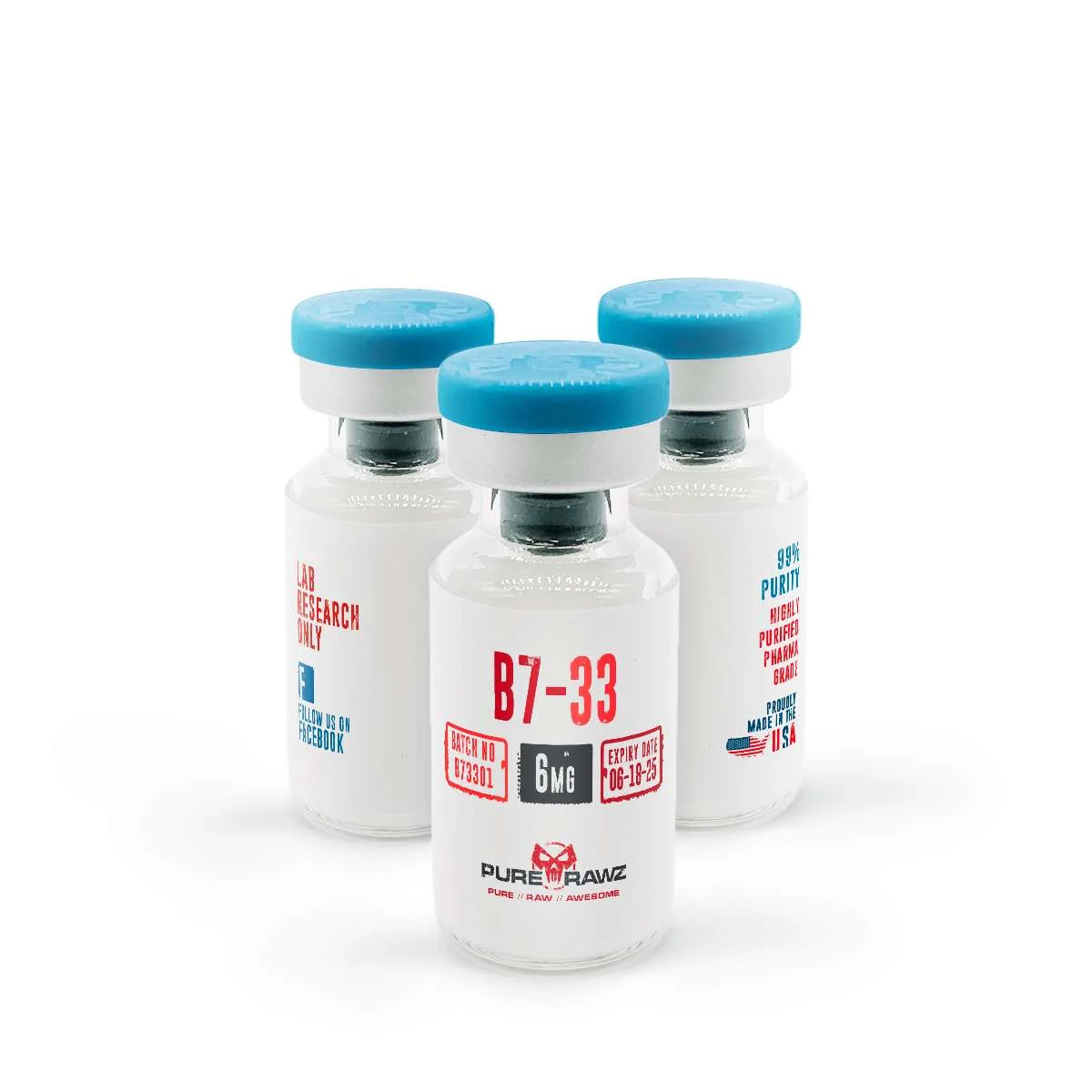




B7-33
Price range: $75.96 through $129.48
Earn 76 - 129 points upon purchasing this product.
✅ 99% Purity – Third-Party Tested
🚚 Free U.S. Shipping on Orders $100+
 Proudly Made in the USA
⚡ Fast & Reliable Shipping
🔒 Secure Checkout Guaranteed
All products are strictly intended for laboratory and research purposes only and are not approved for veterinary or human use.
Description
What is B7-33?
B7-33 is a synthetic peptide derived from relaxin that has been studied as a biased signaling agonist of the RXFP1 receptor.
B7-33 is studied as part of a class of relaxin-derived peptides investigated for receptor modulation in preclinical research models.
The compound is still in early-stage, preclinical research, where it is being evaluated for its stability, selectivity, and signaling profile. However, researchers have suggested that, unlike traditional full agonists, B7-33 has been described in studies as producing more selective intracellular signaling profiles.
Note: It has not received approval from the U.S. Food and Drug Administration and remains under investigation in experimental development settings.
Proposed Working Mechanism of B7-33
B7-33 has been shown in preclinical studies to interact with the RXFP1 receptor in a selective, pathway-restricted manner.
Compared with native relaxin ligands, it has been reported to induce selective intracellular signaling responses in experimental models. It has been associated with modulation of kinase pathways such as ERK1/2 while limiting broader second-messenger amplification like excessive cAMP signaling.
This “partial signaling” approach leads to a controlled and targeted intracellular response profile in research preclinical models.
Possible Research Applications of B7-33 in Experimental Models
Here are the possible research applications of B7-33. However, the compound is still experimental and has not been evaluated or approved by the U.S. Food and Drug Administration.
- Helps analyze selective activation of RXFP1 and its downstream signaling pathways.
- Supports research into GPCR signaling pathway separation (how one receptor produces different intracellular responses)
- Used in experimental studies to map specific intracellular signaling cascades (e.g., ERK-related pathways)
- Provides a tool to study controlled signaling vs. full receptor activation effects
- Used as a reference compound for understanding structure–function relationships in engineered peptides
- Helps evaluate pathway-specific modulation strategies in preclinical models.
Buy First and Third-Party Tested B7-33 for Research Purposes
If you want to buy B7-33 for research, Purerawz is the best option. Each purchase includes a reference-grade Certificate of Analysis outlining peptide identity, purity, and concentration for research compliance.
Disclaimer
This information is for educational purposes only and not medical advice. Products are for research use only. Research must follow IRB or IACUC guidelines. Verify information independently before purchasing. By ordering, you agree to our Terms and Conditions. If you are not 100% satisfied with the product you received, please contact us at support@purerawz.co
ATTENTION: All our products are for LABORATORY AND RESEARCH PURPOSES ONLY, not for veterinary or human usage.
Reference Links
- Devarakonda, T., Mauro, A. G., Guzman, G., Hovsepian, S., Cain, C., Das, A., Praveen, P., Hossain, M. A., & Salloum, F. N. (2020). B7‐33, a Functionally Selective Relaxin Receptor 1 Agonist, Attenuates Myocardial Infarction–Related Adverse Cardiac Remodeling in Mice. Journal of the American Heart Association, 9(8). https://doi.org/10.1161/jaha.119.015748
- Devarakonda, T., Mauro, A. G., Guzman, G., Hovsepian, S., Cain, C., Das, A., Praveen, P., Hossain, M. A., & Salloum, F. N. (2020). B7‐33, a Functionally Selective Relaxin Receptor 1 Agonist, Attenuates Myocardial Infarction–Related Adverse Cardiac Remodeling in Mice. Journal of the American Heart Association, 9(8). https://doi.org/10.1161/jaha.119.015748
- Marshall, S. A., O’Sullivan, K., Ng, H. H., Bathgate, R. A. D., Parry, L. J., Hossain, M. A., & Leo, C. H. (2017). B7-33 replicates the vasoprotective functions of human relaxin-2 (serelaxin). European Journal of Pharmacology, 807, 190–197. https://doi.org/10.1016/j.ejphar.2017.05.005

About Team PureRawz
Team PureRawz is dedicated to providing accurate, science-based information on research chemicals, including Peptides, Nootropics, and SARMs. Our team of expert writers, researchers, and editors is committed to delivering reliable, up-to-date content you can trust.
Our mission is to build an educated and informed community spanning researchers, laboratories, and general readers empowering them to make confident, well-informed decisions when selecting the right research chemical.
Related products
-

Thymosin Alpha 1
Price range: $79.45 through $424.10 Select options This product has multiple variants. The options may be chosen on the product page -

KP-102
Price range: $35.50 through $127.32 Select options This product has multiple variants. The options may be chosen on the product page -

Thymalin
Price range: $76.92 through $321.92 Select options This product has multiple variants. The options may be chosen on the product page - Sale!

FOXO4-DRI (Proxofim)
Original price was: $327.39.$271.69Current price is: $271.69. Select options This product has multiple variants. The options may be chosen on the product page