

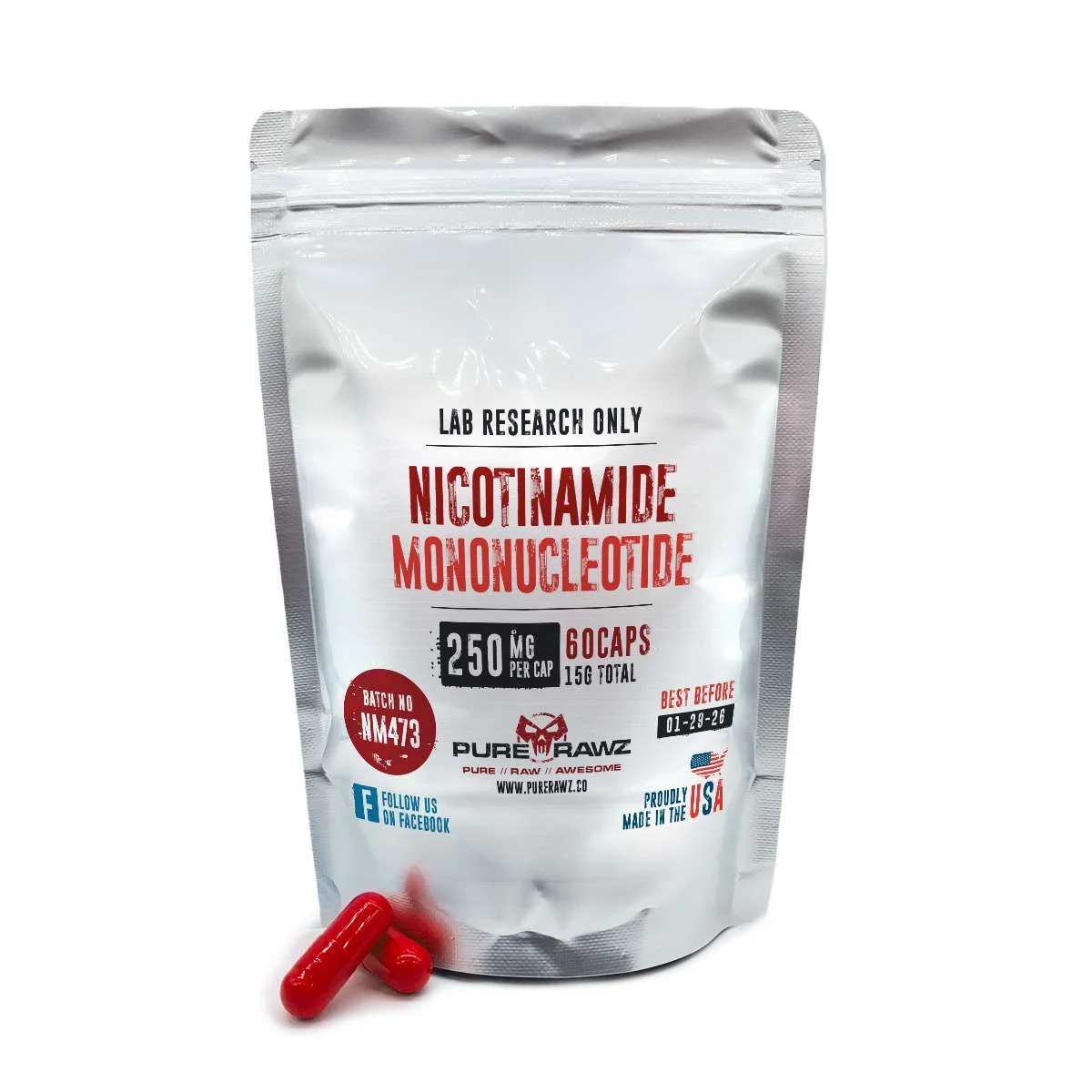
Nicotinamide Mononucleotide (NMN)
Price range: $52.99 through $55.19
Earn 53 - 55 points upon purchasing this product.
✅ 99% Purity – Third-Party Tested
🚚 Free U.S. Shipping on Orders $100+
 Proudly Made in the USA
⚡ Fast & Reliable Shipping
🔒 Secure Checkout Guaranteed
All products are strictly intended for laboratory and research purposes only and are not approved for veterinary or human use.
Description
Nicotinamide Mononucleotide (NMN) Overview
Nicotinamide mononucleotide (NMN) is a nucleotide-derived compound that functions as a biochemical precursor to nicotinamide adenine dinucleotide (NAD+), a coenzyme involved in numerous cellular processes. NAD+ is present in virtually all living cells and participates in a wide range of metabolic and enzymatic reactions.
In laboratory research environments, NMN is investigated for its role in cellular metabolism, energy regulation, and NAD+ biosynthesis pathways. Due to its biochemical properties, NMN has become a subject of interest in studies exploring cellular signaling and metabolic regulation.
Chemical and Molecular Properties
| PubChem CID | 14180 |
| Molecular Formula | C11H15N2O8P |
| Molecular Weight | 334.22 g/mol |
| Synonyms | Nicotinamide ribotide 2KG6QX4W0V Pyridinium, 3-(aminocarbonyl)-1-(5-O-phosphono-beta-D-ribofuranosyl)-, inner salt DTXSID50911152 |
| IUPAC | [(2R,3S,4R,5R)-5-(3-carbamoylpyridin-1-ium-1-yl)-3,4-dihydroxyoxolan-2-yl]methyl hydrogen phosphate |
| CAS | 1094-61-7 |
| Labeling | Research Use Only (RUO), not for human or animal consumption. |
| Chemical Structure Depiction | |
| Purity | 99% Purity |
| Classification | Research Use Only (RUO) |
| Storage Temperature | Store at controlled room temperature, typically between 15°C to 30°C (59°F to 86°F) |
Mechanisms of Action
NMN is primarily studied for its ability to contribute to intracellular NAD+ biosynthesis.
NAD+ plays an essential role in numerous metabolic reactions, including those involving:
- Cellular energy production
- DNA repair processes
- Enzyme activation
- Cellular stress responses
By serving as a precursor molecule, NMN is investigated for how it influences NAD+ -dependent biochemical pathways in experimental models.
Potential Research Applications
Current scientific interest in nicotinamide mononucleotide (NMN) primarily centers on its role in cellular metabolism and NAD+ biosynthesis. The following areas summarize topics that have been explored in laboratory research.
- Cellular Energy Metabolism
NMN is frequently investigated for its involvement in metabolic pathways that regulate intracellular NAD+ production.
- Sirtuin and Enzyme Signaling Pathways
Laboratory studies often examine NMN in connection with NAD+ -dependent enzymes, including members of the sirtuin family.
- Cellular Stress and DNA Maintenance Mechanisms
NMN is also explored in studies focused on cellular responses to oxidative stress and DNA maintenance pathways.
- Metabolic Regulation Studies
In experimental animal models, researchers investigate how NMN influences metabolic signaling pathways, including those associated with energy balance and nutrient metabolism.
- Neurobiological Research
Certain preclinical studies explore NMN within the context of neuronal metabolism and cellular signaling in neural tissues.
- Cardiovascular and Vascular Biology Research
NMN has also been examined in laboratory models that study endothelial cell function, oxidative stress pathways, and vascular signaling mechanisms.
Disclaimer
This information is for educational purposes only and not medical advice. Products are for research use only. Research must follow IRB or IACUC guidelines. Verify information independently before purchasing. By ordering, you agree to our Terms and Conditions. If you are not 100% satisfied with the product you received, please contact us at support@purerawz.co
ATTENTION: All our products are for LABORATORY AND RESEARCH PURPOSES ONLY, not for veterinary or human use
References:
- Gujar, A. D., Le, S., Mao, D. D., Dadey, D. Y. A., Turski, A., Sasaki, Y., Aum, D., Luo, J., Dahiya, S., Yuan, L., Rich, K. M., Milbrandt, J., Hallahan, D. E., Yano, H., Tran, D. D., & Kim, A. H. (2016). An NAD+ -dependent transcriptional program governs self-renewal and radiation resistance in glioblastoma. Proceedings of the National Academy of Sciences, 113(51), E8247–E8256. https://doi.org/10.1073/pnas.1610921114
- Song, J., Li, J., Yang, F., Ning, G., Zhen, L., Wu, L., Zheng, Y., Zhang, Q., Lin, D., Xie, C., & Peng, L. (2019). Nicotinamide mononucleotide promotes osteogenesis and reduces adipogenesis by regulating mesenchymal stromal cells via the SIRT1 pathway in aged bone marrow. Cell Death and Disease, 10(5), 336. https://doi.org/10.1038/s41419-019-1569-2
- Mills, K. F., Yoshida, S., Stein, L. R., Grozio, A., Kubota, S., Sasaki, Y., Redpath, P., Migaud, M. E., Apte, R. S., Uchida, K., Yoshino, J., & Imai, S. (2016). Long-Term administration of nicotinamide mononucleotide mitigates Age-Associated physiological decline in mice. Cell Metabolism, 24(6), 795–806. https://doi.org/10.1016/j.cmet.2016.09.013

About Team PureRawz
Team PureRawz is dedicated to providing accurate, science-based information on research chemicals, including Peptides, Nootropics, and SARMs. Our team of expert writers, researchers, and editors is committed to delivering reliable, up-to-date content you can trust.
Our mission is to build an educated and informed community spanning researchers, laboratories, and general readers empowering them to make confident, well-informed decisions when selecting the right research chemical.
Related products
-

Reishi Extract 30% Powder
Price range: $19.11 through $50.26 Select options This product has multiple variants. The options may be chosen on the product page -

Evodiamine
Price range: $21.13 through $34.53 Select options This product has multiple variants. The options may be chosen on the product page -

Blue Lotus 30:1
Price range: $16.91 through $40.98 Select options This product has multiple variants. The options may be chosen on the product page -

Elderberry Sambucus Anthocyanin 5% Tablets
Price range: $15.83 through $25.12 Select options This product has multiple variants. The options may be chosen on the product page