

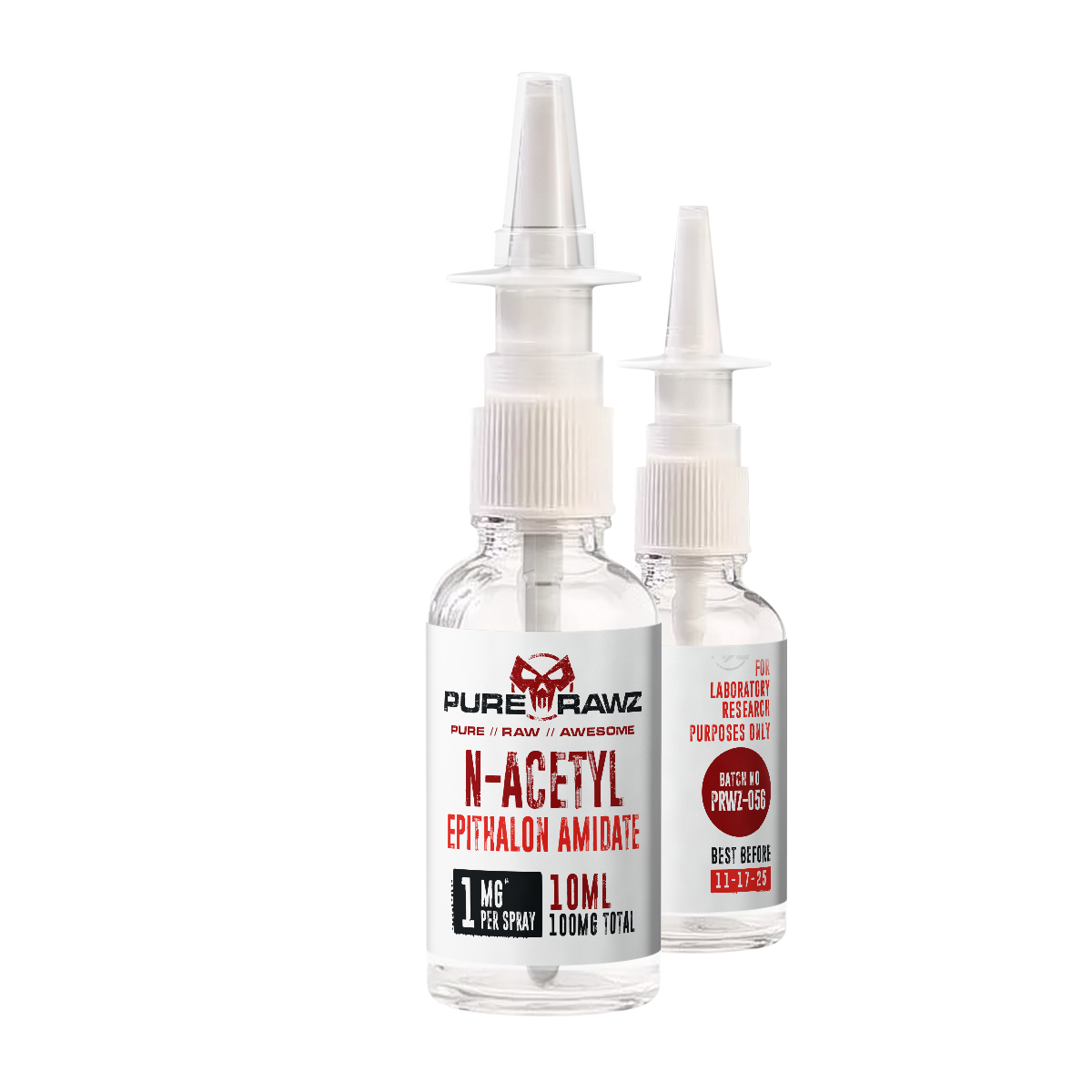
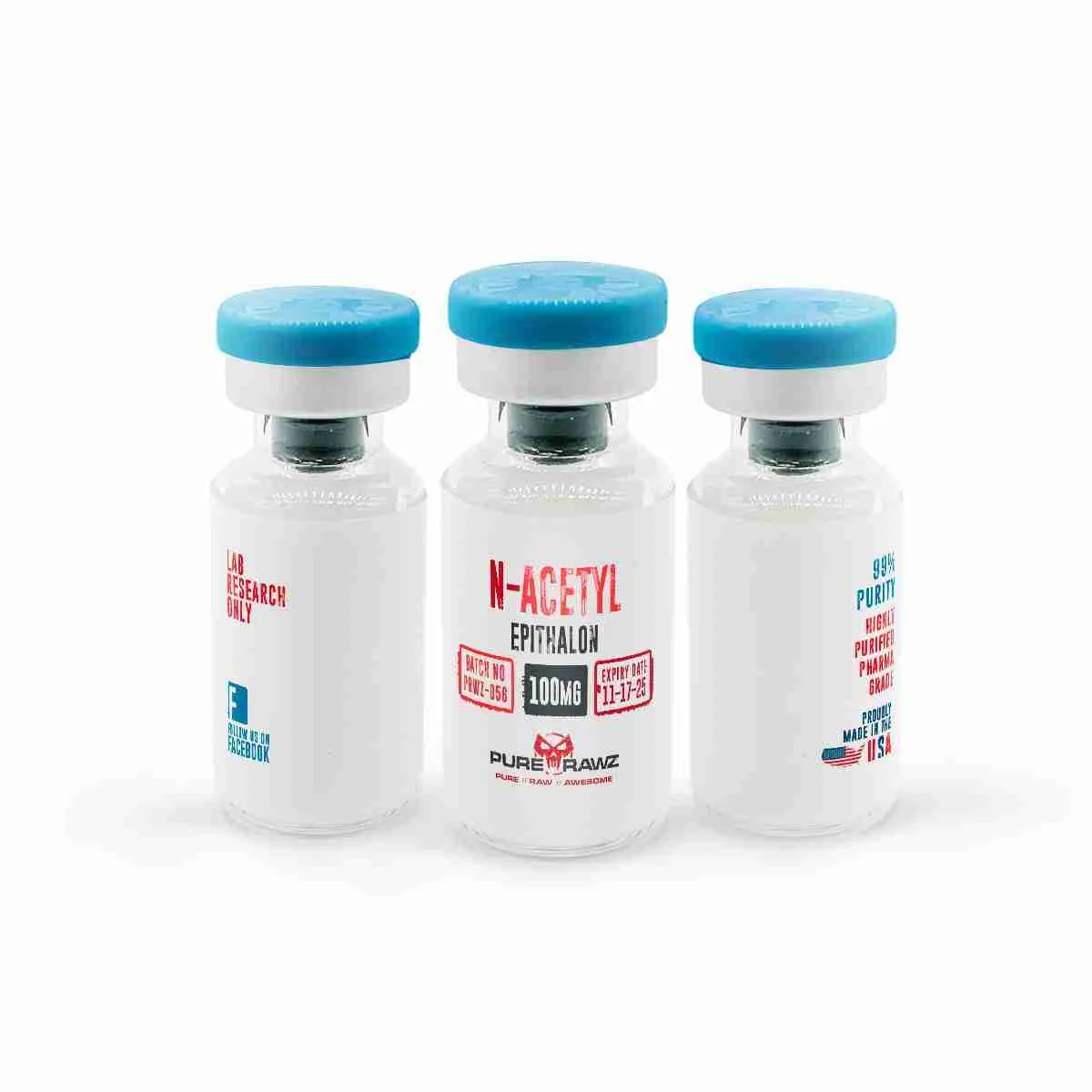

N-Acetyl Epithalon Amidate
Price range: $171.57 through $419.51
Earn 172 - 420 points upon purchasing this product.
Note: We recommend using sterile Bacteriostatic Water for reconstitution.
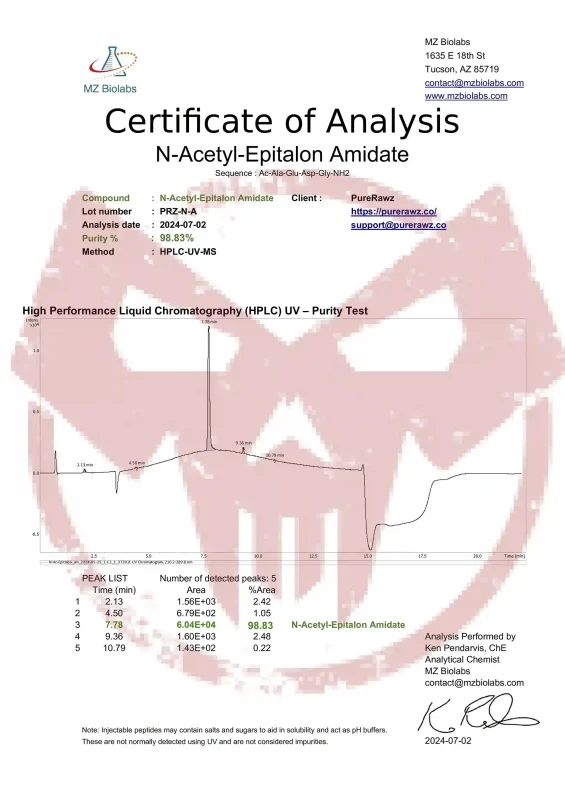
✅ 99% Purity – Third-Party Tested
🚚 Free U.S. Shipping on Orders $100+
 Proudly Made in the USA
⚡ Fast & Reliable Shipping
🔒 Secure Checkout Guaranteed
All products are strictly intended for laboratory and research purposes only and are not approved for veterinary or human use.
Description
N-Acetyl Epithalon Amidate (Ac-AEDG-NH2) Overview
N-Acetyl Epithalon Amidate (Ac-AEDG-NH2) is a research-grade synthetic tetrapeptide. It is derived from the parent compound Epithalon (Epitalon), originally characterized from the bovine pineal gland.
It's an investigational compound and is not approved for clinical use. It is supplied exclusively for controlled laboratory and in vitro research applications.
The compound has a four-amino-acid sequence Alanine-Glutamic acid-Aspartic acid-Glycine (AEDG) of the parent peptide. In addition, it has two deliberate structural modifications that researchers believe significantly enhance its physicochemical profile for research settings.
Structural Modifications & Enhanced Stability
The N-terminus is modified via acetylation (addition of an acetyl group, Ac-). Whereas, the C-terminus undergoes amidation (conversion of the carboxyl group (-COOH) to an amide group (-NH2).
-
N-Terminal Acetylation (Ac-)
N-terminal acetylation improves peptide stability by protecting against aminopeptidase degradation in laboratory research environments. This modification removes the positive charge at the N-terminus, which may influence peptide interaction dynamics in experimental models. The result is enhanced stability and improved consistency during in vitro studies.
-
C-Terminal Amidation (-NH2)
C-terminal amidation helps protect the peptide from carboxypeptidase-mediated degradation, increasing overall molecular stability. This modification also mimics the natural structure of many endogenous peptides, which may support receptor-binding research applications.
Together, these enhancements provide greater resistance to proteolytic breakdown during controlled laboratory analysis.
Chemical Properties of N-Acetyl Epithalon Amidate
| Property | Value |
| Compound Name | N-Acetyl Epithalon Amidate |
| Peptide Sequence | Ala-Glu-Asp-Gly |
| Molecular Formula | C14H22N4O9 |
| Molecular Weight | ~390.35 g/mol |
| CAS Number | 307297-39-8 |
| Chemical Classification | Synthetic peptide (tetrapeptide derivative) |
| Structural Modifications | N-terminal acetylation and C-terminal amidation |
| Storage | −20°C, protected from light and moisture |
N-Acetyl Epithalon Amidate| Proposed Working Mechanism
The following working mechanism summarizes the principal molecular pathways under active investigation in research settings.
-
Epigenetic Modulation
Research suggests that N-Acetyl Epithalon Amidate peptide may interact with chromatin-associated structures. Preclinical studies have suggested that it influences gene accessibility and transcriptional activity.
A few studies in preclinical cell-based models have observed increased expression of neurogenesis-related markers through proposed epigenetic modulation mechanisms.
These effects remain investigational and limited to controlled laboratory research.
-
Telomerase & Telomere Research
A few preclinical studies have indicated that the peptide sequence may influence hTERT expression and telomerase-associated pathways.
Additionally, experimental data in in vitro investigational models have shown observations of telomere maintenance markers. It may also appear to extend cellular proliferative capacity under research conditions.
-
Oxidative Stress & Redox Research
Research models have evaluated the peptide’s influence on oxidative stress biomarkers and redox-associated pathways.
Experimental observations suggest potential modulation of lipid peroxidation and endogenous antioxidant response mechanisms.
-
Circadian Rhythm Research
The peptide has been investigated for its potential interactions with circadian signaling and pineal-associated molecular pathways.
Research models have reported effects on clock gene expression and melatonin-related dynamics under controlled experimental conditions.
Note: These effects are currently limited to non-clinical laboratory investigations.
Potential Research Applications
Researchers may utilize N-Acetyl Epithalon Amidate for potential research in controlled laboratory settings, including:
-
Cellular Aging & Longevity Research
Studies involving telomere dynamics and cellular senescence pathways may incorporate Epithalon analogs to evaluate peptide-mediated signaling mechanisms.
-
Circadian Rhythm & Pineal Peptide Studies
For research related to melatonin signaling and the pineal gland, N-Acetyl Epithalon Amidate peptide may be used in laboratory settings.
-
Oxidative Stress & DNA Stability Investigations
The peptide may be utilized in assays determining oxidative stress markers and genomic stability under controlled experimental conditions.
-
Peptide Engineering & Stability Analysis
Due to its modified peptide structure, N-Acetyl Epithalon Amidate may be studied for improved molecular stability and peptide delivery characteristics during analytical testing.
-
In Vitro Biochemical Research
This research compound may be incorporated into receptor-binding studies, peptide characterization workflows, and molecular pathway investigations conducted by qualified professionals.
Why Choose Purerawz for N-Acetyl Epithalon Amidate?
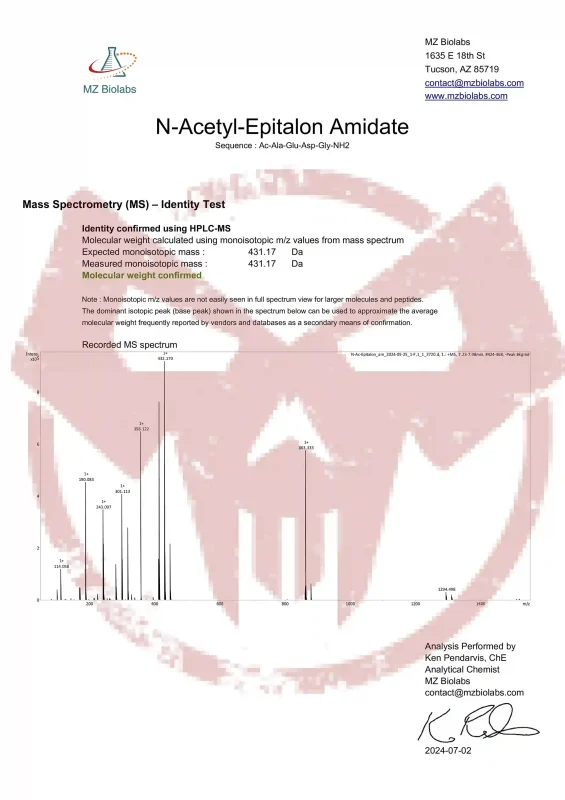
Buy N Acetyl Epithalon Amidate for laboratory research use from our online shop. At Purerawz, we provide high-quality reference materials. Each research compound comes with a Certificate of Analysis for verification of purity and concentration.
Risk & Handling
N-Acetyl Epithalon Amidate is a synthetic tetrapeptide under investigation in preclinical research.
Risk Tier: LOW-MODERATE
This rating reflects the compound's bioactive epigenetic and telomerase-related modulation activity in preclinical models and the need for proper handling to prevent accidental exposure during reconstitution. Researchers must observe the following precautions at all times. Handling Precautions: Handle exclusively in a controlled laboratory environment by trained personnel. Use appropriate PPE at all times, nitrile gloves, lab coat, and eye protection at minimum. Avoid direct skin and eye contact during reconstitution.
Exposure Risks: No human safety data has been established for the research-grade formulation supplied here. Long-term or chronic toxicity data do not exist.
Disclaimer
This information is for educational purposes only and not medical advice. Products are for research use only. Research must follow IRB or IACUC guidelines. Verify information independently before purchasing. By ordering, you agree to our Terms and Conditions. If you are not 100% satisfied with the product you received, please contact us at support@purerawz.co
ATTENTION: All PureRawz products are strictly for LABORATORY AND RESEARCH PURPOSES ONLY. They are not intended for human consumption, veterinary use, or any other non-research application. The FDA has not evaluated these products, and they are not intended to diagnose, treat, cure, or prevent any disease.
Reference Links
- Araj, S. K., Brzezik, J., Madra-Gackowska, K., & Szeleszczuk, L. (2025). Overview of Epitalon-Highly Bioactive Pineal Tetrapeptide with Promising Properties. International Journal of Molecular Sciences, 26(6), 2691. https://doi.org/10.3390/ijms26062691
- Al-dulaimi, S., Thomas, R., Matta, S., & Roberts, T. (2025). Epitalon increases telomere length in human cell lines through telomerase upregulation or ALT activity. Biogerontology, 26(5). https://doi.org/10.1007/s10522-025-10315-x [Cited for in vitro mechanistic context only.]
- Yue, X., Liu, S.-L., Guo, J.-N., Meng, T.-G., Zhang, X.-R., Li, H.-X., Song, C.-Y., Wang, Z.-B., Schatten, H., Sun, Q.-Y., & Guo, X.-P. (2022). Epitalon protects against post-ovulatory aging-related damage of mouse oocytes in vitro. Aging, 14(7), 3191–3202. https://doi.org/10.18632/aging.204007
FAQs
What is N-Acetyl Epithalon Amidate?
N-Acetyl Epithalon Amidate (Ac-AEDG-NH2) is a synthetic tetrapeptide derived from Epithalon (Epitalon), the pineal-origin Khavinson peptide. It incorporates N-terminal acetylation and C-terminal amidation for enhanced proteolytic stability in research settings.
It is not approved for human use.
How does N-Acetyl Epithalon Amidate differ from Epithalon?
The parent compound Epithalon (AEDG) lacks the protective end-modifications. N-Acetyl Epithalon Amidate adds N-terminal acetylation and C-terminal amidation, which
improve resistance to enzymatic degradation in laboratory settings and may support more consistent experimental outcomes in in vitro research models.
Is N-Acetyl Epithalon Amidate FDA-approved?
No. It is not approved by the FDA for human or veterinary use. It is supplied strictly for laboratory research purposes only.
What purity standard does PureRawz provide for this compound?
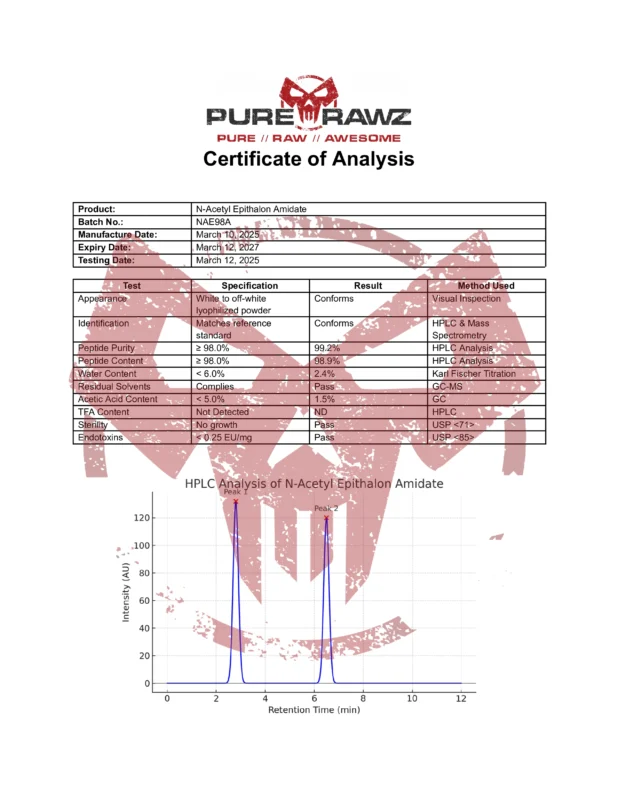
Every batch is verified at ≥98% purity by HPLC analysis through independent third-party testing. A batch-specific Certificate of Analysis is available per lot on the product page before purchase.
How should N-Acetyl Epithalon Amidate be stored?
Store at −20°C in a dry, dark environment, protected from light, heat, and moisture. Avoid repeated freeze-thaw cycles. Always refer to the batch Certificate of Analysis
for specific guidance.

About Team PureRawz
Team PureRawz is dedicated to providing accurate, science-based information on research chemicals, including Peptides, Nootropics, and SARMs. Our team of expert writers, researchers, and editors is committed to delivering reliable, up-to-date content you can trust.
Our mission is to build an educated and informed community spanning researchers, laboratories, and general readers empowering them to make confident, well-informed decisions when selecting the right research chemical.
Related products
-

Sermorelin + GHRP-6 Blend
$97.81 Select options This product has multiple variants. The options may be chosen on the product page -

MOTS-c
Price range: $50.59 through $404.72 Select options This product has multiple variants. The options may be chosen on the product page -

Viking 1 (GHRP-2 + GHRP-6 + Sermorelin)
$140.33 Select options This product has multiple variants. The options may be chosen on the product page -

Mod GRF 1-29 (CJC-1295 No Dac)
Price range: $39.60 through $72.30 Select options This product has multiple variants. The options may be chosen on the product page